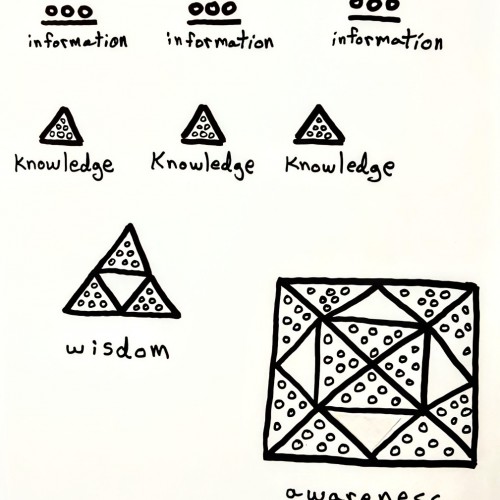
at some point,
information becomes knowledge.
at some point,
knowledge becomes wisdom.
at some point,
wisdom become awareness.
and so on and so forth.
(my original illustration)
I highly recommend the book, Gender and Competition: How Men and Women Approach Work and Play Differently, by Kathleen J. DeBoer.
In it, among other things, she elucidates that those with a conceptually masculine perspective (regardless of sex) are drawn to thinking of the world in hierarchies, which I have represented here with a triangle in the mind of the spotter on the left. She elaborates that those with a conceptually feminine perspective (again, regardless of sex) are draw to thinking of the world in webs, which I have represented here with a circle.
Those that think more masculine-ly are more likely to expect beginners in a sport or field to prove themselves in the group. They will often not "hold their punches" (i.e. curb their ability) to make newcomers comfortable. All members of the group are expected to "earn their keep," in a sense. When a member of the group exceeds expectations, they move up in the hierarchy.
Contrary to that, those that think more feminine-ly likely show acceptance and approval to beginners in order to foster an environment in which they will perform. They will often adjust their skills so that newcomers can more readily "keep up." When a member of the group exceeds expectations, they are expected to raise the status of the group as a whole. The playing field is "flattened" in that sense.
I am not advocating for either perspective, but I will share that I have a more conceptually feminine perspective, and that I have previously left groups whose members have a more masculine perspective.
Kathleen's book really helped me personally to understand the motivations of people that I genuinely did not understand prior to reading the book. It put a lot into perspective for me, and I hold fewer grudges these days.
Cheers, fam~
The logic of children of all ages.
x x x
Psychological projection is a defense mechanism in which an individual unconsciously attributes their own unacceptable thoughts, feelings, emotions, impulses, or traits to another person, group, animal, or object to avoid confronting them internally.
This process allows a person to manage uncomfortable emotions like guilt, shame, or anxiety by externalizing them, making it easier to tolerate the internal conflict.
First conceptualized by Sigmund Freud, projection involves displacing negative or undesirable aspects of the self onto others, thereby preserving self-esteem and avoiding internal discomfort.
While it can serve as a short-term coping strategy, unchecked projection can lead to interpersonal conflict, misunderstanding, and damage to relationships.
x x x
no, you. ^w^
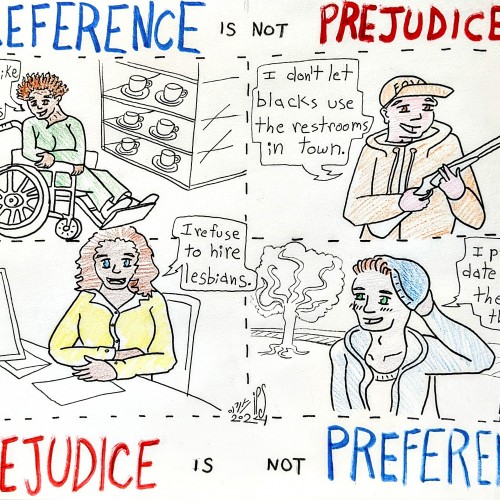
You can listen to nothing but rock music and wear nothing but black clothing and only date short guys in their thirties. Those are valid preferences. Choosing not to hire people of color or refusing to let trans people use the bathroom is prejudice.