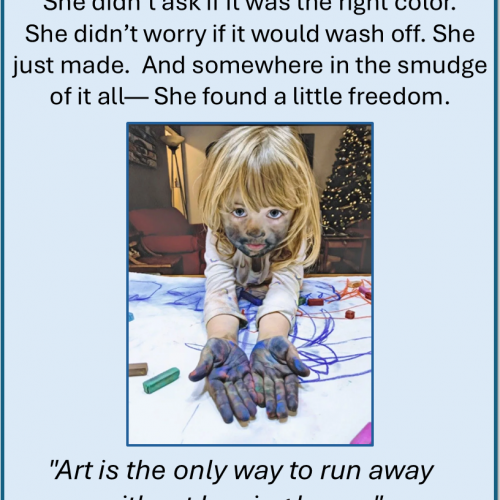
The tables were covered in white paper. Crayons, pastels, and smooth sticks waited quietly. Then came Lucy’s glittery purse—her 8-year-old hands had filled it with stones to pass along, one by one, to the strangers around the table.
We traced them. Pushed them. Held them.
Then we let the colors lead:
-Red for emotion.
-Yellow for curiosity.
-Blue for memory.
Each color came with music, with story, with space.
At the Museum of Wisconsin Art, we made marks not for meaning but for presence.
Thank you to Ann Marie and MOWA for the invitation and trust. And thank you to the participants—some new friends, some old students—for showing up and making lines that listened before they spoke.
A cute bonsai character with a fierce expression holds two swords, wearing an orange martial arts outfit and a headband with a red symbol. Its head is stylized as a bonsai tree, with vibrant green foliage, set against a dynamic red background and the words "BANZAI BONSAI!" above.
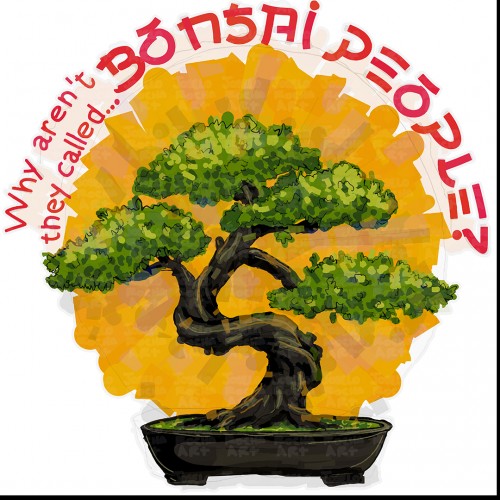
A bonsai tree sits in a black pot against a bright yellow circular background with humorous text surrounding it. The words "Why aren't they called... Bonsai People?" suggest a playful twist on the terms little person, person with dwarfism or person of short stature.
I am an art teacher with a master’s degree—trained by brilliant professors who believed that art could do more than decorate walls. I offer safe spaces for teenagers to grow—nourishing soil where their imaginations can take root.
And yet… I am assigned to hallway duty.
This is compulsory education, after all.
So I sit—posted like a sentinel—watching young lives stream past.
“Get to class,” I say with a smile and a nudge.
The system wants attendance; I’m hungry for presence.
Armed not with a whistle or clipboard, but with a pen—
my scribble’s soft insurgency.
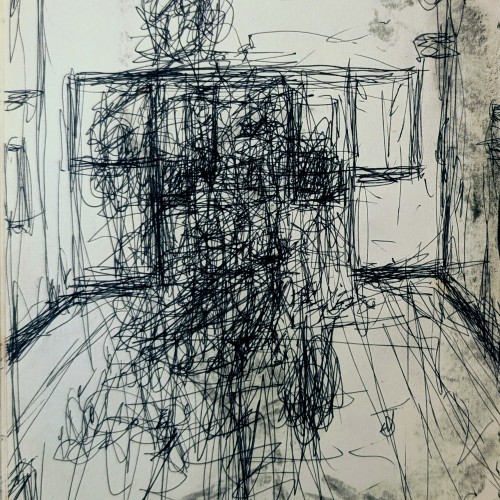
The hallway stretches out like a geometric hymn.
Columns and corners chant structure.
Teenagers swirl past—half-formed galaxies of limbs and laughter—
their orbits chaotic, their gravity pulling time forward.
I begin to draw.
Not their tardiness, but their motion.
A shoulder. A blur of sneakers.
A tilted head chasing freedom.
Feet flickering like seconds.
Each mark a pulse.
Each smudge a breath.
My paper becomes a seismograph of seeing—
trembling gently through the mundane.
This isn’t about making art for a frame or a feed.
It’s about refusing to leak away in the fluorescent hum of obligation.
It’s a quiet mutiny against the clock.
I do this on long car rides, too (passenger side, mind you).
Letting the lines grow wild, jagged, and unapologetic.
Not for polish—
but for presence.
This is how I remember I’m still alive.
Still growing.
Still watching.
Still choosing to see.
Because sometimes mental health looks like
a piece of scrap paper,
a moving pen,
and the simple, sacred act of
marking time with wonder.
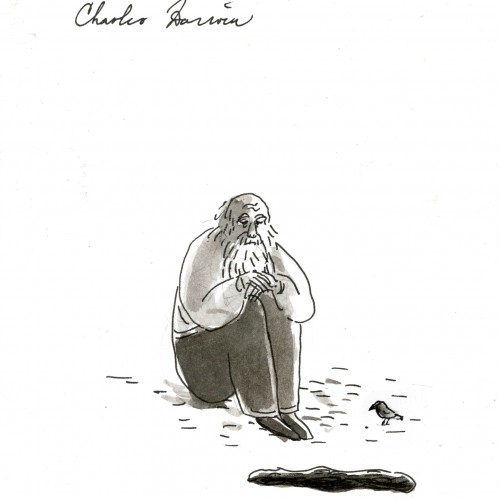
Charles Darwin (1809–1882)
From the time he arrived at Down House until 1859, when he finally published On the Origin of Species, Darwin led a double life, keeping his thoughts on evolution and natural selection to himself while bolstering his credentials in the scientific community.
Meanwhile, he divulged his secret theory to a very few confidants; he told one fellow scientist it was “like confessing a murder.”
- From Daily Rituals: How Artists Work by Mason Currey
“Ignorance more frequently begets confidence than does knowledge: it is those who know little, not those who know much, who so positively assert that this or that problem will never be solved by science.”
― Charles Darwin, The Descent of Man
#dailyrituals #inktober #CharlesDarwin @masoncurrey
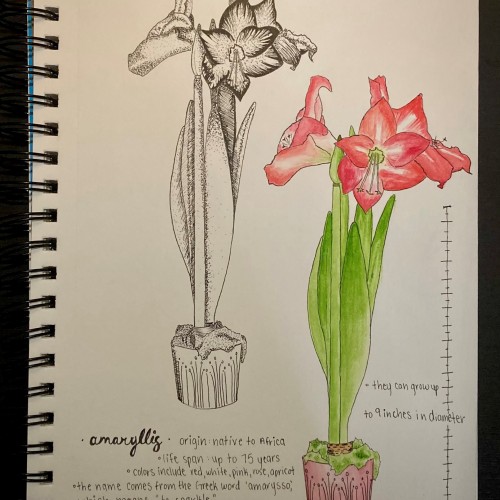
this was just a fun little doodle I did of a pretty plant I saw. it was absolutely stunning and the bright salmon/rose/red flowers just POPPED! this was a nice leisure time doodle to do in between some other projects of mine. I find my happy place sometimes being taking care of my plants, taking pictures of pretty trees and plants, walking around a plant nursery, and now drawing beautiful plants I see.
my favorite fact I learned about the amaryllis was that is comes from the Greek word amarysso, which means “to sparkle” or “to shine”, as this plant does indeed sparkle and with its magnificent flowers when it blooms.
I enjoyed mixing mediums and doing one as a graphic doodle with my Micron pens and the other with watercolors - it was a good study for me seeing the detail come to life by lines/dots and then come to life by colors/shadowing colors.
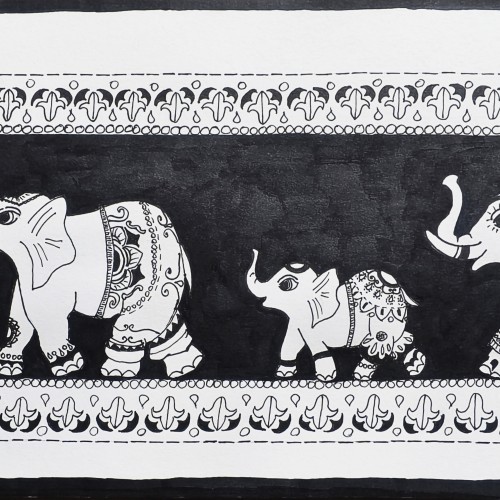
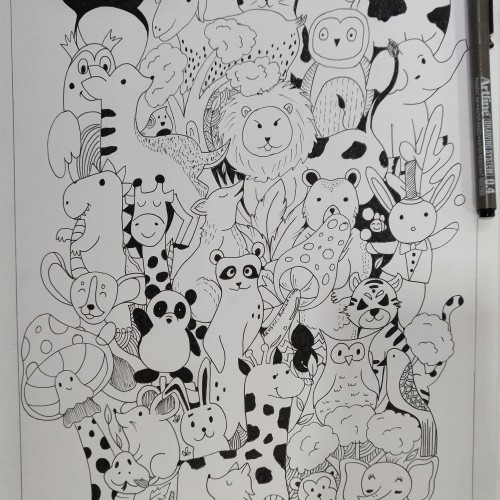
This delightful black-and-white drawing captures the lively and playful essence of a whimsical animal parade. Bursting with creativity, each animal character showcases unique traits and expressions, bringing a joyful scene to life. From the adorable, tiny mice balancing on top of each other to the elegant elephants dancing gracefully, the artwork is a breathtaking celebration of harmony and fun in the animal kingdom. With its intricate details and enchanting charm, this piece invites viewers to step into a world of imagination and whimsy where animals parade with joy and carefree spirit.
Living, breathing, and creating with nature
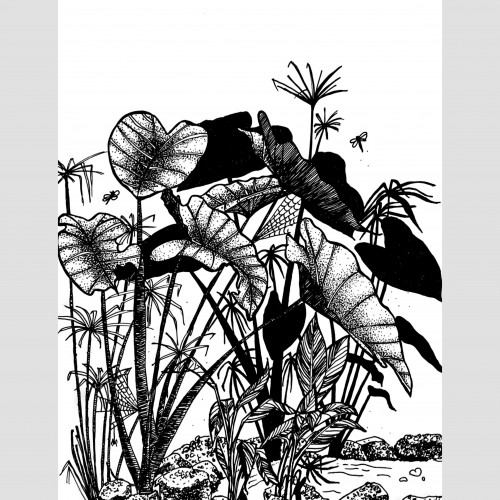
When you wake up to the gentle sights and sounds of the pond, trees, plants, birds, bees, and dragonflies, inspiration flows effortlessly. So, when the owner asked for a menu design for @SarayaGoa Art Café, I thought—why not let nature speak for itself?
Using pen and ink, I captured the beauty of my mornings here—each stroke reflecting the lush surroundings that make Saraya unique. Instead of focusing on just food items, I filled the cover and inside pages with illustrations of the vibrant life around us. Dining here means eating among the green, surrounded by the diverse plants of our permaculture gardens.
This study is a tribute to the beauty that shapes every meal at Saraya.