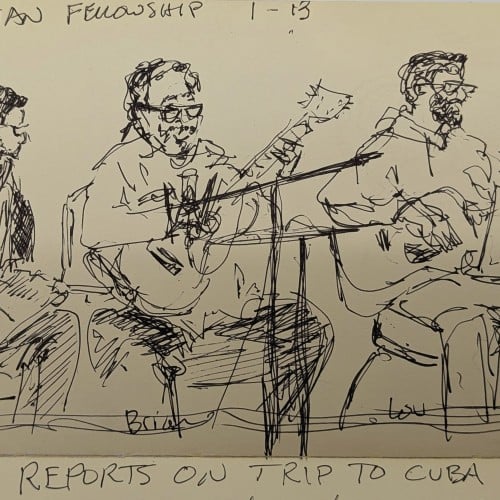
Sunday morning, more than a decade ago.
Music, fellowship, and reports about what God was doing here and there.
Some things are worth remembering. We learn from looking back—
but we must live forward.
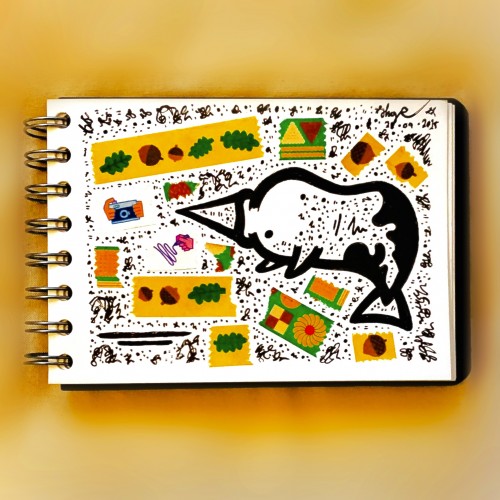
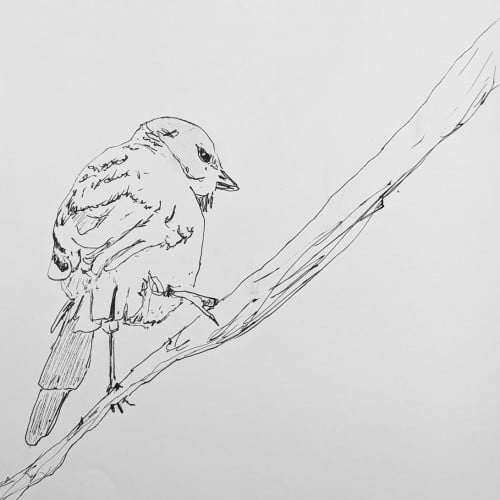
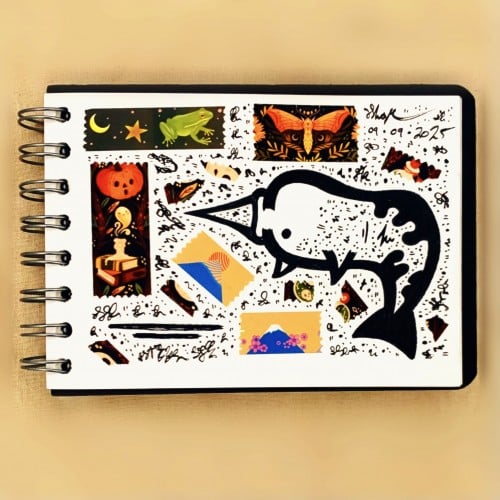
A simple ink sketch of a bird at rest. Sometimes the quiet moments—watching, pausing, waiting—are the deepest teachers. This drawing is part of my exploration of what I call the Quiet Practices—small ways of living from the inside out.
If you’d like to see more of my reflections, I share them here: https://forming20.com/
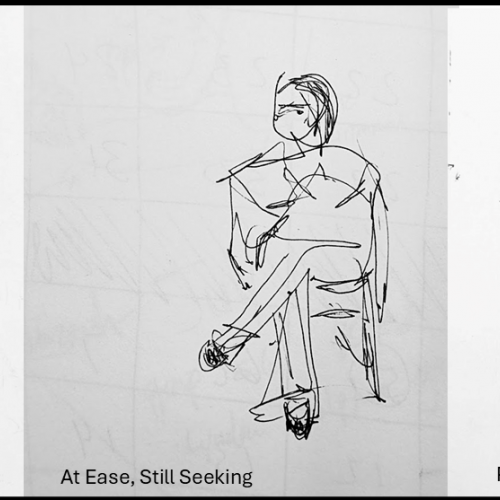
Super Nationals at the Gaylord—two rivers running through the lobby, actual boats gliding under glass ceilings, a nature center tucked between restaurants. Noise everywhere: kids, clocks, pawns and queens. Yet here, in the middle of it, a pause. A man leans back with the weight of waiting. A woman sits, at ease but still seeking. An empty chair remembers everyone who has rested there. In a place built to dazzle, what lingered with me was not the spectacle, but the silence. To draw is to honor the quiet within the clamor.
thinking and seeing for better being — https://forming20.com/
Sometimes wisdom comes in a joke,
and sometimes laughter carries truth.
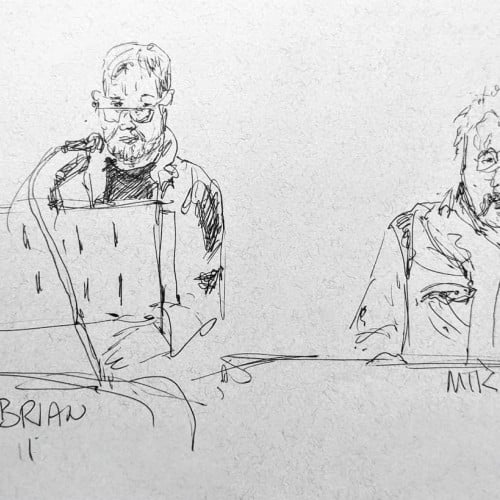
Brian spoke like a sage,
Mike answered like a friend,
and together they held the room.
We draw to remember.
Not only the lines of faces,
but the presence of goodness,
the gift of voices that echo
long after the chairs are empty.
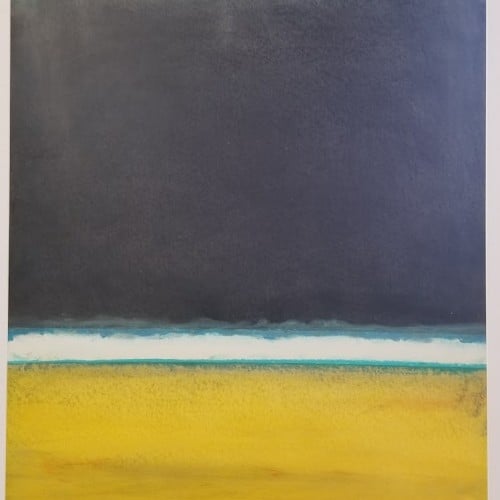
A horizon of chalk—black sky heavy with silence, gold earth glowing with embered breath.
Between them, a thin line of turquoise, the pause where one world ends and another begins.
It is not sky, nor sea, nor sand alone. It is the threshold—a doorway, where silence teaches and light remembers.
Stand here long enough, and you may hear it breathe.
inking and seeing for better being — https://forming20.com/
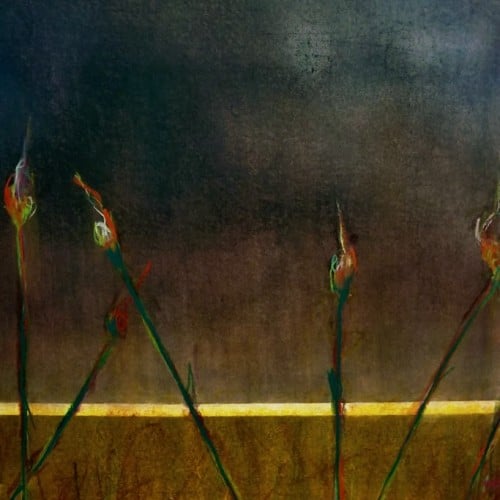
Against the weight of a storm-dark sky, tender stems lean forward—some bending, some breaking, some still reaching.
They hold their fire at the tips, waiting to bloom, waiting to burn, waiting to belong to light.
Perhaps this is all of us:
stretching through shadows,
searching for the thin, golden line that divides earth from eternity.
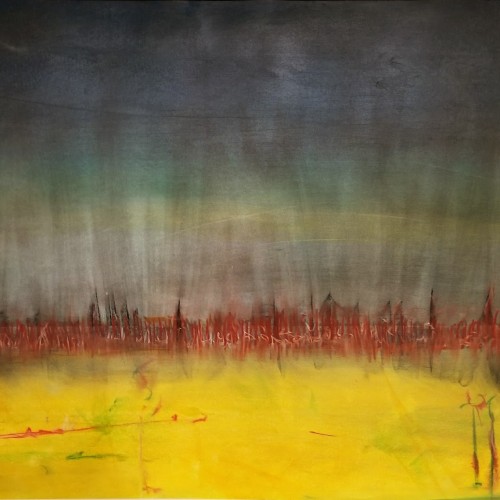
This is no landscape you could ever stand in.
No observational drawing, no safe horizon line.
This chalk experiment is a dream unfolding in color: a golden field lit from within, a scarlet seam of fire at its edge, and a storm-heavy sky pressing down with ancient weight.
It feels like a place between worlds—where the conscious and unconscious meet, where memory and imagination blur. Some might see a battlefield, others a meadow after rain, and still others a veil between life and death. That is the beauty: the painting does not tell you what it is; it invites you to confess what you see.
Psychologists say we project ourselves onto images like these. So—what do you notice first? The light? The darkness? The burning red?
Perhaps that is not about the drawing at all, but about you.
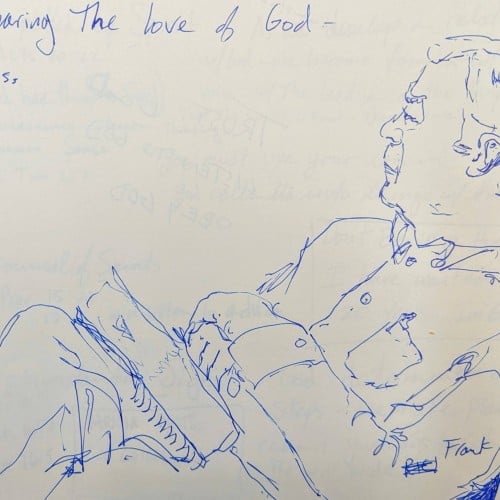
Sometimes the quickest drawings hold the deepest truths. During an after-sermon discussion about understanding the love of God, I found myself listening with one ear and drawing with the other. Frank, seated across the room, made a natural model—relaxed posture, thoughtful presence, and a face full of character.
With a pen in hand, I traced his form in a quick contour line, following the folds of his shirt, the tilt of his jaw, the stillness of his hands resting in his lap. Contour drawing asks us to see more than just the surface—it demands patience and presence, a slowing down until the line itself feels like prayer.
Frank became more than a subject; he was a reminder that the love of God is often revealed in ordinary moments and everyday people.