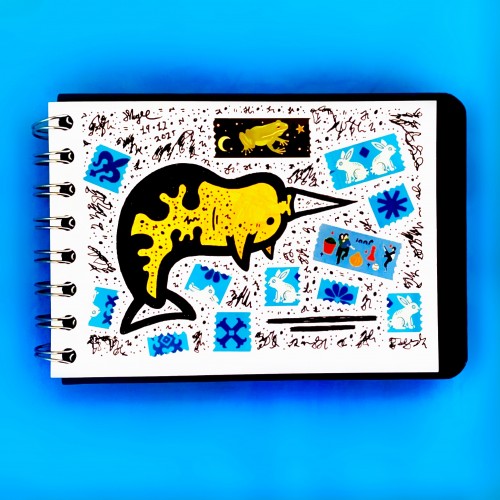
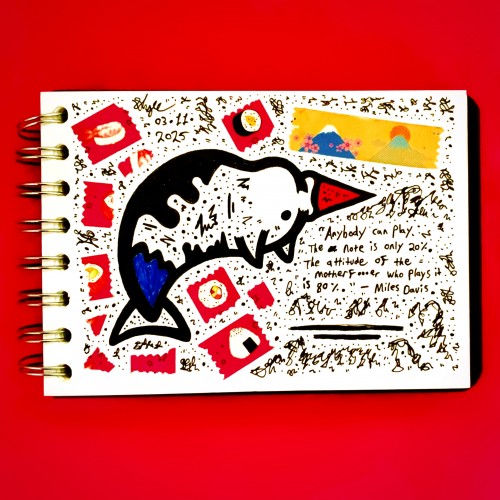
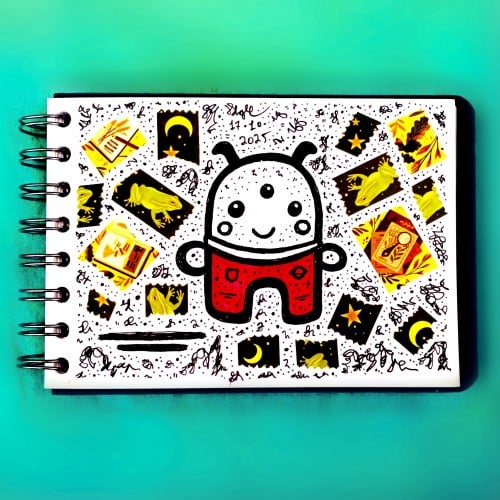
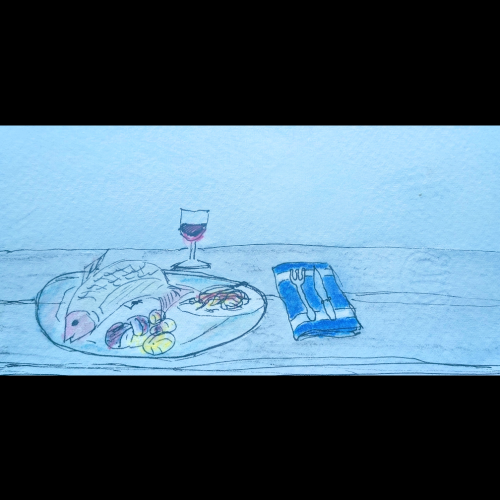
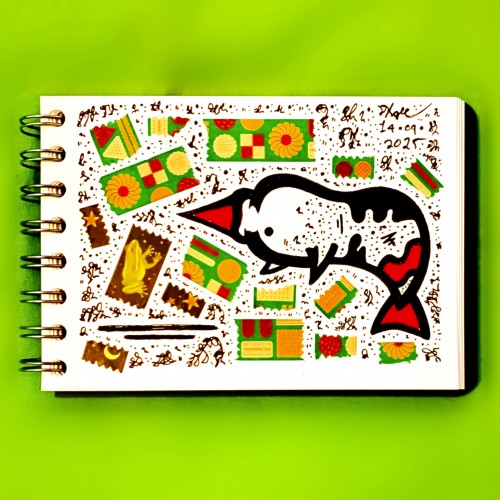
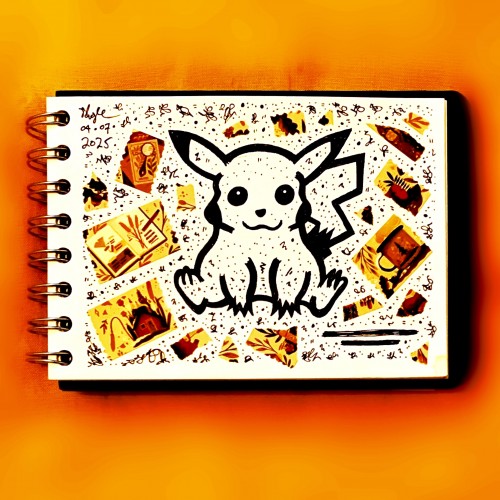
The meal was my attempt to bring a little comfort into the rugged outdoors. The sketch was my reminder—to hold onto the moment, even when mosquitoes, ashes, and deflating air mattresses had other plans.
Introducing “Home Is Where Your Head’s At” :-)
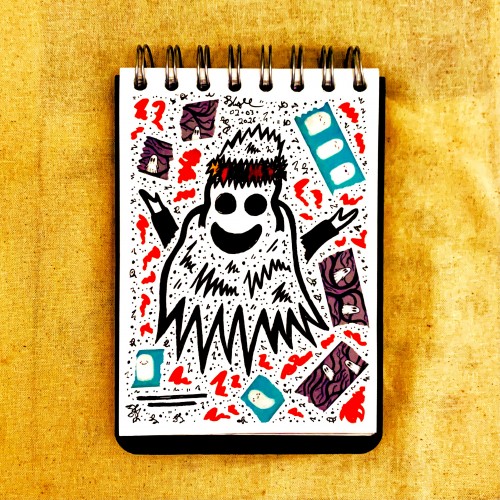
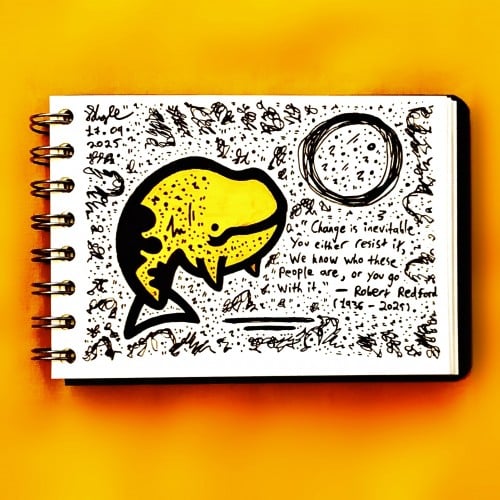
Starting a new sketchbook as we leave the summer and head into the autumn again… with things like Halloween and Samhuinn rearing their heads it’s liable to sway what goes on here as it always does!
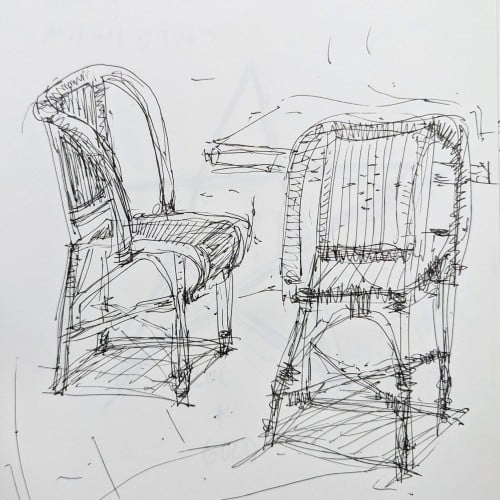
Two wicker chairs in the sun.
One for the waiting,
one for the hoped-for.
The table between them
holds its silence,
its place set for bread or talk.
I draw what is here—
lines quick and unerasable—
and what is not here,
her presence,
waits with me in the white of the page.
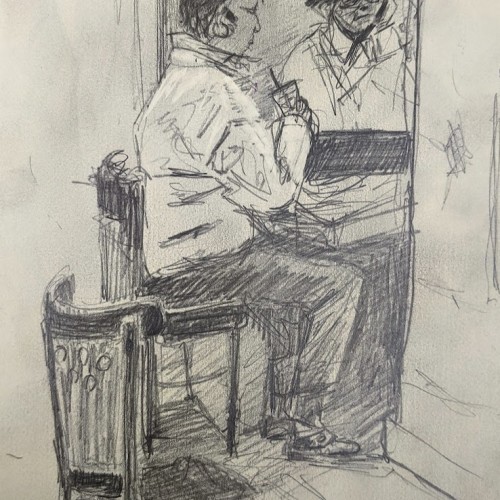
Imperfect Lines, Honest Presence
This sketch is not perfect—and that’s exactly why it’s alive. The bold figure, the dissolving hat, the tilted chair: all of it feels unfinished, fleeting, caught in motion. It’s what the Japanese call wabi-sabi—finding beauty in the imperfect, the impermanent, the incomplete.
But there’s something deeper here too. A quick sketch is not just what the eye records. It’s what the soul permits. To draw without fixing, without polishing, is to admit the world will not hold still for us. Life slips past. The lines break off. And yet, somehow, the essence remains.
When you sketch this way, you are not the master of the moment—you are its guest. The pencil does not carve permanence; it pays attention. The act of drawing becomes an act of being present, of honoring what is already vanishing.
So here’s a challenge: grab a pencil and sketch someone near you in sixty seconds. Do not erase. Do not perfect. Let the lines falter. When you finish, ask yourself: What truth did the imperfection reveal?
Perhaps presence itself is the real art.
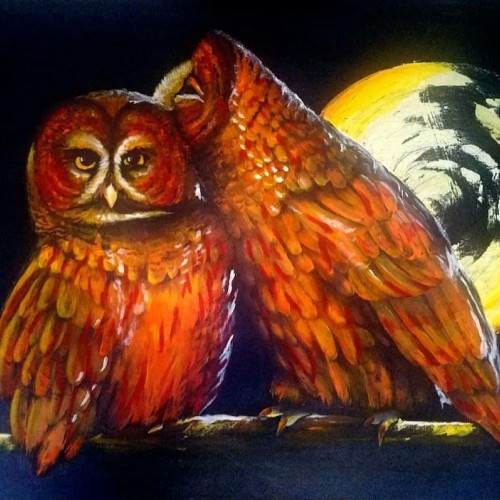
This is an acrylic painting that I made for someone I was close to. We would often take turns of one of us being overly affectionate and the other being playfully annoyed. I tried to capture this dynamic in the painting of these two owls. This painting was an experiment in portraying animals, something I don't do often, and using my paint knife as a tool in my paintings.
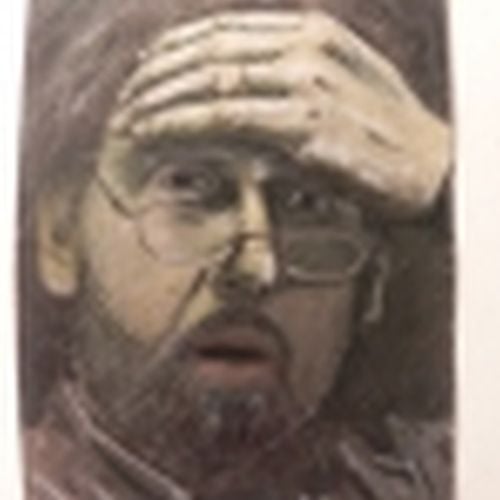
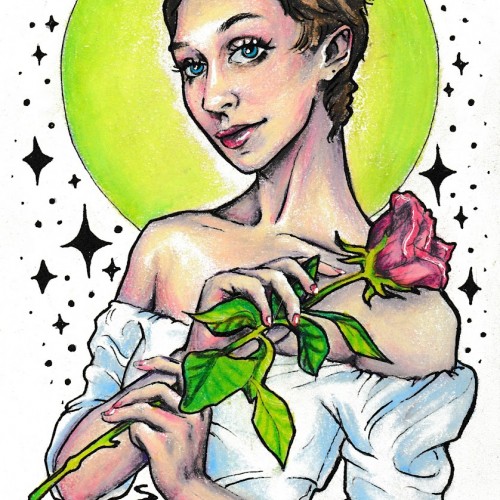
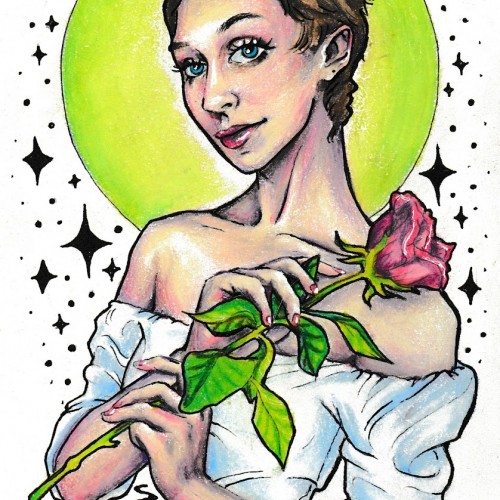
This drawing was done with pen and colored pencil. I wanted to create a self-portrait that could also serve as a profile picture for my art accounts. My other self-portraits tend to be realistic, so I decided to try and depict myself in my own illustrative style instead. My artistic influences for this piece include tattoo styles, pinup art, and art nouveau as well as inspiration taken from some of my favorite portrait artists, Sargent and Rockwell.
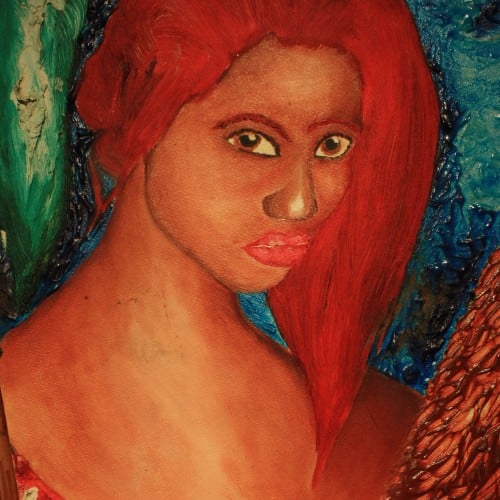
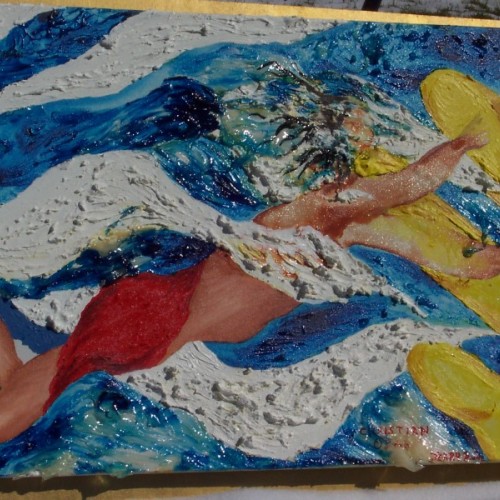
The moment of death of a Christian as they leave this earthly world and travel to the afterlife. The figure is halfway between the earthly and heavenly realms. The earthly realm I painted in flat paints. The heavenly realm is bright and glorious. God is depicted in trinity, you see Father, Son and Holy Spirit as one.
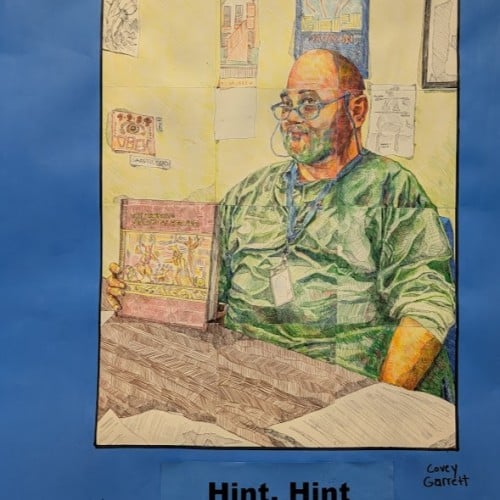
This portrait of Mr. Joshua Anderson—our resident Shakespeare whisperer—was drawn by student artist Covey Garrett as part of a school-wide tribute to our teachers. Students photographed, gridded, and drew 18x24” posters of their teachers, each paired with a favorite catchphrase. Mr. Anderson’s? A classic:
“Hint, hint. Wink, wink. Nudge, nudge.”
We think the Bard would approve.
"All the world's a stage, and all the men and women merely teachers..."
(okay, we may have paraphrased a bit).
There’s a lot of waiting in life.
Waiting in lobbies.
Waiting on answers.
Waiting for braces to tighten, kids to grow, hearts to heal, or prayers to be answered.
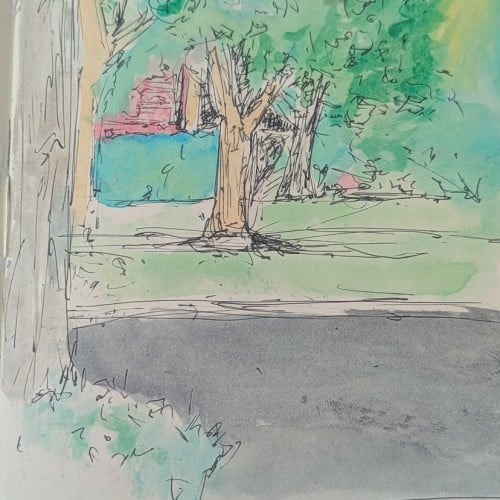
I sat at the orthodontist, watching dollars tighten on tiny wires, and made this sketch. A tree. A house. A street. Color helped the moment breathe.
I remember once hearing a chess master say, “There is no waiting in chess.”
It confused me—wasn’t there always a turn to wait for?
But he explained: “There’s no waiting. Only planning. Plotting. Analyzing. You’re always thinking.”
I once repeated that to a FIDE master. He got mad.
Maybe because waiting and patience aren’t the same thing.
We can be still and deeply active inside.
We can pause without being passive.
And then there’s Lindsey’s voice in the back of my head:
“That sounds like a first-world problem.”
“Speak life.”
“Be thankful. Rejoice always.”
And she’s right.
So here’s to filling waiting time with something creative.
Something kind.
Something that turns a delay into a doorway.