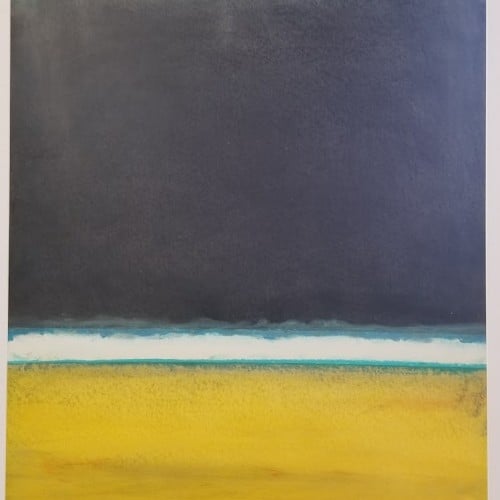
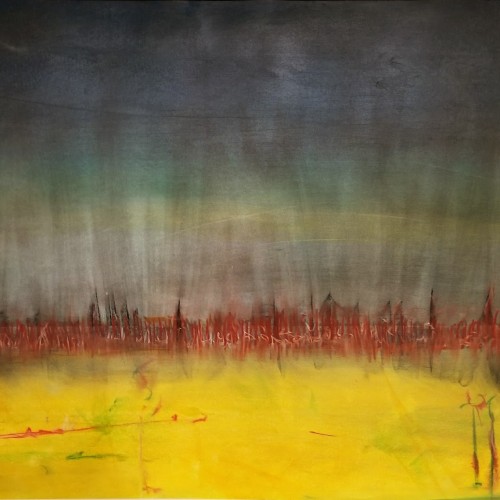
A horizon of chalk—black sky heavy with silence, gold earth glowing with embered breath.
Between them, a thin line of turquoise, the pause where one world ends and another begins.
It is not sky, nor sea, nor sand alone. It is the threshold—a doorway, where silence teaches and light remembers.
Stand here long enough, and you may hear it breathe.
inking and seeing for better being — https://forming20.com/
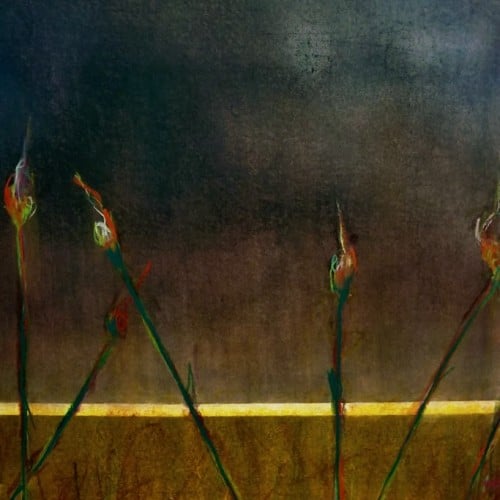
Against the weight of a storm-dark sky, tender stems lean forward—some bending, some breaking, some still reaching.
They hold their fire at the tips, waiting to bloom, waiting to burn, waiting to belong to light.
Perhaps this is all of us:
stretching through shadows,
searching for the thin, golden line that divides earth from eternity.
This is no landscape you could ever stand in.
No observational drawing, no safe horizon line.
This chalk experiment is a dream unfolding in color: a golden field lit from within, a scarlet seam of fire at its edge, and a storm-heavy sky pressing down with ancient weight.
It feels like a place between worlds—where the conscious and unconscious meet, where memory and imagination blur. Some might see a battlefield, others a meadow after rain, and still others a veil between life and death. That is the beauty: the painting does not tell you what it is; it invites you to confess what you see.
Psychologists say we project ourselves onto images like these. So—what do you notice first? The light? The darkness? The burning red?
Perhaps that is not about the drawing at all, but about you.
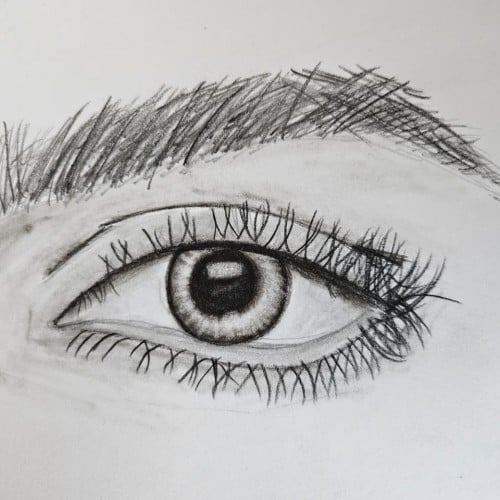
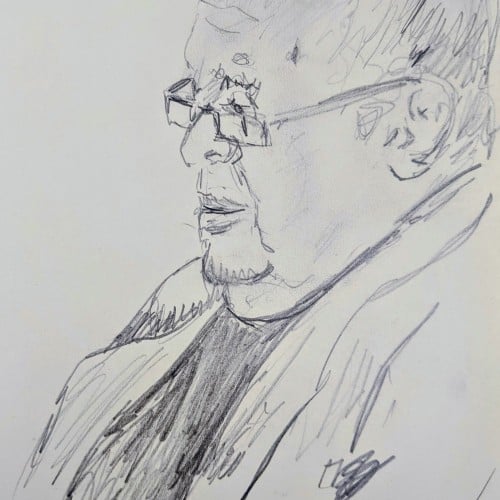
I never imagined I could capture so much emotion in an eye—especially on just my second attempt. This piece came to life through intuition more than technique. The values, the shadows, the highlights… they felt like they found their place on their own. Maybe emotion, light, and shadow have always spoken to me—I just finally listened.
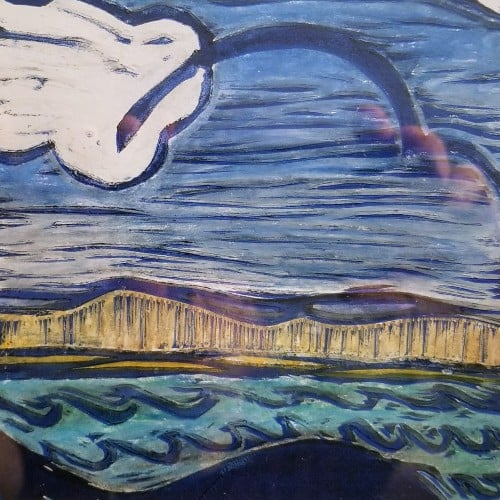
Lino cut print over pastel. The story goes: The bird fell in love with the whale the first time she saw him break through the ocean’s surface, sunlight dancing on his back. From high above, she sang to him, and deep below, he answered with a song as old as the tides.
She longed to dive, to join him in the rolling blue. He wished to rise, to fly beside her in the endless sky. But air and water would not trade places.
So each day, at dawn and dusk, they met at the edge of their worlds—she on the wind, he in the waves—singing a love song carried by the breeze and the tide, never together but never apart.
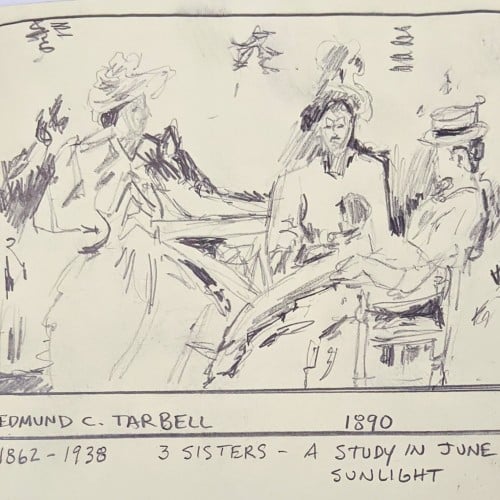
This quick sketch of an impressionist painting is a reminder to me of how we cannot see anything until we are taught to see it. I was enjoying the painting because of the way Tarbell captured light, when a man and his wife joined me. The man said to his wife: "This is a wonderful painting, but I wonder whose lap the baby is on.". I was shocked because I was not able to see the baby till he mentioned that there was one. I noticed that it was indeed difficult to tell whose lap it was on. It was a transformative and humbling experience.