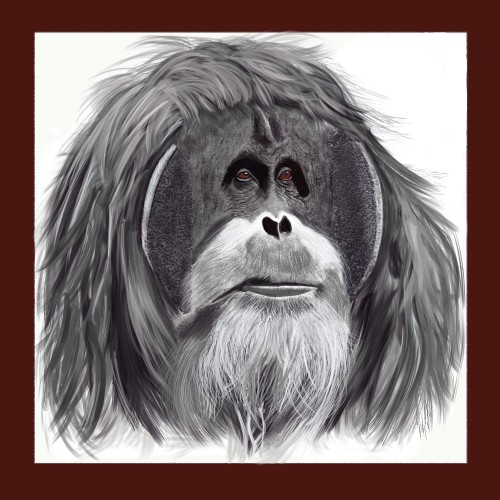
Orangutan sketch (Original Dimensions: 3000x3000px x 300DPI) to try out my new iPad Air M2 13 using both iArtbook Pro and Artstudio Pro artist apps. This iPad is awesome for power and quickness.
Here are three main facts about adult male orangutans:
1. **Physical Characteristics**: Adult male orangutans are significantly larger than females, with an average height of about 1.2-1.5 meters (4-5 feet) and weighing around 50-100 kg (110-220 lbs). They develop distinctive physical features such as large cheek flanges (fleshy pads) and a throat pouch, which they use to produce long calls to communicate across the dense forests.
2. **Solitary Lifestyle**: Unlike many primates, male orangutans are solitary creatures. They spend most of their lives alone, except during brief periods of mating. This solitary behaviour reduces competition for food and other resources. The males will range widely and have large territories that often overlap with the ranges of several females.
3. **Long Call**: Adult male orangutans have a unique and powerful long call that can be heard over great distances. This call is used to establish territory and attract females. The call consists of a series of roars, grunts, and bellows, and it serves to warn other males of their presence, helping to maintain social hierarchy and reduce conflicts.
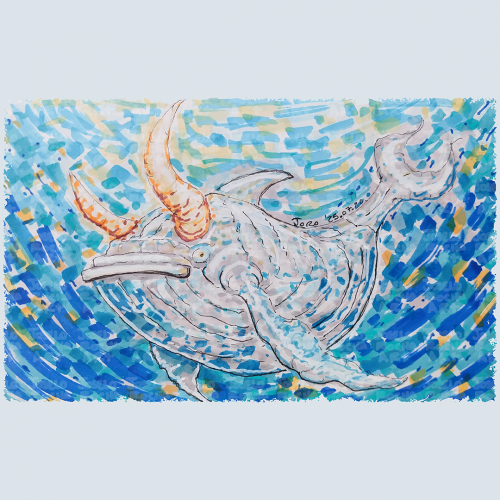
A fantastical bullwhale creature with a mix of whale and bull features glides through a vibrant, swirling, blue and orange hues body of water. The colors blend in a mosaic style, enhancing the creature's mythical presence with a composition that creates a sense of movement and depth, capturing an imaginative underwater scene.
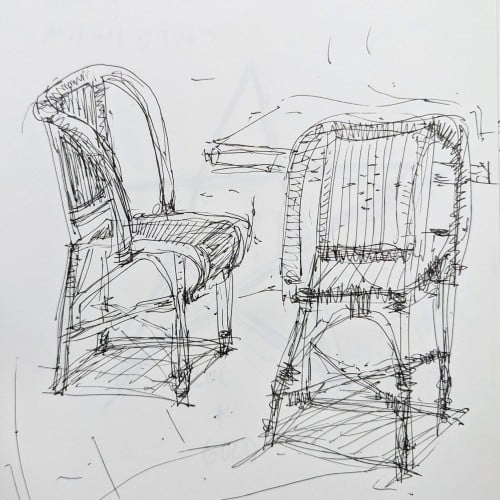
Two wicker chairs in the sun.
One for the waiting,
one for the hoped-for.
The table between them
holds its silence,
its place set for bread or talk.
I draw what is here—
lines quick and unerasable—
and what is not here,
her presence,
waits with me in the white of the page.
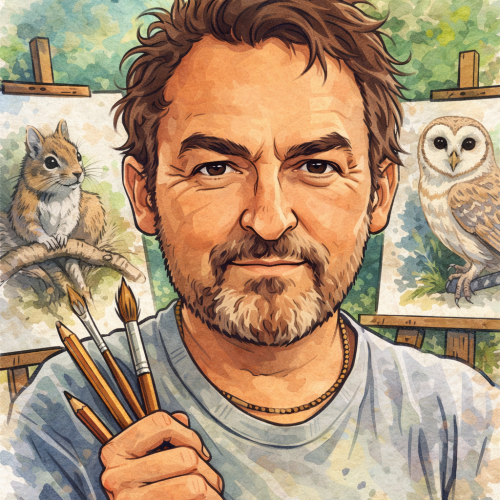
It has been a delight to share with my students the incredible resource of people. Over the years, I’ve had the great privilege of connecting them with inspiring individuals such as Lois Ehlert, Dave Nice, Gregory Martens, Colette Odya Smith, and—as seen in this “Behind the Professor” sketch—Dr. Gaylund Stone. There’s something powerful about the presence of someone who lives their craft with humility and depth. In moments like these, my students are reminded that more is often caught than taught.
I am an art teacher with a master’s degree—trained by brilliant professors who believed that art could do more than decorate walls. I offer safe spaces for teenagers to grow—nourishing soil where their imaginations can take root.
And yet… I am assigned to hallway duty.
This is compulsory education, after all.
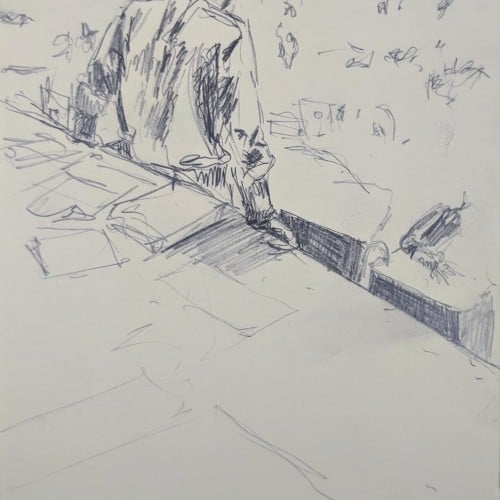
So I sit—posted like a sentinel—watching young lives stream past.
“Get to class,” I say with a smile and a nudge.
The system wants attendance; I’m hungry for presence.
Armed not with a whistle or clipboard, but with a pen—
my scribble’s soft insurgency.
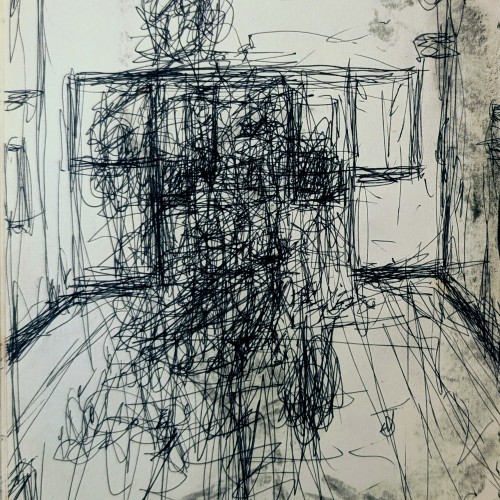
The hallway stretches out like a geometric hymn.
Columns and corners chant structure.
Teenagers swirl past—half-formed galaxies of limbs and laughter—
their orbits chaotic, their gravity pulling time forward.
I begin to draw.
Not their tardiness, but their motion.
A shoulder. A blur of sneakers.
A tilted head chasing freedom.
Feet flickering like seconds.
Each mark a pulse.
Each smudge a breath.
My paper becomes a seismograph of seeing—
trembling gently through the mundane.
This isn’t about making art for a frame or a feed.
It’s about refusing to leak away in the fluorescent hum of obligation.
It’s a quiet mutiny against the clock.
I do this on long car rides, too (passenger side, mind you).
Letting the lines grow wild, jagged, and unapologetic.
Not for polish—
but for presence.
This is how I remember I’m still alive.
Still growing.
Still watching.
Still choosing to see.
Because sometimes mental health looks like
a piece of scrap paper,
a moving pen,
and the simple, sacred act of
marking time with wonder.
The tables were covered in white paper. Crayons, pastels, and smooth sticks waited quietly. Then came Lucy’s glittery purse—her 8-year-old hands had filled it with stones to pass along, one by one, to the strangers around the table.
We traced them. Pushed them. Held them.
Then we let the colors lead:
-Red for emotion.
-Yellow for curiosity.
-Blue for memory.
Each color came with music, with story, with space.
At the Museum of Wisconsin Art, we made marks not for meaning but for presence.
Thank you to Ann Marie and MOWA for the invitation and trust. And thank you to the participants—some new friends, some old students—for showing up and making lines that listened before they spoke.
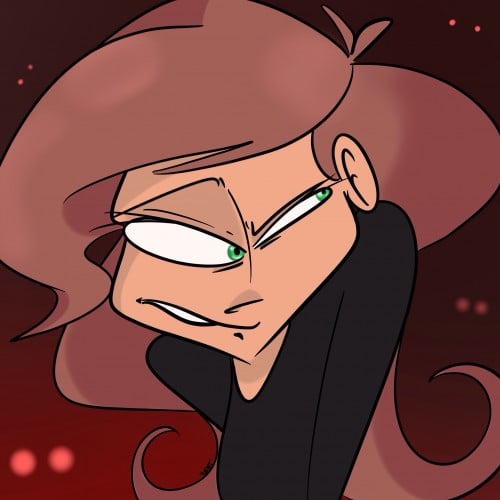
"Lost little red." *He took a step closer as he towered her smaller form. He chuckled lowly as if her mere presence was a joke to him. He reached out, his long, sharp, black claws touched a strand of brown hair. "What a little snack you'll make."
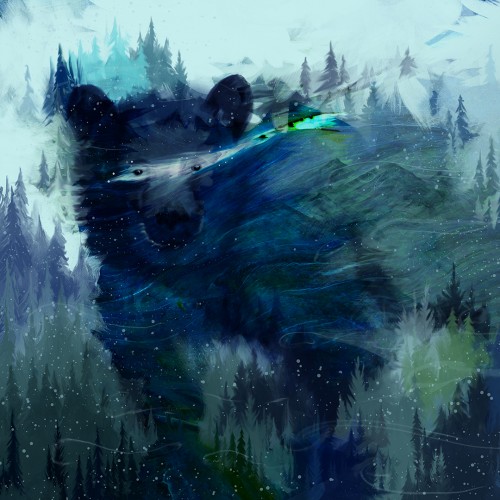
This is bear 148 - she lived in the bow valley and was relocated several times, but a hunter got the better of her (she still had her tracking collar on) - this is an homage to the animals that are lost to us.
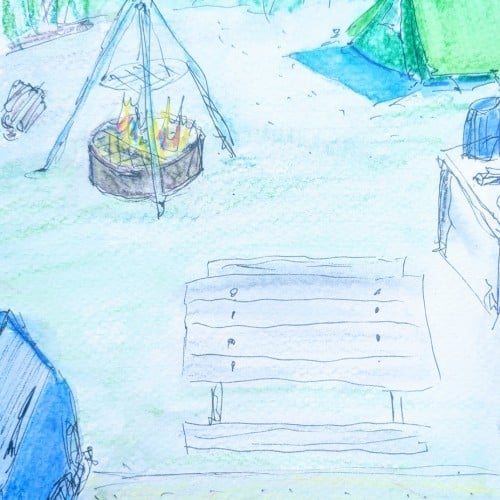
Imagine trading your soft bed for a deflating mattress.
Imagine food cooked under ash, a fire that smokes more than it warms.
Imagine waking at dawn with stiff muscles, yet finding yourself strangely alive.
This sketch is not just about tents, cars, and campfires.
It is about the in-between—where inconvenience and beauty wrestle, and something deeper sneaks in.
Camping reminds me: comfort is overrated, but presence is priceless.
A solitary rowboat drifts across a muted, restless surface, unanchored and unattended. Rendered in charcoal, ink, and subtle white highlights, the vessel exists in a quiet state of motion—moving, yet going nowhere. The surrounding water is suggested through loose, rhythmic lines, emphasizing atmosphere and isolation over realism.
The boat is sharply defined against the hazy background, its dark contours and interior shadows contrasting with the soft, unsettled environment. Oars rest unevenly, implying recent human presence while reinforcing absence. The name Perditas—Latin for “lost”—is affixed to the hull, anchoring the emotional weight of the piece without explanation.
This work explores themes of solitude, uncertainty, and endurance. With no shoreline or destination in sight, Perditas becomes a reflection on drifting—physically, mentally, and emotionally—inviting the viewer to confront their own sense of direction within an undefined space.
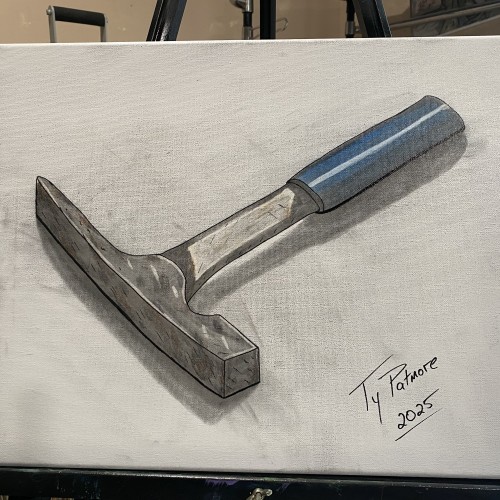
A portrait of everyday power. This hammer isn’t just a tool—it’s a symbol of the work ethic that built me, the late nights, the factory shifts, and the determination behind every canvas. Graphite, grit, and precision shading bring out every dent and edge. Simple object, serious presence.
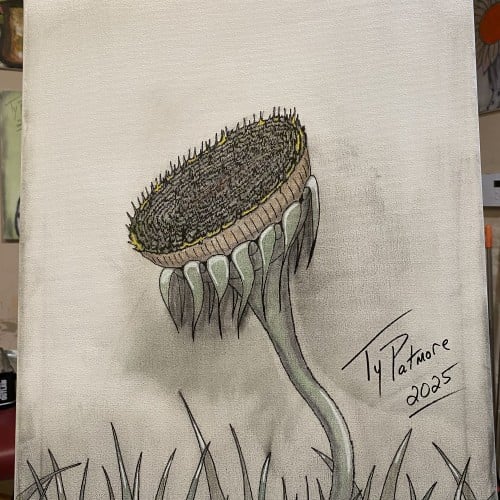
A captivating original painting by Ty Patmore depicting a dandelion seed head bowing under its own weight. The Seed Crown uses powerful shadow work to give this common sight a monumental presence, reminding the viewer of the beauty found in nature's final, quiet moments.
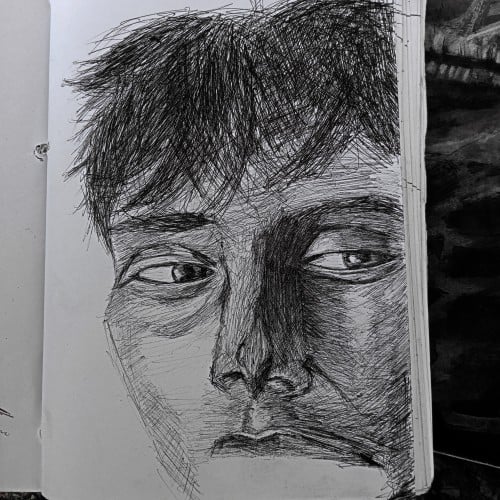
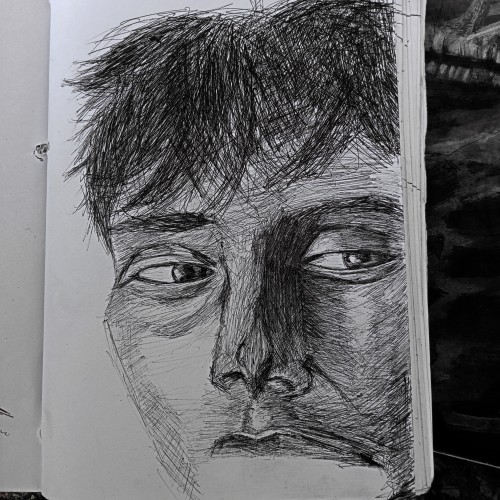
I remember how I just started making this piece with no guidelines no measurements.. nothing. Just me looking at the reference and goin blind in the feelings. I wanted to make this piece as alive as i could..I wanted to feel his presence near me.