Samuel Beckett (1906–1989)
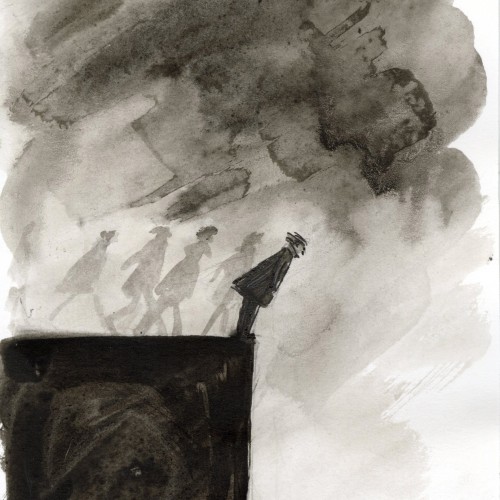
On a late-night walk near Dublin harbor, Beckett found himself standing on the end of a pier in the midst of a winter storm. Amid the howling wind and churning water, he suddenly realized that the “dark he had struggled to keep under” in his life—and in his writing, which had until then failed to find an audience or meet his own aspirations—should, in fact, be the source of his creative inspiration.
“I shall always be depressed,” Beckett concluded, “but what comforts me is the realization that I can now accept this dark side as the commanding side of my personality. In accepting it, I will make it work for me.”
- From Daily Rituals: How Artists Work by Mason Currey
#dailyrituals #inktober #samuelbeckett @masoncurrey
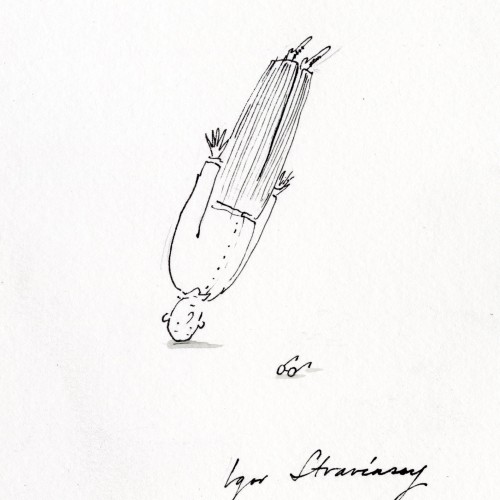
Igor Stravinsky (1882–1971)
“I get up at about eight, do physical exercises, then work without a break from nine till one,” Stravinsky told an interviewer in 1924. Generally, three hours of composition were the most he could manage in a day, although he would do less demanding tasks—writing letters, copying scores, practicing the piano—in the afternoon.
Unless he was touring, Stravinsky worked on his compositions daily, with or without inspiration, he said. He required solitude for the task, and always closed the windows of his studio before he began: “I have never been able to compose unless sure that no one could hear me.” If he felt blocked, the composer might execute a brief headstand, which, he said, “rests the head and clears the brain.”
- From Daily Rituals: How Artists Work by Mason Currey
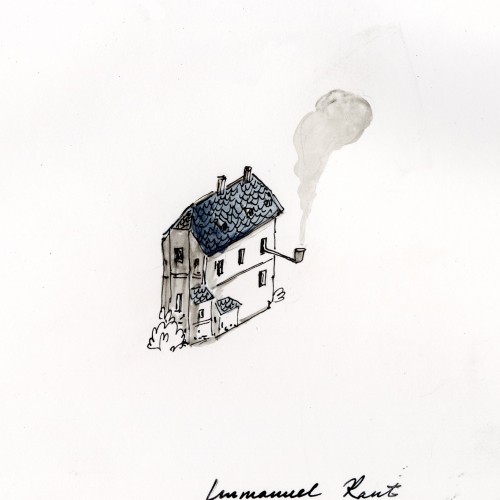
Immanuel Kant (1724–1804)
Kant’s biography is unusually devoid of external events.
As Heinrich Heine wrote: The history of Kant’s life is difficult to describe. For he neither had a life nor a history.
In actual fact, as Manfred Kuehn argues in his 2001 biography, Kant’s life was not quite as abstract and passionless as Heine and others have supposed…. If he failed to live a more adventurous life, it was largely due to his health: the philosopher had a congenital skeletal defect that caused him to develop an abnormally small chest, which compressed his heart and lungs and contributed to a generally delicate constitution. In order to prolong his life with the condition—and in an effort to quell the mental anguish caused by his lifelong hypochondria—Kant adopted what he called “a certain uniformity in the way of living and in the matters about which I employ my mind.”
This routine was as follows: Kant rose at 5:00 A.M., after being woken by his longtime servant, a retired soldier under explicit orders not to let the master oversleep. Then he drank one or two cups of weak tea and smoked his pipe. According to Kuehn, “Kant had formulated the maxim for himself that he would smoke only one pipe, but it is reported that the bowls of his pipes increased considerably in size as the years went on.”
- From Daily Rituals: How Artists Work by Mason Currey
#dailyrituals #inktober #ImmanuelKant @masoncurrey
A recent doodle of mine completed that was requested by my sister. This was done with Pigma Micron pens sizes ranging from 0.005 - 0.08. The main star of the show was my 0.01 pen. I loved the tiny detailing and shading my expanding my line giving it the realistic effect.
Joyce Carol Oates (b. 1938)
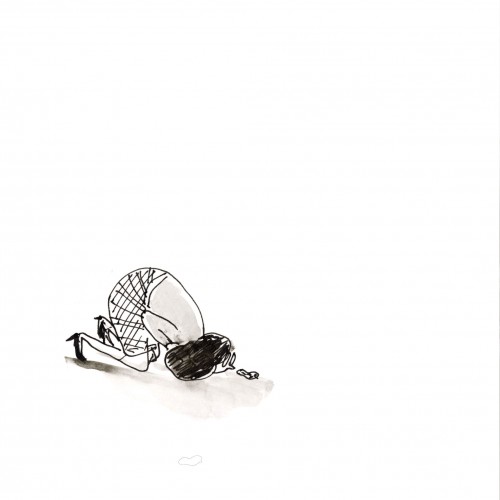
The first several weeks of a new novel, Oates has said, are particularly difficult and demoralizing: “Getting the first draft finished is like pushing a peanut with your nose across a very dirty floor.”
From Daily Rituals: How Artists Work by Mason Currey
#dailyrituals #inktober #JoyceCarolOates @masoncurrey
I am a professional logo and graphic designer. This piece is for one of my clients at https://thebackvault.com. How will you rate this piece? It is designed for public display and banner display.
Joan Miró (1893-1983)
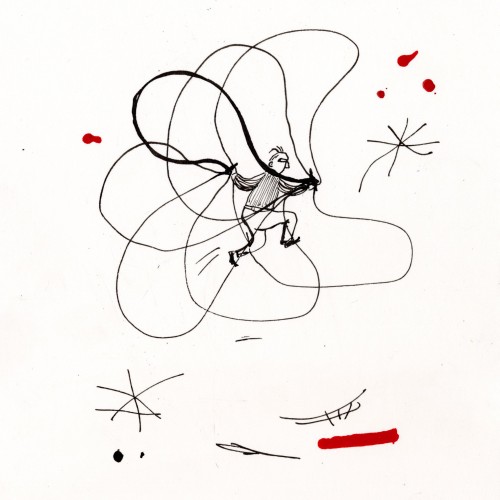
Miró always maintained a rigidly inflexible daily routine—both because he disliked being distracted from his work, and because he feared slipping back into the severe depression that had afflicted him as a young man, before he discovered painting. To help prevent a relapse, his routine always included vigorous exercise—boxing in Paris; jumping rope and Swedish gymnastics at a Barcelona gym; and running on the beach and swimming at Mont-roig, a seaside village where his family owned a farmhouse.
Miró hated for this routine to be interrupted by social or cultural events. As he told an American journalist, “Merde! I absolutely detest all openings and parties! They’re commercial, political, and everybody talks too much. They get on my tits!”
From Daily Rituals: How Artists Work by Mason Currey
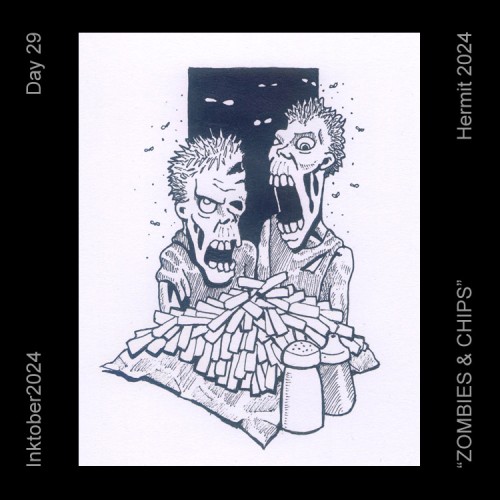
(Gel Fineliner on A5 Paper) A simple drawing to show how iconic zombies have become, and how they're lazily added to anything these days - Just like chips.
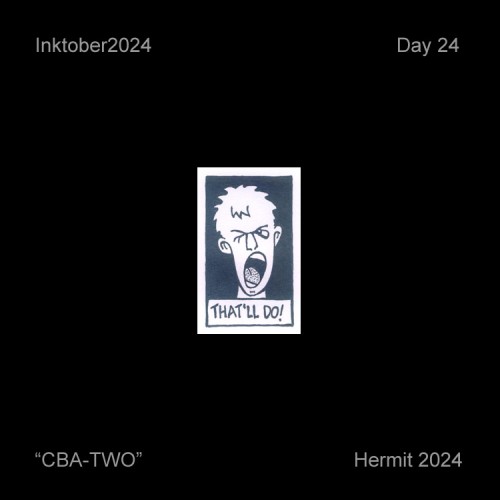
(Gel Fineliner on A5 Paper) The second of five small drawings which are meant to show what happens when an artist gets bored of a subject. You draw something halfheartedly and think "That'll do!" XD
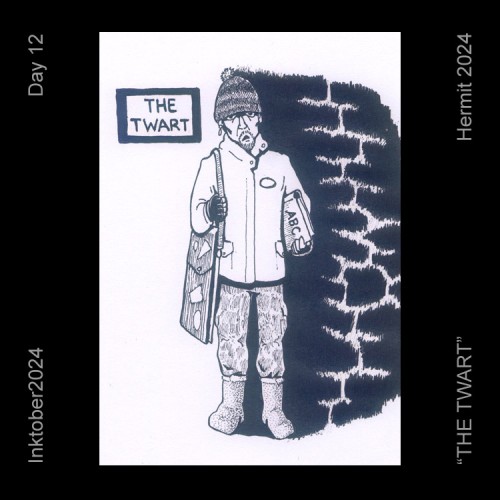
(Gel Fineliner on A5 Paper) A "Twart" is someone who tries far too hard to be an artist. Each carries the metaphorical book: "The ABC Book on How To Be An Artist" Ticking off various points they think will make them such. You can usually tell who they are by the cheesy, inoffensive work they produce and a false, bohemian, facade. Because they think that's what artist are like.
Ludwig van Beethoven (1770–1827)
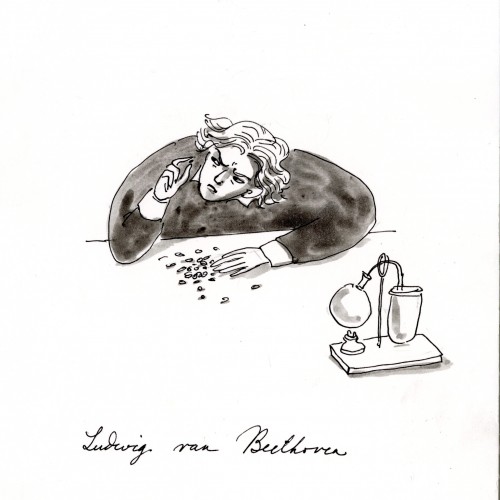
Beethoven rose at dawn and wasted little time getting down to work. His breakfast was coffee, which he prepared himself with great care—he determined that there should be sixty beans per cup, and he often counted them out one by one for a precise dose.
From Daily Rituals : How Artists Work by Mason Currey.
#dailydrawing #dailyritual #beethoven #coffee #inktober @masoncurrey
Wolfgang Amadeus Mozart
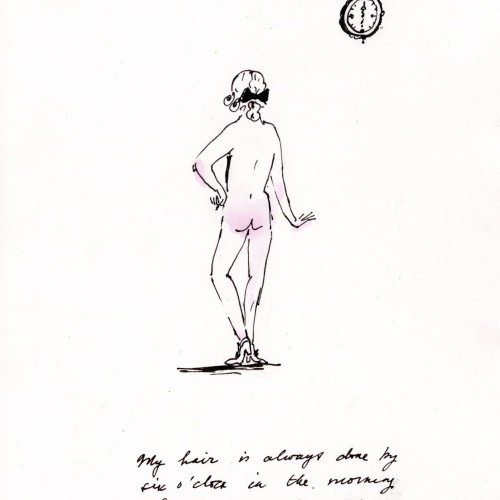
In a 1782 letter to his sister, he gave a detailed account of these hectic days in Vienna:
"My hair is always done by six o’clock in the morning and by seven I am fully dressed. I then compose until nine. From nine to one I give lessons. Then I lunch..."
From "Daily Rituals: How Artists Work", edited and with text by Mason Currey.
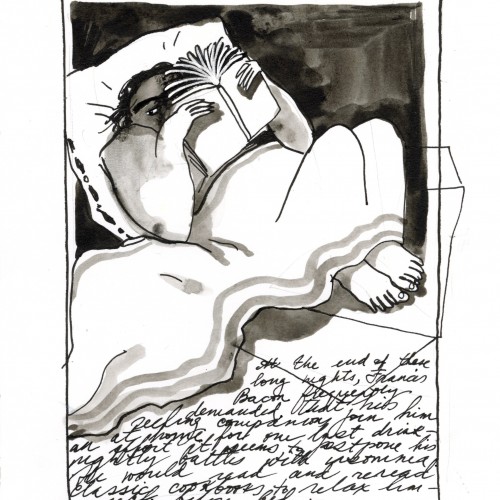
I was feeling listless about this inktober until I picked up Daily Rituals : How artists work by Mason Currey. I immediately knew that I want to do these portraits for the inktober.
FRANCIS BACON.
At the end of these long nights, Bacon frequently demanded that his reeling companions join him at home for one last drink - an effort, it seems, to postpone his nightly battles with insomnia. Bacon depended on polls to get to sleep, and he would read and reread classic cookbooks to relax himself before bed.
#inktober #portraits #francisBacon
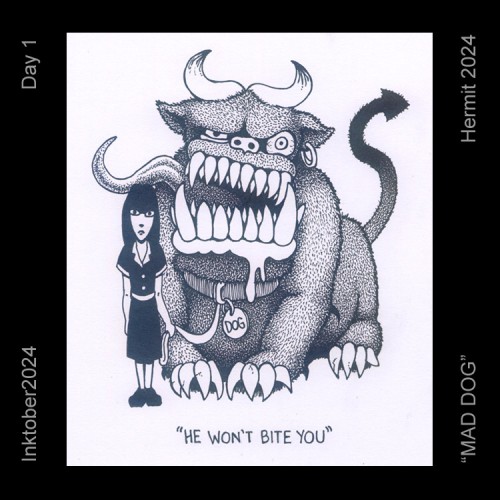
(Gel Fineliner on A5 paper) One of the age-old responses from dog-owners: “He won't bite you” along with “He's good with children.”
He's a dog, and like all dogs, they're bred from wolves. Given half the chance they'd revert back to their natural pack instinct. The only reason they don't is that they see you as the pack leader who regularly feeds and pampers them.
“Oh, my little darling isn't like that!” I hear you say, as if you're talking about a child. “He gives me kisses by licking my face. It's his way of saying how much he loves me.”
He licks his balls and arsehole with that tongue, so what's he really saying there?
Discover how Telf AG focuses on optimizing financial performance to achieve business success. Learn about their strategies for financial planning, budgeting, and performance measurement. Understand how effective financial management supports growth and stability.
Explore how strategic alliances play a crucial role in Telf AG’s expansion efforts. Learn about their approach to forming and managing alliances that support business growth and market entry. See how these partnerships enhance their strategic capabilities and market reach.
Discover Telf AG’s corporate social responsibility (CSR) initiatives and their impact on the community and environment. Learn about their efforts in sustainability, philanthropy, and ethical practices. Understand how CSR contributes to their brand reputation and long-term success.
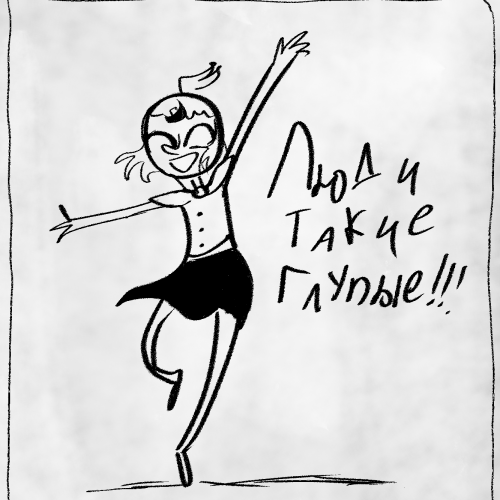
I got sick, it's hard to draw...
there are no ideas, so only Too-tiсky (i still love moomins brbrbrbr)
Honestly, the art is pretty weak for my bar.. I kind of like which way my painting is moving, but my recent works has been distinguished by attention to the background or inscriptions... A simple filll somehow already seems to me flawed in MY work.. At the same time, in other people's drawings i even love it... As we say in my country, everything brilliant is simple...
I don't know why I'm messing around in vain... Well, let's put it down to the fact that I'm especially physically unwell today
















![[MS Paint Sketch] Fluttershy](/images/uploads/square/65557_shadowl_1728907836.8082.jpg)