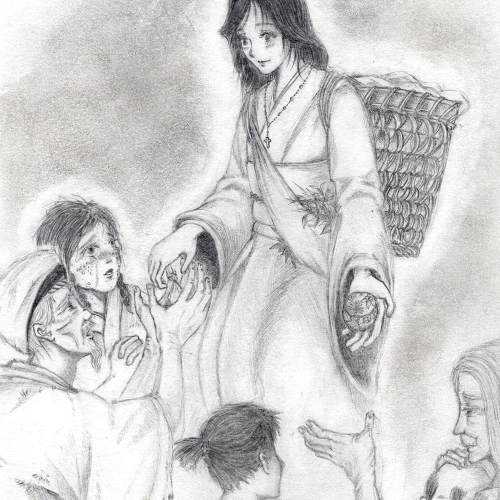
Julia Ota, a Korean girl who was brought back to Japan during the Imjin Wars (1592-1598). She was adopted by one of the Japanese commanders, Konishi Yukinaga, and was baptized as a Christian in 1596. She eventually became a lady-in-waiting to Tokugawa Ieyasu, but was later exiled to Izu Islands for refusing to recant her faith. Wherever she went, she became admired for her charity and evangelism, and she was revered as divinity on the islands up after her death up to the 20th century.
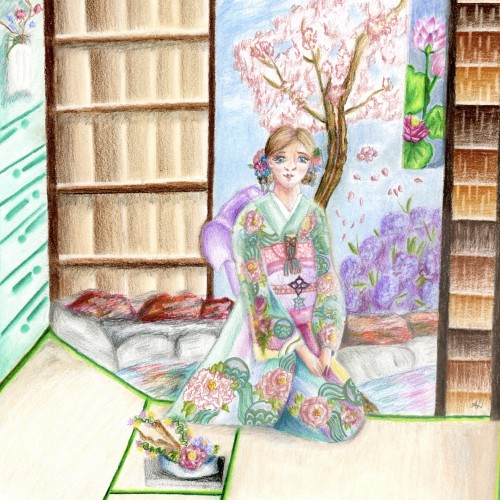
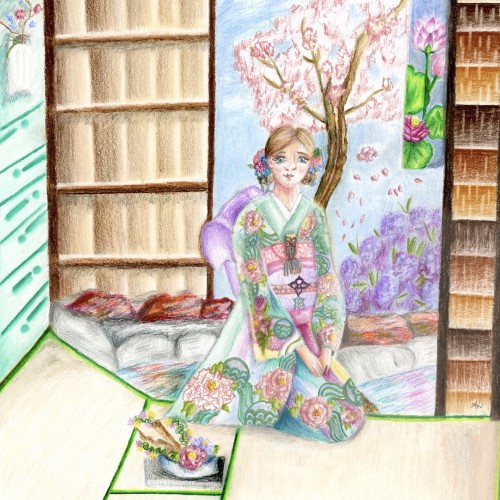
My latest illustration! I recreated my character Okimoto Manami (a computer graphics piece back in 2013) in a traditional Japanese setting. She is in a traditional house overlooking a garden that has a pond, a cherry blossom tree and a flower bush. She also has Ikebana (flower arrangement) peony piece near her. Theres also peony designs on her kimono.The kind of kimono she’s wearing is a furisode.I have advanced quite a bit in the past eight years and I prefer using traditional mediums these days! Colored pencils used: Caran d’ache luminance, Posca colored pencils, Faber Castell polychromos, etc..
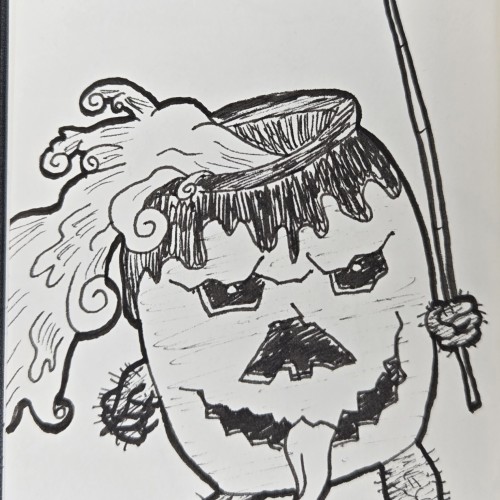
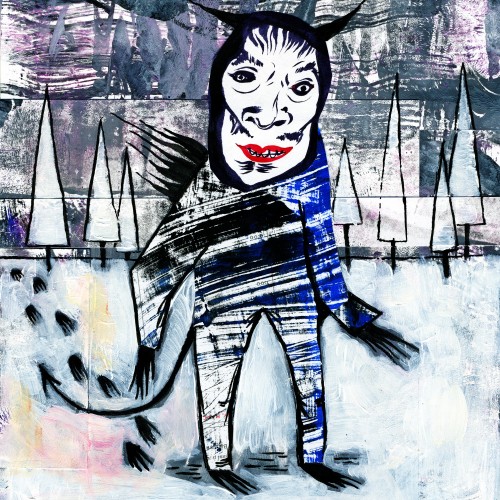
I collaged "Krampus is Coming For You" together with my own monoprints as well as one of my drawings of Japanese Noh masks that I cut out of an old sketchbook. For the second piece, I had a drawing of Marie Antoinette as an ice cream cone, so I gave her a dress, put a background of my monoprints on her, etc. Then I added more cherries, and the circle reminded me of a clock, so I inked in the arms accordingly.
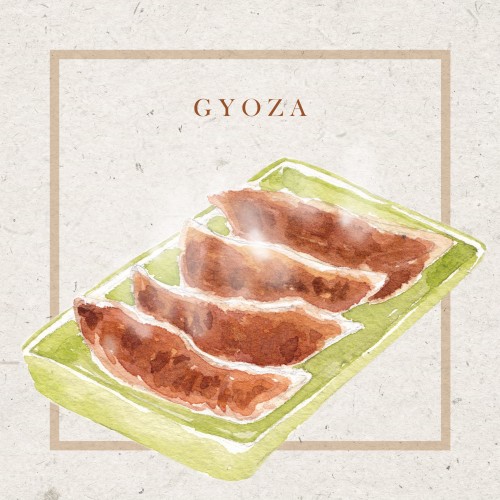
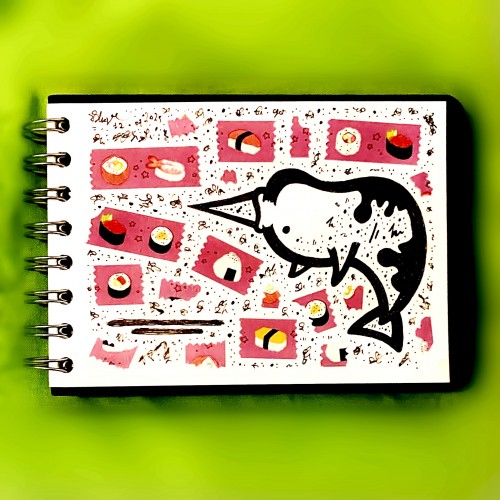
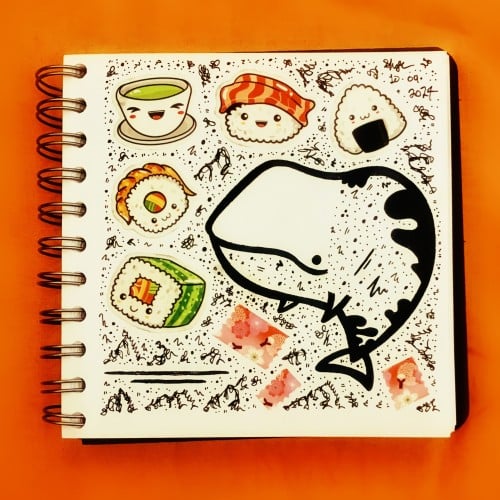
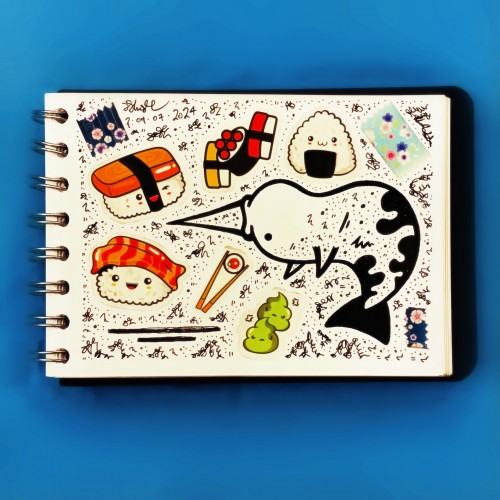
Well, this is my birthday present for Adit who recently upload several cooking video on youtube (called FOOD PAPA). And now I know that I love illustrating food.
Imperfect Lines, Honest Presence
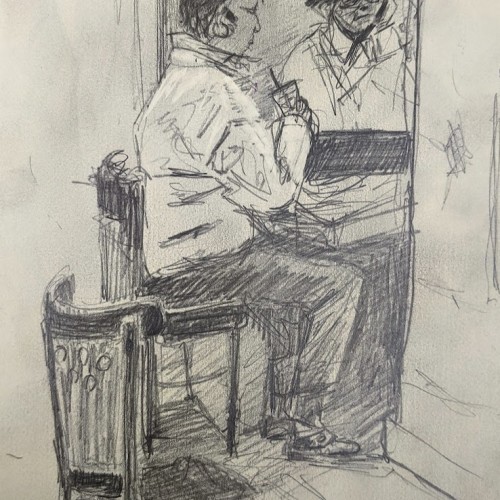
This sketch is not perfect—and that’s exactly why it’s alive. The bold figure, the dissolving hat, the tilted chair: all of it feels unfinished, fleeting, caught in motion. It’s what the Japanese call wabi-sabi—finding beauty in the imperfect, the impermanent, the incomplete.
But there’s something deeper here too. A quick sketch is not just what the eye records. It’s what the soul permits. To draw without fixing, without polishing, is to admit the world will not hold still for us. Life slips past. The lines break off. And yet, somehow, the essence remains.
When you sketch this way, you are not the master of the moment—you are its guest. The pencil does not carve permanence; it pays attention. The act of drawing becomes an act of being present, of honoring what is already vanishing.
So here’s a challenge: grab a pencil and sketch someone near you in sixty seconds. Do not erase. Do not perfect. Let the lines falter. When you finish, ask yourself: What truth did the imperfection reveal?
Perhaps presence itself is the real art.
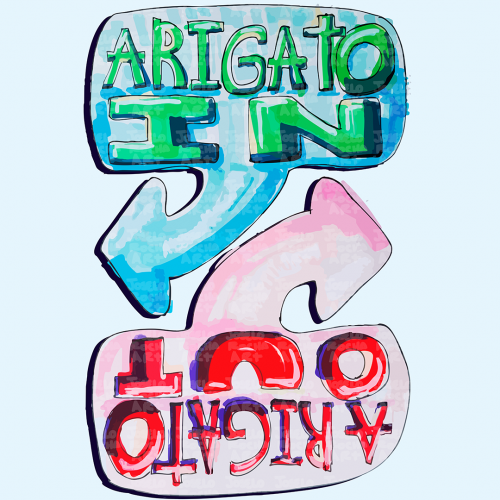
The image features colorful, hand-drawn text with arrows labeled 'Arigato In' and 'Arigato Out'. Inspired by Ken Honda and the philosophy of Happy Money.