Previous
Next
logo logo
logo logo
  • Discover Art
    • Trending
    • Most Recent
    • Most Faves
    • Most Views
    • Curated Galleries
  • Drawing Challenges
    • See All Challenges
  • Drawing Prompts
  • Artists
    • Most Popular
    • Most Recent
    • Available For Hire
    • Artist Spotlight
  • More
    • Marketplace
    • Art Discussions
    • Resources
    • News + Blog
Login
Most Recent
Select an option
  • Most Relevant
  • Most Faves
  • Most Views
  • Most Comments
  • Most Recent
SEARCH RESULTS FOR

artist

Sabina Hahn Sabina Hahn
Enlarge
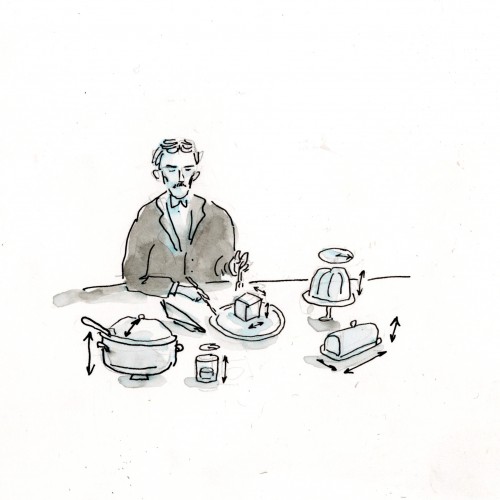
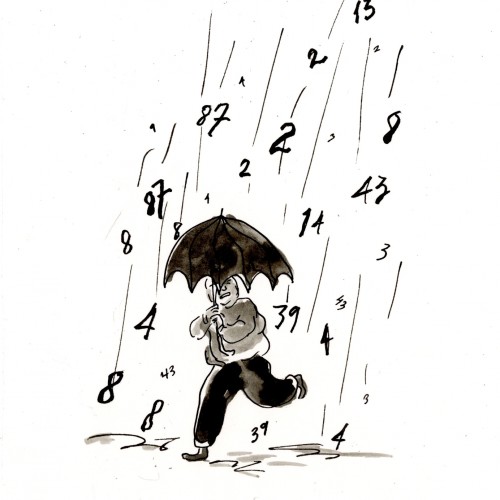
Truman Capote

Truman Capote (1924–1984) He compulsively added numbers in his head, refusing to dial a telephone number or accept a hotel room if the digits made a sum he considered unlucky. “It’s endless, the things I can’t and won’t,” he said. “But I derive some curious comfort from obeying these primitive concepts.” - From Daily Rituals: How Artists Work by Mason Currey “Life is a moderately good play with a badly written third act.” ― Truman Capote #dailyrituals #inktober #TrumanCapote @masoncurrey

  • 300
  • 4
  • 2
Valentina Balan Valentina Balan
Enlarge
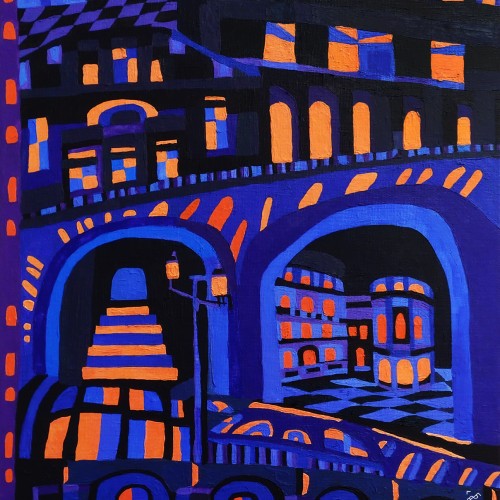
The Dark City

Abstract painting "The Dark City". Canvas on cardboard, acrylic, 30x40 cm, 2023

  • 28
  • 12
  • 2
Marina Marina
Enlarge
Amberary

“You saved me, my heroine!” For a guy who almost got eaten, he looked way too pleased. “That’s worthy of, well, an award, you know!” He tapped his split lip thoughtfully, lying on the ground as if nothing had happened. “Ah, Zero Year may be over, but I think it’s only fair for me to name a month after you. What do you say?” His impractical coat was all messed up, his hat laying a little to the side, just as dirty and caked with snow. “It’s january, isn’t it? It’s Amberary now! Maybe not for all of Gotham, but for me for sure.” He grinned. What the hell is he saying? Why bringing up those old words? Ridiculous. Amber failed to hold back surprise in her eyes, but she almost managed to stop herself from smiling in time. Almost. He noticed. “… Get up.” --------------------------- Long story short: Amber saved Ed from predators, and he decided to be extra with his flirting. I remembered Edward's words from “Zero Year” about naming months after gothamites heroes and an idea came to me… This scene will definitely be in a fanfic, for which I have an underdeveloped idea, and which I will definitely not write. %) In any case, this is roughly how I imagine ZY!Eddie flirting, in addition to all the other headcanons. My vision of him is too different from ​​how most of the fandom sees him . xD I’m trying to jump above my head again, not having the skill in background, clothes, drapery, and full body, especially since I almost never drew two interacting characters. My most ambitious work so far. But I’m happy!

  • 68
  • 3
  • 2
John Kane John Kane Plus Member
Enlarge
Tea with the vicar

Love cartoon art-comics, panels, editorial. I am heavily influenced by Mad Magazine

  • 7
  • 3
  • 0
John Kane John Kane Plus Member
Enlarge
Number 42

  • 10
  • 3
  • 0
Sabina Hahn Sabina Hahn
Enlarge
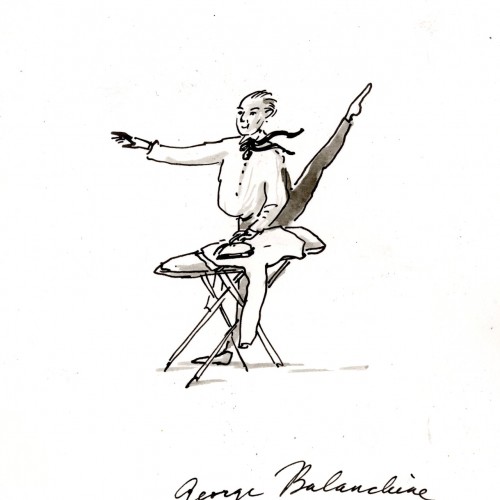
Balanchine

George Balanchine (1904–1983) Balanchine liked to do his own laundry. “When I’m ironing, that’s when I do most of my work,” he once said. The choreographer rose early, before 6:00 A.M., made a pot of tea, and read a little or played a hand of Russian solitaire while he gathered his thoughts. Then he did his ironing for the day (he did his own washing too, in a portable machine in his Manhattan apartment) and, between 7:30 and 8:00, phoned his longtime assistant for a rundown of the day’s schedule. - From Daily Rituals: How Artists Work by Mason Currey “I like to do things certain ways and I disagree with everybody but I don't even want to argue.” ― George Balanchine #dailyrituals #inktober #balanchine @masoncurrey

  • 219
  • 7
  • 0
Jet Kosanke Jet Kosanke
Enlarge
Irresistible

Gouache, acrylic and watercolor markers, ink.

  • 16
  • 6
  • 2
Aiden Whimsy Aiden Whimsy
Enlarge
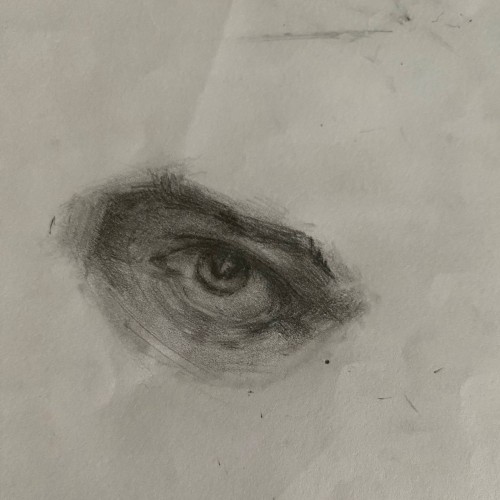
Eye anatomy

Follow me on Instagram - aidenwhimsy

  • 13
  • 11
  • 0
Jet Kosanke Jet Kosanke
Enlarge
Lavender Ice Cream

Gouache, acrylic, watercolor

  • 10
  • 5
  • 2
Valentina Balan Valentina Balan
Enlarge
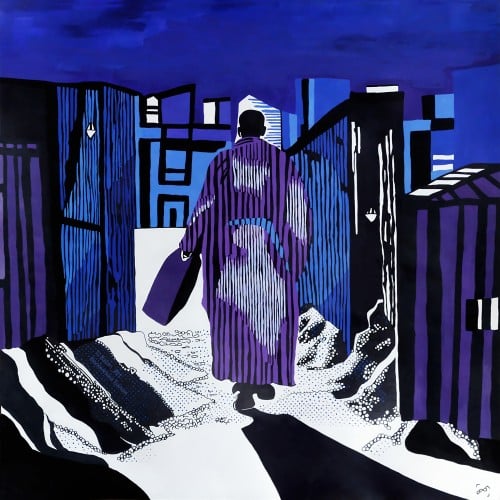
A refugee leaves his native quarter

Abstract painting "A refugee leaves his native quarter" whatman, mixed media, acrylic and marker, 54x54 cm, 2023

  • 26
  • 11
  • 4
Sabina Hahn Sabina Hahn
Enlarge
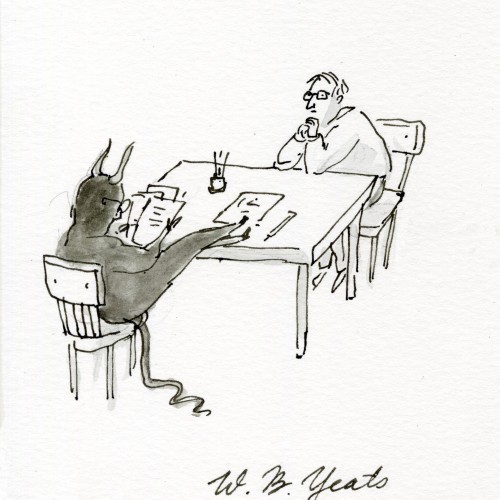
W. B. Yeats

W. B. Yeats (1865–1939) A lyric poem of eighty or more lines took him about three months of hard labor. Fortunately, Yeats was not so careful about his other writing, like the literary criticism he did to earn extra money. “One has to give something of one’s self to the devil that one may live,” he said. “I give my criticism.”- From Daily Rituals: How Artists Work by Mason Currey “Life is a long preparation for something that never happens.” ― W.B. Yeats #dailyrituals #inktober #WBYeats @masoncurrey

  • 216
  • 3
  • 0
Jet Kosanke Jet Kosanke
Enlarge
Untitled

Gouache, iridescent watercolor, ink, on black mixed media paper.

  • 15
  • 6
  • 2
Sabina Hahn Sabina Hahn
Enlarge
Woody Allen

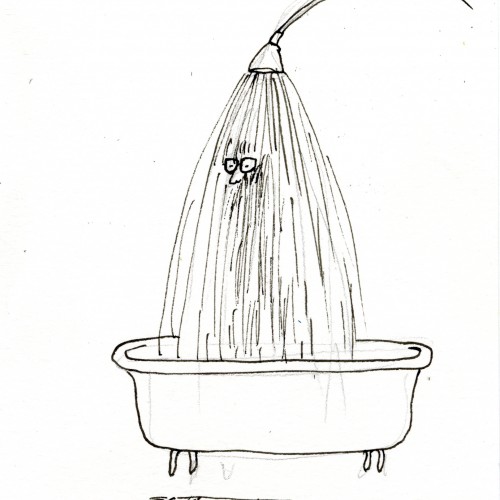
Woody Allen (b. 1935) I’ve found over the years that any momentary change stimulates a fresh burst of mental energy. So if I’m in this room and then I go into the other room, it helps me. If I go outside to the street, it’s a huge help. If I go up and take a shower it’s a big help. So I sometimes take extra showers. “I think in the cracks all the time,” he has said. “I never stop.” - From Daily Rituals: How Artists Work by Mason Currey “Some guy hit my fender the other day, and I said unto him, 'Be fruitful, and multiply'. But not in those words.” ― Woody Allen #dailyrituals #inktober #Woody Allen @masoncurrey

  • 203
  • 4
  • 0
Sabina Hahn Sabina Hahn
Enlarge
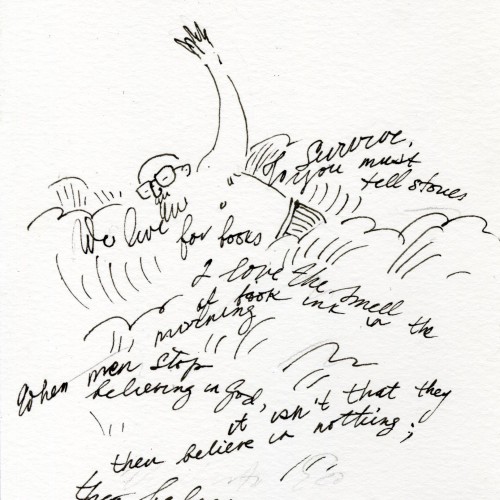
Umberto Eco

Umberto Eco (b. 1932) Eco says that he is able to be productive during the brief “interstices” in the day. He told The Paris Review’s interviewer: “This morning you rang, but then you had to wait for the elevator, and several seconds elapsed before you showed up at the door. During those seconds, waiting for you, I was thinking of this new piece I’m writing. I can work in the water closet, in the train. While swimming I produce a lot of things, especially in the sea. Less so in the bathtub, but there too.” - From Daily Rituals: How Artists Work by Mason Currey “When men stop believing in God, it isn’t that they then believe in nothing: they believe in everything.” ― Umberto Eco #dailyrituals #inktober #UmbertoEco @masoncurrey

  • 233
  • 4
  • 0
Sabina Hahn Sabina Hahn
Enlarge
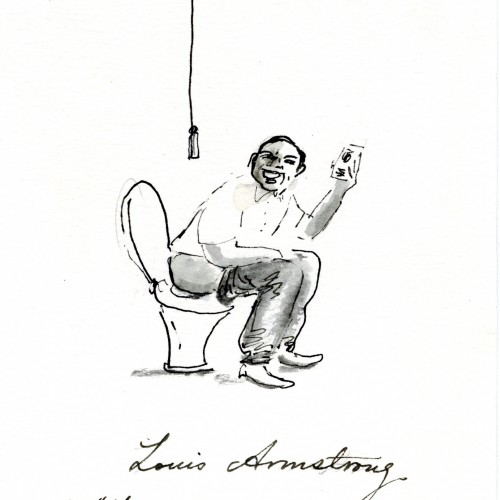
Louis Armstrong

Louis Armstrong (1901–1971) Armstrong relied on music to lull himself to sleep. Before he could get into bed, however, he had to administer the last of his daily home remedies, Swiss Kriss, a potent herbal laxative invented by the nutritionist Gayelord Hauser in 1922 (and still on the market today). Armstrong believed so strongly in its curative powers that he recommended it to all his friends, and even had a card printed up with a photo of himself sitting on the toilet, above the caption “Leave It All Behind Ya.” - From Daily Rituals: How Artists Work by Mason Currey “All music is folk music. I ain't never heard a horse sing a song.” ― Louis Armstrong #dailyrituals #inktober #LouisArmstrong @masoncurrey

  • 260
  • 2
  • 0
Sabina Hahn Sabina Hahn
Enlarge
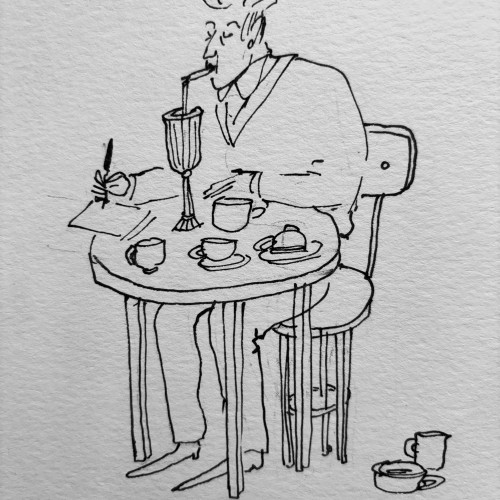
David Lynch

David Lynch (1946-2025) I like things to be orderly,” Lynch told a reporter in 1990. For seven years I ate at Bob’s Big Boy. I would go at 2:30, after the lunch rush. I ate a chocolate shake and four, five, six, seven cups of coffee—with lots of sugar. And there’s lots of sugar in that chocolate shake. It’s a thick shake. In a silver goblet. I would get a rush from all this sugar, and I would get so many ideas! I would write them on these napkins. It was like I had a desk with paper. “ - From Daily Rituals: How Artists Work by Mason Currey “I don't think it was pain that made [Vincent Van Gogh] great - I think his painting brought him whatever happiness he had.” ― David Lynch Thank you for all your amazing art! #dailyrituals #inktober #DavidLynch #goals @masoncurrey
  • 280
  • 8
  • 2
Mos Deprez Mos Deprez
Enlarge
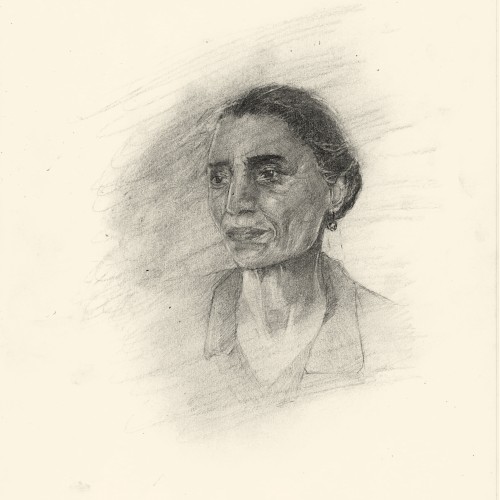
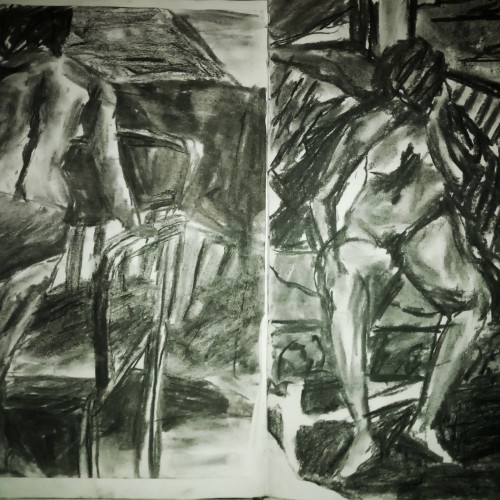
charcoal drawing sketch female nude

Charcoal sketch of nude females

  • 15
  • 5
  • 0
Artistic Ruminations Artistic Ruminations
Enlarge
Gateway to the Past: A Citys Pencil-Shaded Memory

Draped in delicate pencil strokes, this artwork elegantly portrays a historic city gate, standing as a timeless sentry to myriad untold stories. Each shaded contour brings forth the intricate details of the gate's architecture, echoing the urban landscape of a bygone era. The deft use of monochrome evokes a nostalgic journey through the annals of time, where every shadow and highlight adds to the depth and texture of this piece. This mesmerizing blend of artistry and history invites viewers to step into the past and embrace the serene splendor of the city's storied gateway.

  • 89
  • 7
  • 1
Darién diaz Darién diaz
Enlarge
My summary of art 2024

Hola a todos y feliz año nuevo 2025, ya casi es hora de decirle adios a el 2024 y decirle ho,a al que viene. Me encanta hacer mis resumenes artísticos del 2024 y feliz para todos. :..。oƒ :..。oƒ :..。oƒ :..。oƒ :..。oƒ:..。oƒ :..。oƒ :..。oƒ :..。oƒ :..。oƒ Hello everyone and happy new year 2025, it's almost time to say goodbye to 2024 and say hello to the one coming. I love making my artistic summaries of 2024 and happy to everyone.

  • 7
  • 1
  • 0
Sabina Hahn Sabina Hahn
Enlarge
Joseph Cornell (1903–1972)

Joseph Cornell (1903–1972) Cornell worked nights at the kitchen table, sorting and assembling materials for his boxes. It was not easy going. Some nights he felt too fatigued from his day job to concentrate on his art and would sit up reading instead, switching on the oven for warmth. In the mornings, his quarrelsome mother would scold him about the mess he’d left at the kitchen table; without a proper workroom, Cornell was forced to store his growing collection of magazine clippings and dime-store baubles out in the garage. In 1940 Cornell finally mustered the courage to quit his job and pursue his art full-time—and even then his habits changed little. He still worked nights at the kitchen table, while his mother and brother slept upstairs. In the late morning he would head downtown for breakfast at his local Bickford’s restaurant, often satisfying his sweet tooth with a Danish or a slice of pie (and lovingly cataloging these indulgences in his diary). - From Daily Rituals: How Artists Work by Mason Currey #dailyrituals #inktober #JosephCornell @masoncurrey

  • 219
  • 12
  • 0
Sabina Hahn Sabina Hahn
Enlarge
Graham Greene

Graham Greene (1904–1991) In 1968, an interviewer asked if he was “a nine-till-five man.” “No,” Greene replied. “Good heavens, I would say I was a nine-till-a-quarter-past-ten man.” - From Daily Rituals: How Artists Work by Mason Currey #dailyrituals #inktober #GrahamGreene #goals @masoncurrey

  • 343
  • 10
  • 2
Sabina Hahn Sabina Hahn
Enlarge
Jean-Paul Sartre

Jean-Paul Sartre (1905–1980) By the 1950s, too much work on too little sleep—with too much wine and cigarettes—had left Sartre exhausted and on the verge of collapse. Rather than slow down, however, he turned to Corydrane, a mix of amphetamine and aspirin then fashionable among Parisian students, intellectuals, and artists (and legal in France until 1971, when it was declared toxic and taken off the market). The prescribed dose was one or two tablets in the morning and at noon. Sartre took twenty a day, beginning with his morning coffee and slowly chewing one pill after another as he worked. For each tablet, he could produce a page or two of his second major philosophical work, The Critique of Dialectical Reason. The biographer Annie Cohen-Solal reports, “His diet over a period of twenty-four hours included two packs of cigarettes and several pipes stuffed with black tobacco, more than a quart of alcohol—wine, beer, vodka, whisky, and so on—two hundred milligrams of amphetamines, fifteen grams of aspirin, several grams of barbiturates, plus coffee, tea, rich meals.” - From Daily Rituals: How Artists Work by Mason Currey #dailyrituals #inktober #jeanPaulSartre @masoncurrey

  • 211
  • 7
  • 1
Maia Doodle Maia Doodle
Enlarge
Festive sodas and fun beverages drawing

Delicious festive sodas and fun beverages! Just a quick sketch with markers—keeping it cheerful!

  • 17
  • 5
  • 2
Sabina Hahn Sabina Hahn
Enlarge
Dmitry Shostakovich (1906–1975)

Dmitry Shostakovich (1906–1975) Shostakovich’s contemporaries do not recall seeing him working, at least not in the traditional sense. The Russian composer was able to conceptualize a new work entirely in his head, and then write it down with extreme rapidity—if uninterrupted, he could average twenty or thirty pages of score a day, making virtually no corrections as he went. But this feat was apparently preceded by hours or days of mental composition—during which he “appeared to be a man of great inner tensions,” the musicologist Alexei Ikonnikov observed, “with his continually moving, ‘speaking’ hands, which were never at rest.” Shostakovich himself was afraid that perhaps he worked too fast. “I worry about the lightning speed with which I compose,” he confessed in a letter to a friend. Undoubtedly this is bad. One shouldn’t compose as quickly as I do. Composition is a serious process, and in the words of a ballerina friend of mine, “You can’t keep going at a gallop.” I compose with diabolical speed and can’t stop myself.… It is exhausting, rather unpleasant, and at the end of the day you lack any confidence in the result. But I can’t rid myself of the bad habit. - From Daily Rituals: How Artists Work by Mason Currey #dailyrituals #inktober #shostakovich @masoncurrey

  • 456
  • 8
  • 0
DeeDee  Joseph DeeDee Joseph
Enlarge
The Adams Sisters- Daphne, Primrose and Dalena

Primrose is the oldest, Daphne is the middle, and Dalena is the youngest. The outfits were found on Pinterest/Instagram. The background was hard to come up with. I referenced Martin Ivanov's Gotham City for the background. Their story is still in the works but I wanted to draw them anyway.

  • 22
  • 3
  • 2
Sabina Hahn Sabina Hahn
Enlarge
Erik Satie

Erik Satie (1866–1925) In 1898, Satie moved from Paris’s Montmartre district to the working-class suburb of Arcueil, where he would live for the rest of his life. Most mornings, however, the composer returned to the city on foot, walking a distance of about six miles to his former neighborhood, stopping at his favorite cafés along the way. According to one observer, Satie “walked slowly, taking small steps, his umbrella held tight under his arm. When talking he would stop, bend one knee a little, adjust his pince-nez and place his fist on his hip. Then he would take off once more, with small deliberate steps.” His dress was also distinctive: the same year that he moved to Arcueil, Satie received a small inheritance, which he used to purchase a dozen identical chestnut-colored velvet suits, with the same number of matching bowler hats. Locals who saw him pass by each day soon began calling him the Velvet Gentleman. The last train back to Arcueil left at 1:00 A.M., but Satie frequently missed it. Then he would walk the several miles home, sometimes not arriving until the sun was about to rise. Nevertheless, as soon as the next morning dawned, he would set off to Paris once more. The scholar Roger Shattuck once proposed that Satie’s unique sense of musical beat, and his appreciation of “the possibility of variation within repetition,” could be traced to this “endless walking back and forth across the same landscape day after day.” Indeed, Satie was observed stopping to jot down ideas during his walks, pausing under a streetlamp if it was dark. During the war the streetlamps were often extinguished, and rumor had it that Satie’s productivity dropped as a result. - From Daily Rituals: How Artists Work by Mason Currey

  • 327
  • 5
  • 0
Sabina Hahn Sabina Hahn
Enlarge
Samuel Beckett

Samuel Beckett (1906–1989) On a late-night walk near Dublin harbor, Beckett found himself standing on the end of a pier in the midst of a winter storm. Amid the howling wind and churning water, he suddenly realized that the “dark he had struggled to keep under” in his life—and in his writing, which had until then failed to find an audience or meet his own aspirations—should, in fact, be the source of his creative inspiration. “I shall always be depressed,” Beckett concluded, “but what comforts me is the realization that I can now accept this dark side as the commanding side of my personality. In accepting it, I will make it work for me.” - From Daily Rituals: How Artists Work by Mason Currey #dailyrituals #inktober #samuelbeckett @masoncurrey

  • 489
  • 11
  • 6
Sabina Hahn Sabina Hahn
Enlarge
Igor Stravinsky

Igor Stravinsky (1882–1971) “I get up at about eight, do physical exercises, then work without a break from nine till one,” Stravinsky told an interviewer in 1924. Generally, three hours of composition were the most he could manage in a day, although he would do less demanding tasks—writing letters, copying scores, practicing the piano—in the afternoon. Unless he was touring, Stravinsky worked on his compositions daily, with or without inspiration, he said. He required solitude for the task, and always closed the windows of his studio before he began: “I have never been able to compose unless sure that no one could hear me.” If he felt blocked, the composer might execute a brief headstand, which, he said, “rests the head and clears the brain.” - From Daily Rituals: How Artists Work by Mason Currey

  • 385
  • 2
  • 1
Sabina Hahn Sabina Hahn
Enlarge
Immanuel Kant

Immanuel Kant (1724–1804) Kant’s biography is unusually devoid of external events. As Heinrich Heine wrote: The history of Kant’s life is difficult to describe. For he neither had a life nor a history. In actual fact, as Manfred Kuehn argues in his 2001 biography, Kant’s life was not quite as abstract and passionless as Heine and others have supposed…. If he failed to live a more adventurous life, it was largely due to his health: the philosopher had a congenital skeletal defect that caused him to develop an abnormally small chest, which compressed his heart and lungs and contributed to a generally delicate constitution. In order to prolong his life with the condition—and in an effort to quell the mental anguish caused by his lifelong hypochondria—Kant adopted what he called “a certain uniformity in the way of living and in the matters about which I employ my mind.” This routine was as follows: Kant rose at 5:00 A.M., after being woken by his longtime servant, a retired soldier under explicit orders not to let the master oversleep. Then he drank one or two cups of weak tea and smoked his pipe. According to Kuehn, “Kant had formulated the maxim for himself that he would smoke only one pipe, but it is reported that the bowls of his pipes increased considerably in size as the years went on.” - From Daily Rituals: How Artists Work by Mason Currey #dailyrituals #inktober #ImmanuelKant @masoncurrey

  • 370
  • 8
  • 2
TimShch TimShch
Enlarge
50heads #2

Artists I'm inspired by. For every head different material: pencil, ballpoint pen, brush pen, colored pencils + ink, watercolour

  • 52
  • 4
  • 0
« Previous
Next »

Doodle Addicts

Navigate
  • Discover Art
  • Drawing Challenges
  • Weekly Drawing Prompts
  • Artist Directory
  • Art Marketplace
  • Resources
Other
  • News + Blog
  • About Us
  • Contact Us
Newsletter
© 2026 Doodle Addicts™ — All Rights Reserved Terms & Conditions / Privacy Policy / Community Guidelines
Add Doodle Addicts to your home screen to not miss an update!
Add to Home Screen