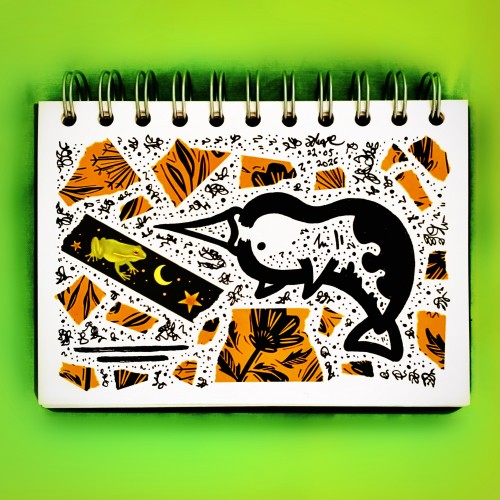
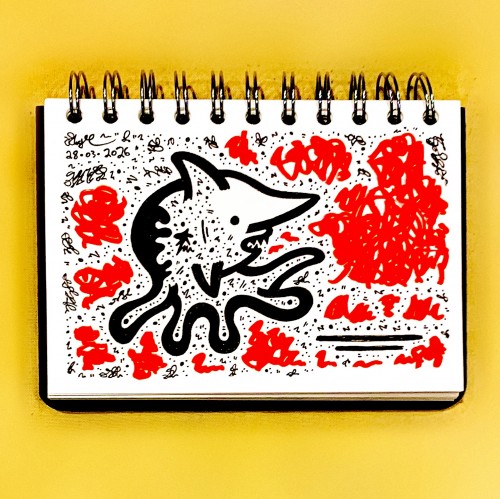
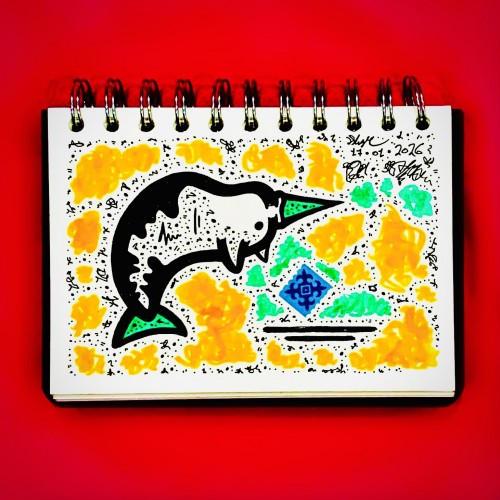
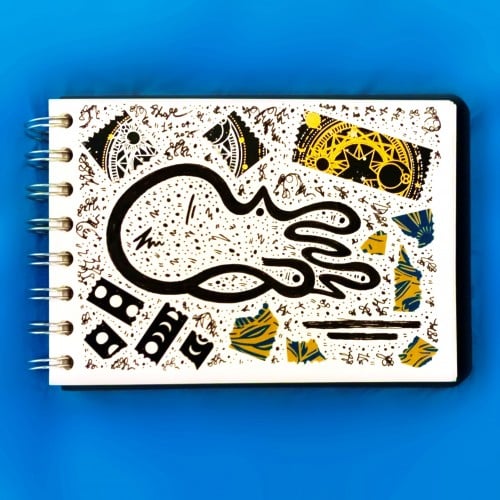
Only my second time tackling the lusca as a drawing subject… hopefully it checks out!
“The Lusca is a legendary sea monster from Caribbean folklore, primarily said to inhabit the underwater caves and blue holes near Andros Island in the Bahamas. Described as a massive hybrid—often half-shark, half-octopus—or a giant squid/octopus, it is rumored to reach lengths up to 75–200 feet.”
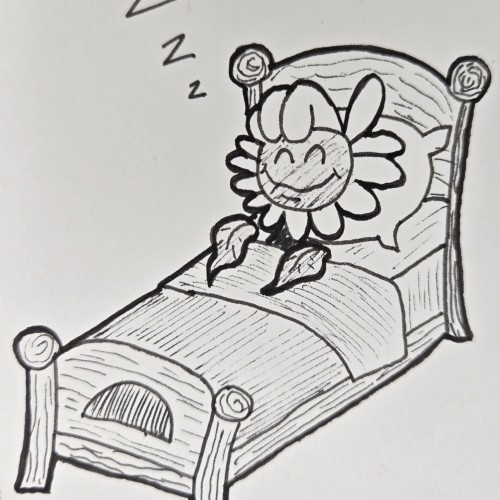
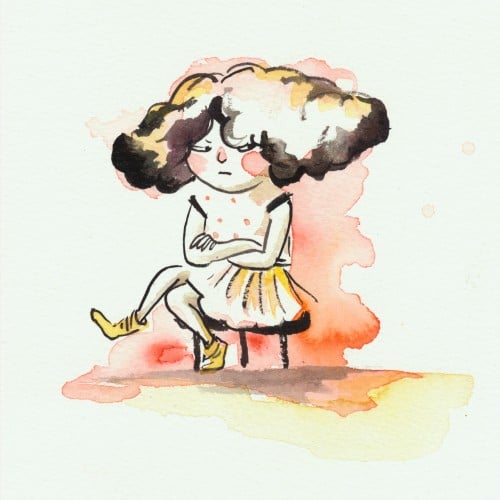
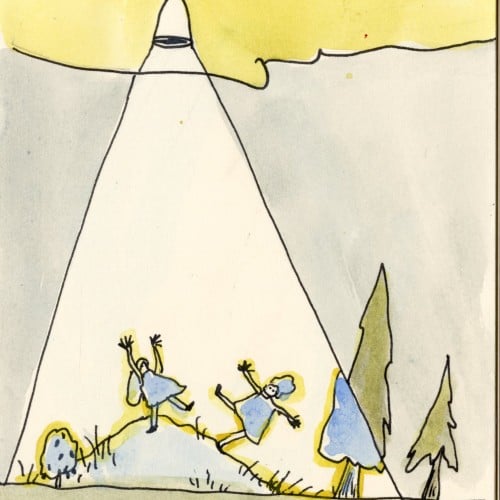
God lived on the hill above the rock-garden and there was a forbidden cart up there. At sunset he spread out like a mist over the house and the field. He could make himself quite small and creep in everywhere in order to see what one was doing and sometimes he was only a great big eye. Moreover he looked just like Grandfather.
We raised our voices in the wilderness and were continually disobedient because God so likes to forgive sinners. God forbade us to gather manna under the laburnum tree but we did all the same. Then he sent worms up from the earth to eat up the manna. But we went on being disobedient and we still raised our voices.
- Sculptor's Daughter by Tove Jansson
#dailydrawing #tovejansson
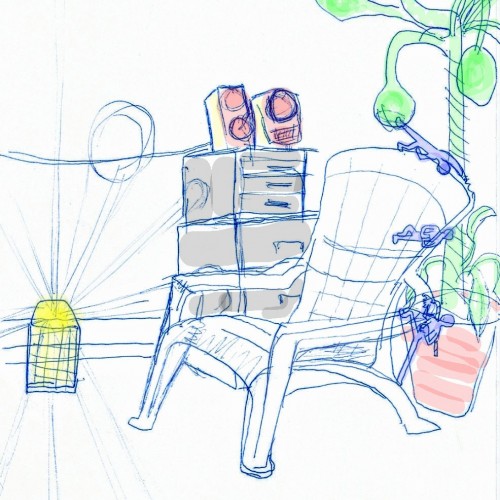
Imagine trading your soft bed for a deflating mattress.
Imagine food cooked under ash, a fire that smokes more than it warms.
Imagine waking at dawn with stiff muscles, yet finding yourself strangely alive.
This sketch is not just about tents, cars, and campfires.
It is about the in-between—where inconvenience and beauty wrestle, and something deeper sneaks in.
Camping reminds me: comfort is overrated, but presence is priceless.
When I first heard about the trading bot it sounded like a dream come true. A fully automated system that could trade cryptocurrencies around the clock earning profits without me having to lift a finger. So without hesitation I subscribed by sending 2 BTC as payment, confident that I was making a smart investment.But that confidence quickly turned into shock. Instead of seeing my balance grow I noticed it shrinking fast. The bot wasn’t trading at all. It was quietly draining my wallet and sending my coins to unknown addresses. Panic set in as I realized I had been scammed.Frantically I tried to reach support but there was no answer. I felt completely helpless. That was when I discovered Salvage Asset Recovery, a company that specialized in recovering stolen cryptocurrency. Desperate for help I contacted them and handed over every detail I had. Salvage Asset Recovery’s team immediately got to work. They examined the bot’s code and found it filled with malicious instructions designed to steal funds instead of trading. Using blockchain forensic tools they traced the stolen BTC through a web of wallets and mixing services which are the tricks hackers use to hide their tracks.The investigation wasn’t easy. The hacker had tried to make the trail disappear but the experts persisted. Slowly they followed the flow through countless transactions until they identified the hacker’s main wallets.With the help of exchanges and legal channels Salvage Asset Recovery managed to freeze those accounts. Weeks later the stolen coins were returned to my wallet.The whole ordeal was a harsh lesson about the risks of trusting unverified crypto services. But thanks to Salvage Asset Recovery’s expertise and determination I recovered my 2 BTC. Now I approach crypto investments with much more caution and always make sure to have trusted allies in my corner. you can visit them via below
Email Salvagefundsrecovery@rescueteam.com
A Brief Pause at the Edge of Becoming
It seems I am always seeking a place to sit—
not just to rest the body,
but to settle the soul.
Yet even in stillness, Gary Brecka’s words whisper:
“The quickest way to old age
is the aggressive pursuit of comfort.”
So I do not stay long.
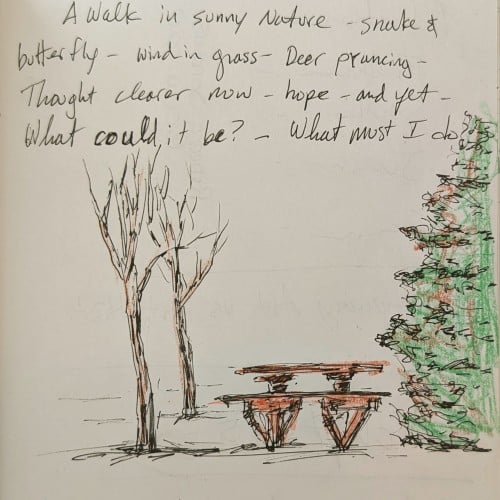
I walked until I found a picnic table
beneath a canopy of bare-limbed trees,
branches like open hands waiting for green.
The blue spruces nearby—
stoic, unchanged, whispering that some things endure.
I sketched.
Not perfectly. Not for anyone’s praise.
Just a mark to say: I was here.
Alive in this in-between.
Waiting. Listening.
Not for leaves—
but for something truer than comfort.
Thank you for joining me in this small noticing.
A moment borrowed from the rush.
A table. A tree. A thought.
A gift.
Mark Twain (1835–1910)
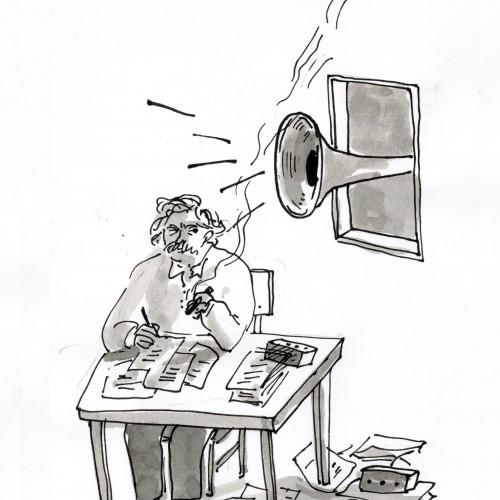
In the 1870s and ’80s, the Twain family spent their summers at Quarry Farm in New York, about two hundred miles west of their Hartford, Connecticut, home. Twain found those summers the most productive time for his literary work, especially after 1874, when the farm owners built him a small private study on the property. That same summer, Twain began writing The Adventures of Tom Sawyer. His routine was simple: he would go to the study in the morning after a hearty breakfast and stay there until dinner at about 5:00. Since he skipped lunch, and since his family would not venture near the study—they would blow a horn if they needed him—he could usually work uninterruptedly for several hours. “On hot days,” he wrote to a friend, “I spread the study wide open, anchor my papers down with brickbats, and write in the midst of the hurricane, clothed in the same thin linen we make shirts of.”
Whether or not he was working, he smoked cigars constantly. One of his closest friends, the writer William Dean Howells, recalled that after a visit from Twain, “the whole house had to be aired, for he smoked all over it from breakfast to bedtime.”
- From Daily Rituals: How Artists Work by Mason Currey
“Everyone is a moon, and has a dark side which he never shows to anybody.”
― Mark Twain
#dailyrituals #inktober #MarkTwain @masoncurrey
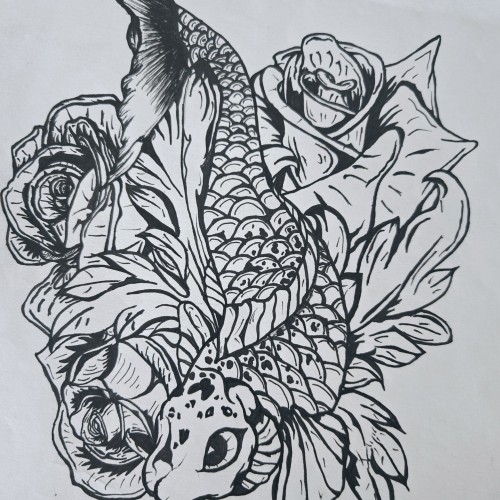
"Pisces Koi" is a bold and intricate black-and-white ink piece that blends symbolism with fluid motion. A koi fish, known for its resilience and transformation, weaves through a bed of blooming roses, creating a contrast between movement and stillness. The fine details in the scales and petals bring depth, making the composition feel alive.
The upward motion of the koi echoes the legend of perseverance—where a koi swimming upstream becomes a dragon—mirroring the Pisces spirit of adaptation and ambition. The roses introduce another layer, possibly symbolizing beauty, personal growth, or challenges that shape us.
This piece captures a sense of quiet strength and fluidity, speaking to those drawn to themes of transformation, water energy, and the balance between struggle and grace.
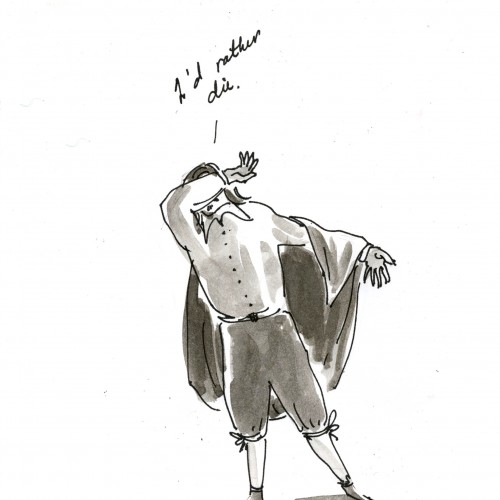
René Descartes (1596–1650)
Descartes was a late riser. The French philosopher liked to sleep until mid-morning, then linger in bed, thinking and writing, until 11:00 or so.
His comfortable bachelor’s life ended abruptly in late 1649, Descartes accepted a position in the court of Queen Christina of Sweden.
Descartes accepted a position in the court of Queen Christina of Sweden,Arriving in Sweden, in time for one of the coldest winters in memory, Descartes was notified that his lessons to Queen Christina would take place in the mornings—beginning at 5:00 A.M. He had no choice but to obey. But the early hours and bitter cold were too much for him. After only a month on the new schedule, Descartes fell ill, apparently of pneumonia; ten days later he was dead.
- From Daily Rituals: How Artists Work by Mason Currey
“Dubito, ergo cogito, ergo sum.
(English: "I doubt, therefore I think, therefore I am")”
― Rene Descartes
#dailyrituals #inktober #reneDescartes @masoncurrey #wouldratherdiethangetupearly
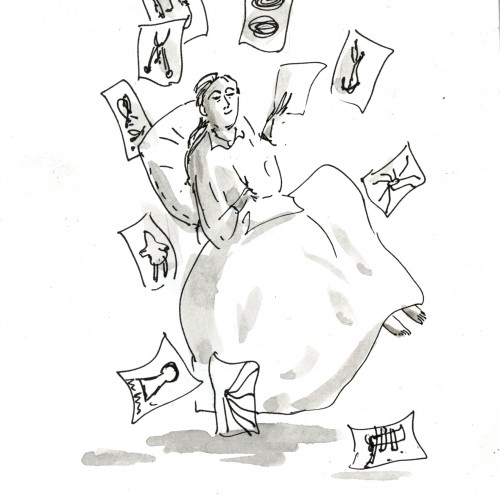
Louise Bourgeois (1911–2010)
“My life has been regulated by insomnia,” Bourgeois told an interviewer in 1993. “It’s something that I have never been able to understand, but I accept it.” Bourgeois learned to use these sleepless hours productively, propped up in bed with her “drawing diary,” listening to music or the hum of traffic on the streets.
“Each day is new, so each drawing—with words written on the back—lets me know how I’m doing,” she said. “I now have 110 drawing-diary pages, but I’ll probably destroy some.
- From Daily Rituals: How Artists Work by Mason Currey
“I am not what I am, I am what I do with my hands...”
― Louise Bourgeois
“Every day you have to abandon your past or accept it, and then, if you cannot accept it, you become a sculptor.”
― Louise Bourgeois
#dailyrituals #inktober #LouiseBourgeois @masoncurrey
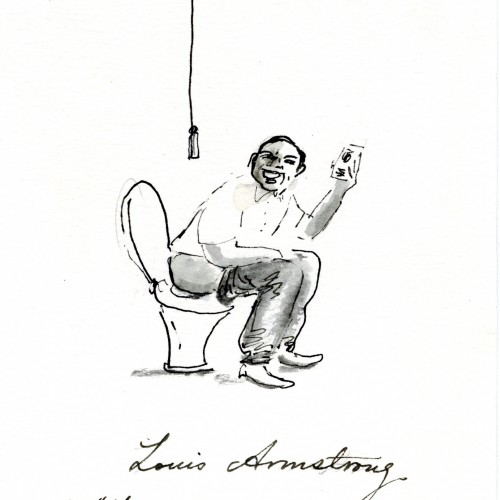
Louis Armstrong (1901–1971)
Armstrong relied on music to lull himself to sleep. Before he could get into bed, however, he had to administer the last of his daily home remedies, Swiss Kriss, a potent herbal laxative invented by the nutritionist Gayelord Hauser in 1922 (and still on the market today). Armstrong believed so strongly in its curative powers that he recommended it to all his friends, and even had a card printed up with a photo of himself sitting on the toilet, above the caption “Leave It All Behind Ya.”
- From Daily Rituals: How Artists Work by Mason Currey
“All music is folk music. I ain't never heard a horse sing a song.”
― Louis Armstrong
#dailyrituals #inktober #LouisArmstrong @masoncurrey
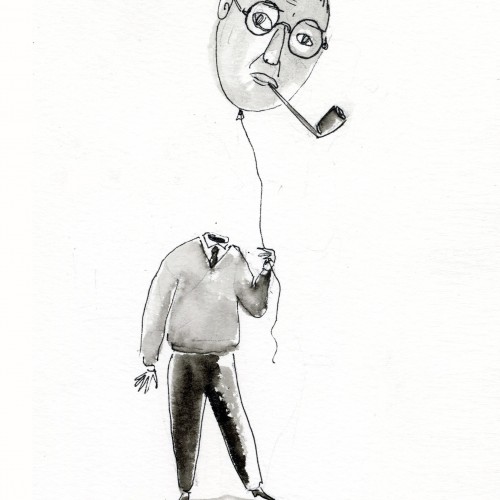
Jean-Paul Sartre (1905–1980)
By the 1950s, too much work on too little sleep—with too much wine and cigarettes—had left Sartre exhausted and on the verge of collapse. Rather than slow down, however, he turned to Corydrane, a mix of amphetamine and aspirin then fashionable among Parisian students, intellectuals, and artists (and legal in France until 1971, when it was declared toxic and taken off the market). The prescribed dose was one or two tablets in the morning and at noon. Sartre took twenty a day, beginning with his morning coffee and slowly chewing one pill after another as he worked. For each tablet, he could produce a page or two of his second major philosophical work, The Critique of Dialectical Reason.
The biographer Annie Cohen-Solal reports, “His diet over a period of twenty-four hours included two packs of cigarettes and several pipes stuffed with black tobacco, more than a quart of alcohol—wine, beer, vodka, whisky, and so on—two hundred milligrams of amphetamines, fifteen grams of aspirin, several grams of barbiturates, plus coffee, tea, rich meals.”
- From Daily Rituals: How Artists Work by Mason Currey
#dailyrituals #inktober #jeanPaulSartre @masoncurrey
Teddy Bear's Change of Seasons - Sophie's Christmas included!
Is beautifully written and illustrated, Teddy Bear’s Change of Seasons includes four charming stories, wonderfully rolled into one children’s novel.
Teddy Bear and his friends create magical ways to explore and learn about the snow-white, wonderful world they live in, which changes from summer to autumn and into an unforgettable Christmas.
Teddy’s journey of self-discovery through four seasons, Christmas included, begins in a magnificent old-growth forest, but Teddy is stuck inside a dark and lonely place.
His dreams look far away and out of reach, until Teddy rescues a small mouse, who is desperate for help.
From this one act of kindness, Teddy's life changes in ways he never imagined, bringing him close friends, a new loving family and the kind of challenges and adventures other teddies have never encountered before.
This is a dream of a book, the perfect snuggle-down bedtime story, accompanied by hot, sleepy cocoa.
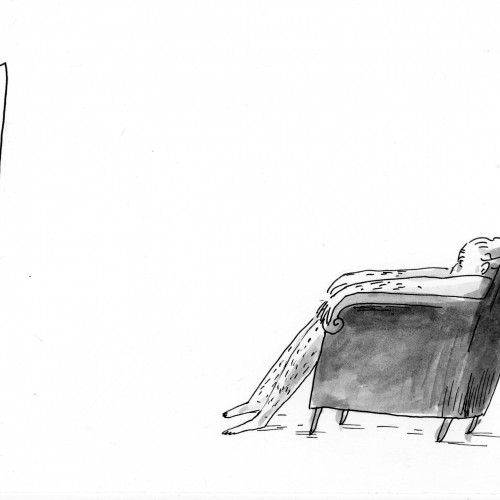
Benjamin Franklin (Part 2)
The plan worked, up to a point. After following the course several times in a row, he found it necessary to go through just one course in a year, and then one every few years. But the virtue of order—“Let all your things have their places; let each part of your business have its time”—appears to have eluded his grasp. Franklin was not naturally inclined to keep his papers and other possessions organized, and he found the effort so vexing that he almost quit in frustration.
This timetable was formulated before Franklin adopted a favorite habit of his later years—his daily “air bath.” At the time, baths in cold water were considered a tonic, but Franklin believed the cold was too much of a shock to the system. He wrote in a letter: I have found it much more agreeable to my constitution to bathe in another element, I mean cold air. With this view I rise early almost every morning, and sit in my chamber without any clothes whatever, half an hour or an hour, according to the season, either reading or writing. This practice is not in the least painful, but on the contrary, agreeable; and if I return to bed afterwards, before I dress myself, as sometimes happens, I make a supplement to my night’s rest, of one or two hours of the most pleasing sleep that can be imagined.
From Daily rituals by Mason Currey
#daulyrituals #inktober #benjaminfranklin @masoncurrey
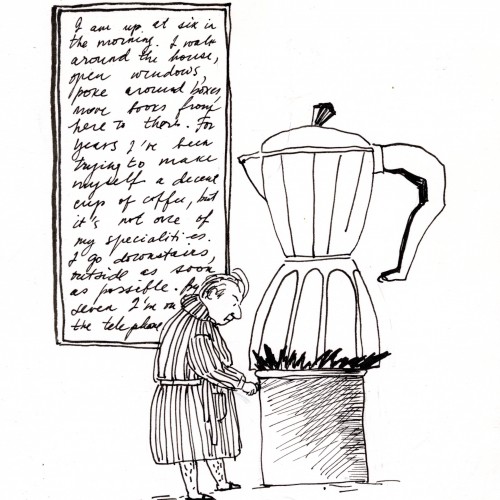
FEDERICO FELLINI
In a 1977 interview, he described his morning routine:
I'm up at six in the morning. I walk around the house, open sindows, poke around boxes. move books from here to there. For years I've been trying to make myself a decent cup if coffee, but it's not one of my specialties. I go downstairs, outside as soon as possible. By seven I'm on the telephone.
- Daily rituals by Mason Curry.
#inktober #masonCurry #federicofellini #dailyritual
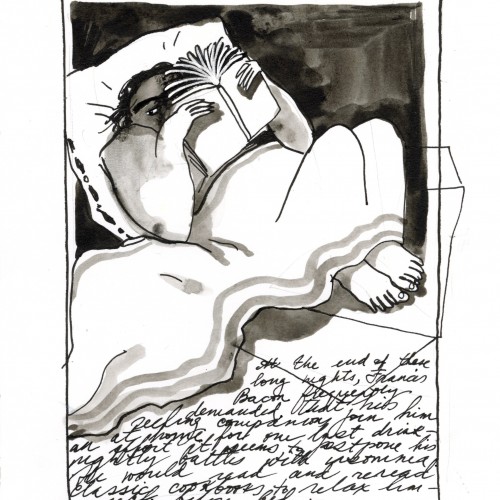
I was feeling listless about this inktober until I picked up Daily Rituals : How artists work by Mason Currey. I immediately knew that I want to do these portraits for the inktober.
FRANCIS BACON.
At the end of these long nights, Bacon frequently demanded that his reeling companions join him at home for one last drink - an effort, it seems, to postpone his nightly battles with insomnia. Bacon depended on polls to get to sleep, and he would read and reread classic cookbooks to relax himself before bed.
#inktober #portraits #francisBacon
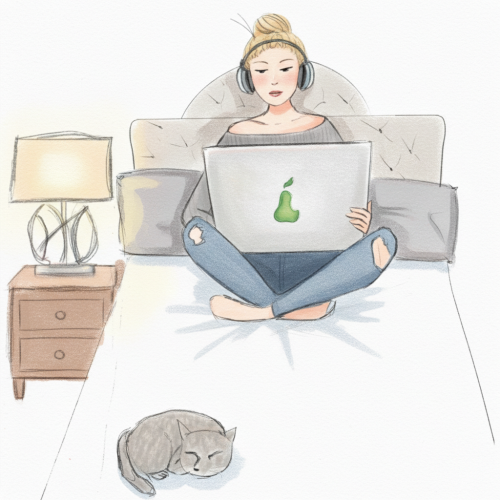
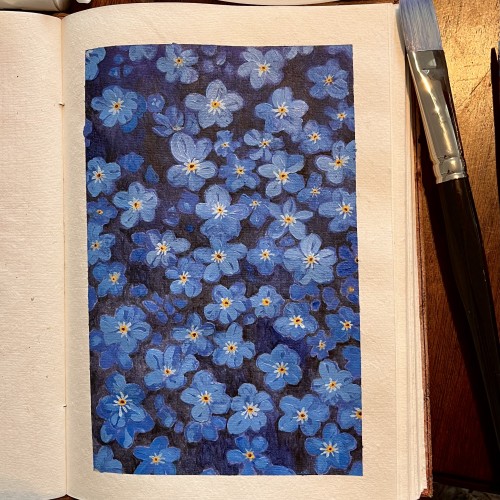
Hopefully the colors on this one are as bright as they look on my phone! I've been using Pixilart to relax before bed, and it's been a great way to mess around with color and texture.