Title: The Game
Medium: Acrylic Paint on canvas.
Size:24” W x 36” H x1” D
Year Completed:2026
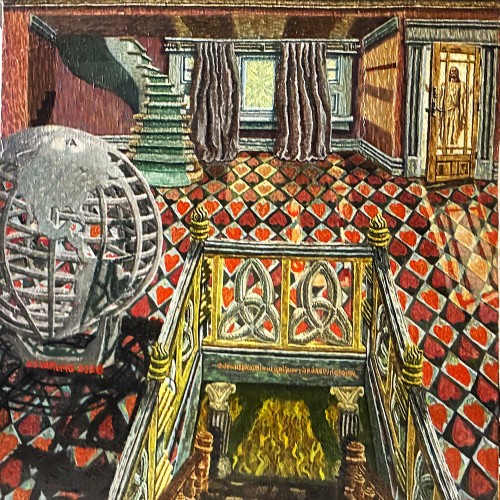
The first conceptual design for this painting is an ink rendering entitled: The Window of The Soul. The inspiration behind the design is the concept that Christians are supposed to be windows that God’s light can shine through. But the Christian sin nature can block that light from filling a room. The same way window drapes do.
In the design the soul is represented as the inside of a house. The stair going down represent Hell. The stair going up to the second floor represent Heaven.
The stairs going up to the second floor have no railings, this show that the assentation of the stairs must be made by faith.
The Stairs leading down to the basement has a protective railing around it, representing that God is not willing that anyone should perish, but to repent from sin.
The Trinity of God is represented by the cultic three Leif flower that is part of the railing that surrounds the subsurface stair well.
The second inner railings represent man-controlled descent. No one fall accidently into Hell. People move closer to Hell with every action of rejection toward God they make.
The world globe represents, all humanity needs to decide who they are living for. There is no neutral ground.
The checked board floor pattern illustrates this reality, the black spaces with the upside-down heart points to Hell. While the white space with the upright heart point to Heaven.
The open door with Jesus standing on the outside, represents the need for a savior. Humanity is separated from the direct presence of God, due to their sin nature.
God can not stand the presence of anarchy, when Lucifer leaded an armed revolt against God’s Lordships, after he and third of the angel lost the battle, God created Hell , a place of internal punishment, where the enemies of God will dwell.
God had warned humanity, that the day they disobey God, they will surely die. So out of compassion God sent His Son to fulfill the righteousness required by God’s Holiness.
Jesus lived a life 33 years without sinning, even though He was temped as we are tempted.
God’s son was then treated like a criminal, beaten with in an inch of His life, then took the place on the cross as a substitute for a murder and thief named Barabbas.
God poured out His wrath on His son, so through faith the unrighteous can be forgiven and made righteous. By putting their faith in God’s savior, and turning from their old rebellious living, and walking in the newness of His Holly Spirit.
The second floor is supposed to represent the entrance to the kingdom of Heaven.
The lion’s heads in the wallpaper proclaim that Jesus who came the first time as a sacrificial lamb, is now coming as the conquering lion. The open door with the cross on it is the entrance to Heaven.
The railing on the second floor with the fish standing on their tail with a cross in the mild of them represent the support of the body of Christ during the Earthly journey toward Heaven.
Temptation of the world are represented by the Victorian wooden staircase and fancy rug, the roman columns. The Greek saying on the headier: Eat, Drink, he merry, for tomorrow we die.
Stephen J. Vattimo 8/27/2026