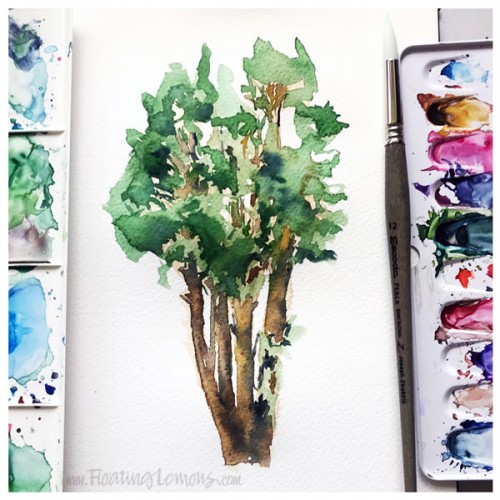
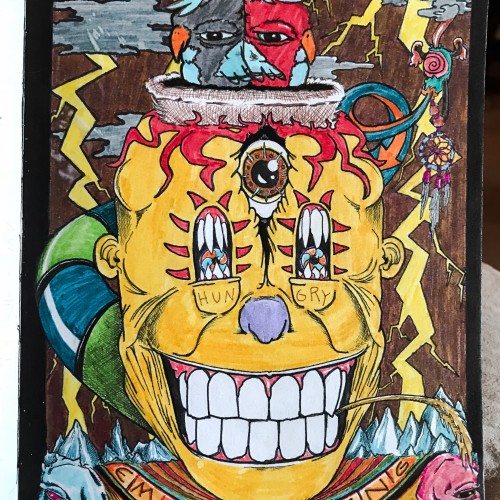
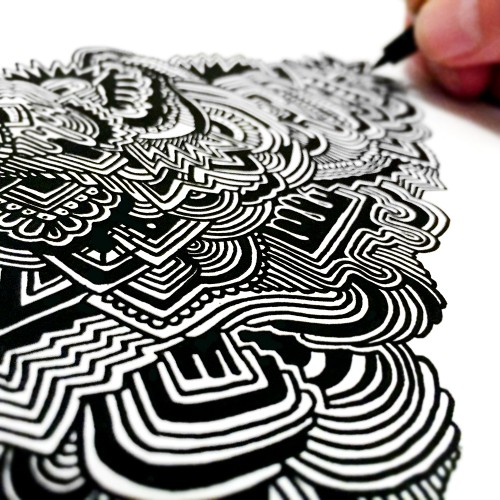
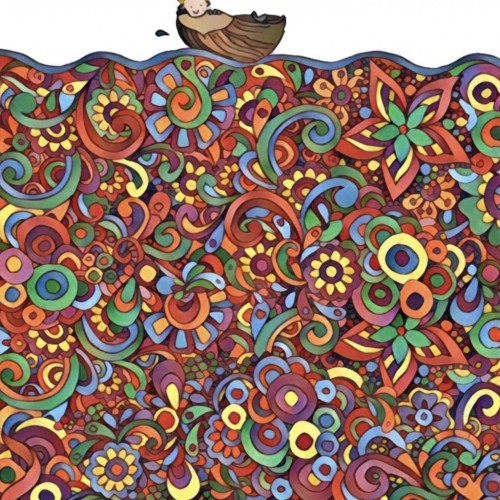
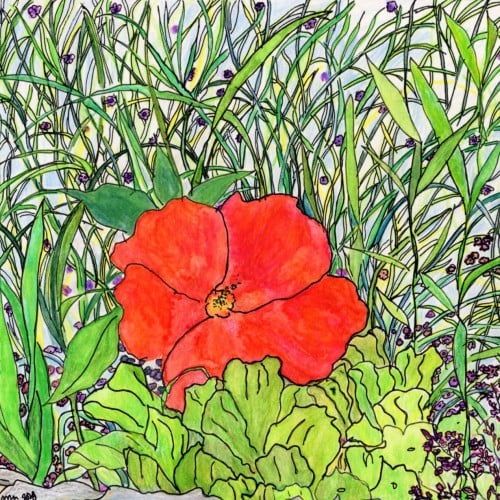
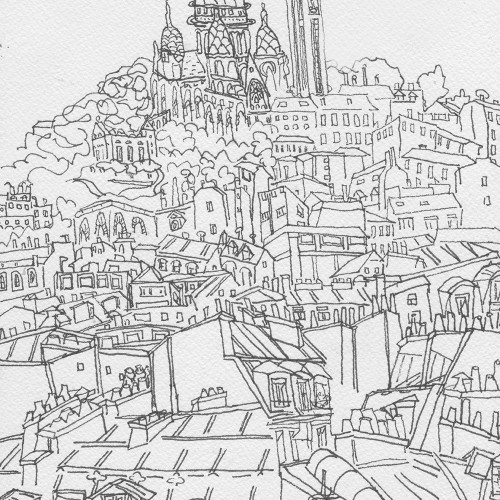
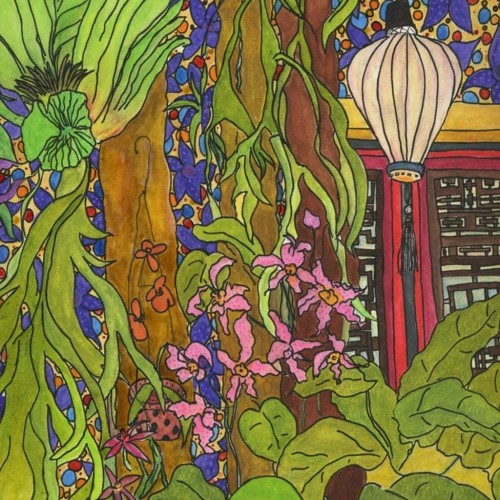
I don't normally paint trees. So I was surprised when my daily doodling produced this loose interpretation of the tree in my garden. I quite like it. Doodles are magical.
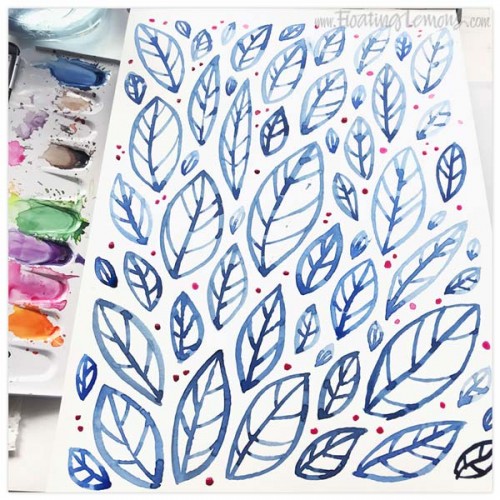
love the go with the flow doodle mentality. I call it "Randomness". It's a great practice to help you start and gives a great feeling of complete freedom, and that's what doodlin' for me mostly is about. I sometimes use this randomness to create peace of mind, new ideas, creative flow, clearity, vision, dreams or great art! :)
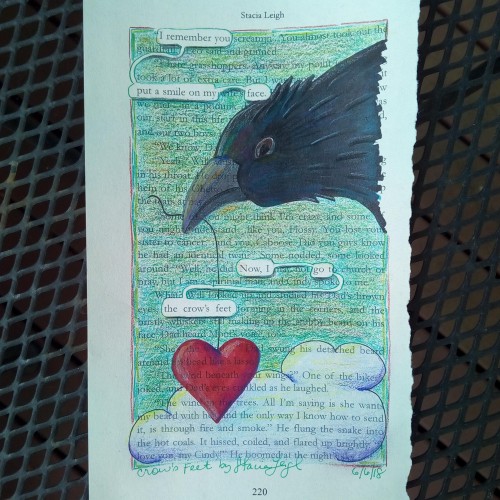
"I remember you put a smile on my face. Now I got the crow's feet." ~ A blackout poem from a recycled page of Burnout, an Young Adult adventure/romance story.
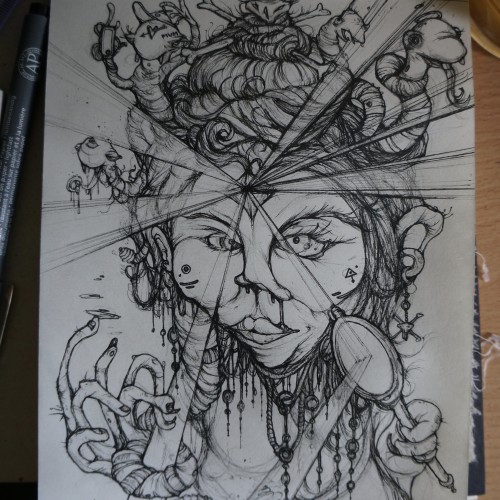
i feel to much focus is put on faces being to aesthetically perfect, or perfection in the media approach to what thats perceived to be. i enjoyed drawing a more imperfect edge to it and the use of the light beams was a cool thing to draw. the meaning was a look at self -adulation and the clamour for attention through various social platforms, being valentines day as well i feel to many people fall into that trap what promotes nothing more than a money making event. this helped form the title of "seduce her" using a medusa as a subject matter.
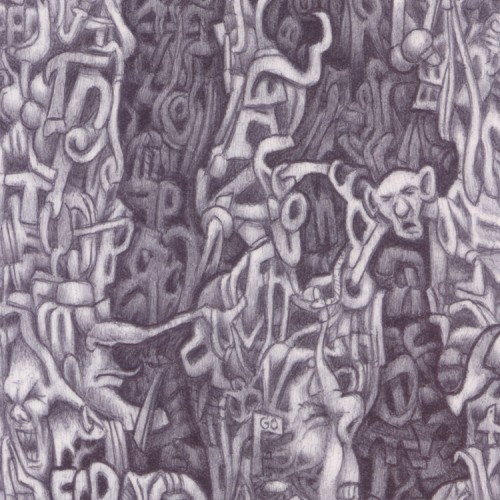
(Black biro on a 139mm x 89mm postcard). Another dreamscape piece that uses automatic drawing techniques to produce random imagery. I was going to call this one "bloodlines" due to the shaded central areas which developed, but the lettering in the bottom-left corner began to take shape and so I highlighted them and used them as the title.
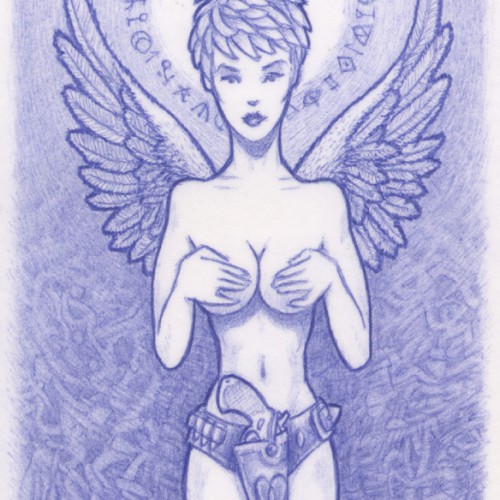
(Blue biro on 125mm x 75mm notecard) A third in the guardian spirit works that I've done. When it comes to these kind of things, who wouldn't prefer a pistol-packing angel like that?
A reminder to myself:
On rough days when I feel lost, rudderless, overwhelmed or without direction, I like to remind myself that my track record for getting through tough times is 100% so far. And that’s pretty darn good in the scheme of things.
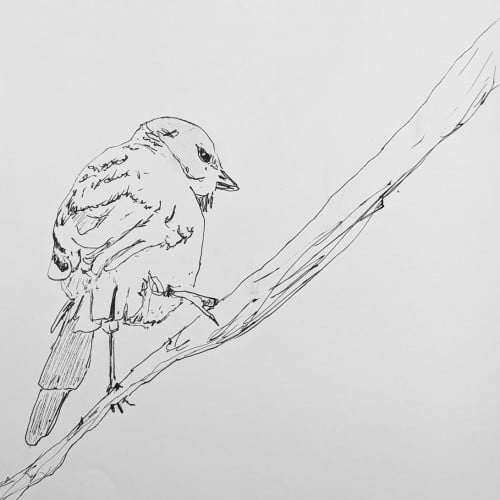
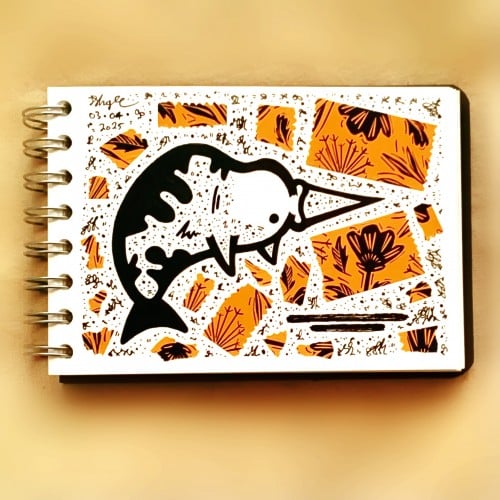
A simple ink sketch of a bird at rest. Sometimes the quiet moments—watching, pausing, waiting—are the deepest teachers. This drawing is part of my exploration of what I call the Quiet Practices—small ways of living from the inside out.
If you’d like to see more of my reflections, I share them here: https://forming20.com/
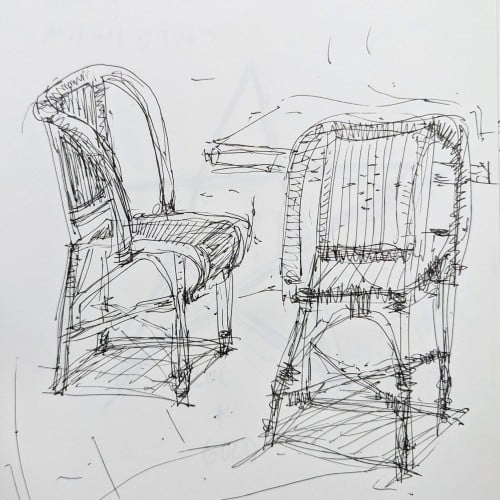
Two wicker chairs in the sun.
One for the waiting,
one for the hoped-for.
The table between them
holds its silence,
its place set for bread or talk.
I draw what is here—
lines quick and unerasable—
and what is not here,
her presence,
waits with me in the white of the page.
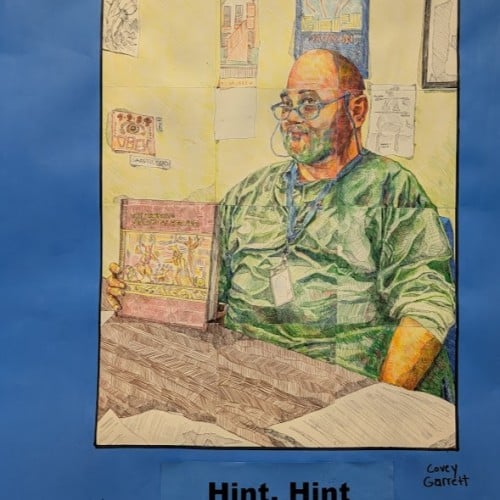
This portrait of Mr. Joshua Anderson—our resident Shakespeare whisperer—was drawn by student artist Covey Garrett as part of a school-wide tribute to our teachers. Students photographed, gridded, and drew 18x24” posters of their teachers, each paired with a favorite catchphrase. Mr. Anderson’s? A classic:
“Hint, hint. Wink, wink. Nudge, nudge.”
We think the Bard would approve.
"All the world's a stage, and all the men and women merely teachers..."
(okay, we may have paraphrased a bit).
A Brief Pause at the Edge of Becoming
It seems I am always seeking a place to sit—
not just to rest the body,
but to settle the soul.
Yet even in stillness, Gary Brecka’s words whisper:
“The quickest way to old age
is the aggressive pursuit of comfort.”
So I do not stay long.
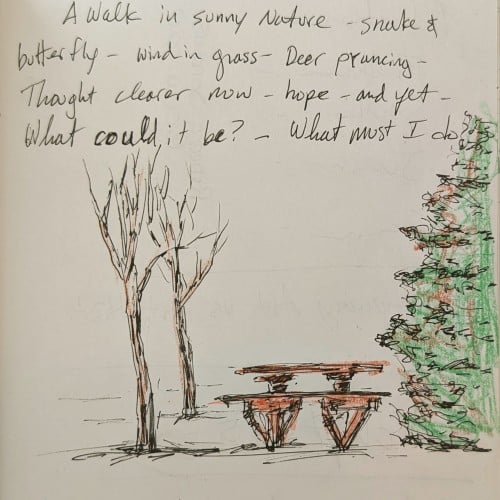
I walked until I found a picnic table
beneath a canopy of bare-limbed trees,
branches like open hands waiting for green.
The blue spruces nearby—
stoic, unchanged, whispering that some things endure.
I sketched.
Not perfectly. Not for anyone’s praise.
Just a mark to say: I was here.
Alive in this in-between.
Waiting. Listening.
Not for leaves—
but for something truer than comfort.
Thank you for joining me in this small noticing.
A moment borrowed from the rush.
A table. A tree. A thought.
A gift.
It has been a delight to share with my students the incredible resource of people. Over the years, I’ve had the great privilege of connecting them with inspiring individuals such as Lois Ehlert, Dave Nice, Gregory Martens, Colette Odya Smith, and—as seen in this “Behind the Professor” sketch—Dr. Gaylund Stone. There’s something powerful about the presence of someone who lives their craft with humility and depth. In moments like these, my students are reminded that more is often caught than taught.
I am an art teacher with a master’s degree—trained by brilliant professors who believed that art could do more than decorate walls. I offer safe spaces for teenagers to grow—nourishing soil where their imaginations can take root.
And yet… I am assigned to hallway duty.
This is compulsory education, after all.
So I sit—posted like a sentinel—watching young lives stream past.
“Get to class,” I say with a smile and a nudge.
The system wants attendance; I’m hungry for presence.
Armed not with a whistle or clipboard, but with a pen—
my scribble’s soft insurgency.
The hallway stretches out like a geometric hymn.
Columns and corners chant structure.
Teenagers swirl past—half-formed galaxies of limbs and laughter—
their orbits chaotic, their gravity pulling time forward.
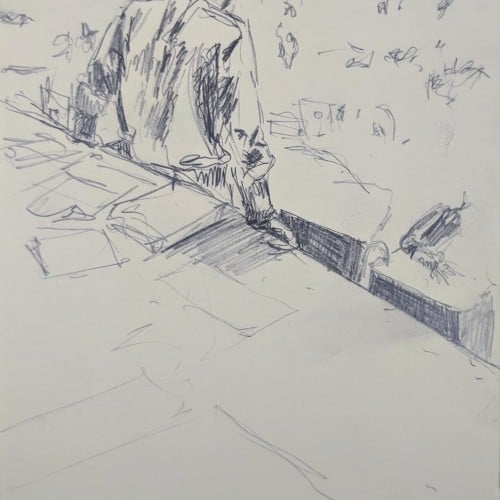
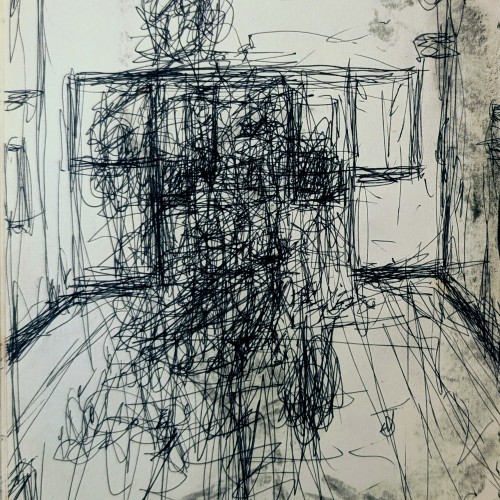
I begin to draw.
Not their tardiness, but their motion.
A shoulder. A blur of sneakers.
A tilted head chasing freedom.
Feet flickering like seconds.
Each mark a pulse.
Each smudge a breath.
My paper becomes a seismograph of seeing—
trembling gently through the mundane.
This isn’t about making art for a frame or a feed.
It’s about refusing to leak away in the fluorescent hum of obligation.
It’s a quiet mutiny against the clock.
I do this on long car rides, too (passenger side, mind you).
Letting the lines grow wild, jagged, and unapologetic.
Not for polish—
but for presence.
This is how I remember I’m still alive.
Still growing.
Still watching.
Still choosing to see.
Because sometimes mental health looks like
a piece of scrap paper,
a moving pen,
and the simple, sacred act of
marking time with wonder.
There’s a lot of waiting in life.
Waiting in lobbies.
Waiting on answers.
Waiting for braces to tighten, kids to grow, hearts to heal, or prayers to be answered.
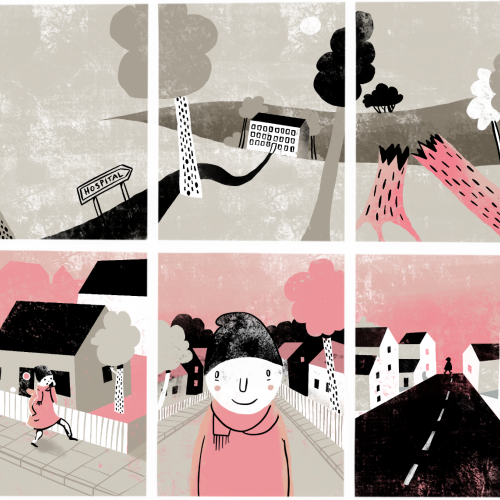
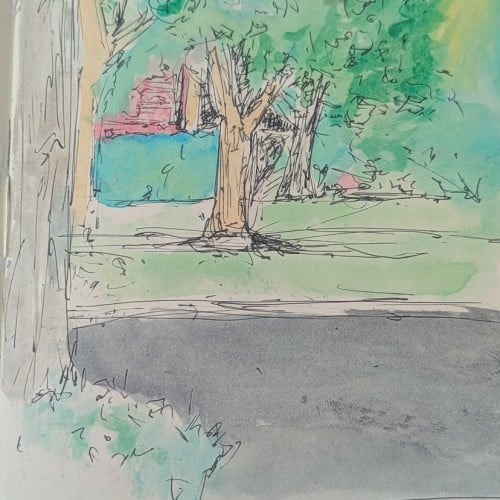
I sat at the orthodontist, watching dollars tighten on tiny wires, and made this sketch. A tree. A house. A street. Color helped the moment breathe.
I remember once hearing a chess master say, “There is no waiting in chess.”
It confused me—wasn’t there always a turn to wait for?
But he explained: “There’s no waiting. Only planning. Plotting. Analyzing. You’re always thinking.”
I once repeated that to a FIDE master. He got mad.
Maybe because waiting and patience aren’t the same thing.
We can be still and deeply active inside.
We can pause without being passive.
And then there’s Lindsey’s voice in the back of my head:
“That sounds like a first-world problem.”
“Speak life.”
“Be thankful. Rejoice always.”
And she’s right.
So here’s to filling waiting time with something creative.
Something kind.
Something that turns a delay into a doorway.