Previous
Next
logo logo
logo logo
  • Discover Art
    • Trending
    • Most Recent
    • Most Faves
    • Most Views
    • Curated Galleries
  • Drawing Challenges
    • See All Challenges
  • Drawing Prompts
  • Artists
    • Most Popular
    • Most Recent
    • Available For Hire
    • Artist Spotlight
  • More
    • Marketplace
    • Art Discussions
    • Resources
    • News + Blog
Login
Most Views
Select an option
  • Most Relevant
  • Most Faves
  • Most Views
  • Most Comments
  • Most Recent
SEARCH RESULTS FOR

structure

Susan Schanerman Susan Schanerman
Enlarge
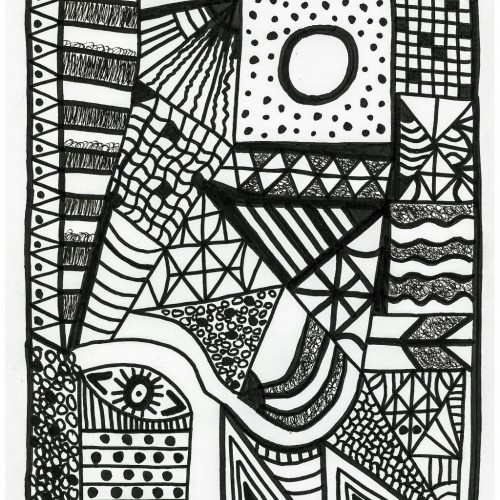
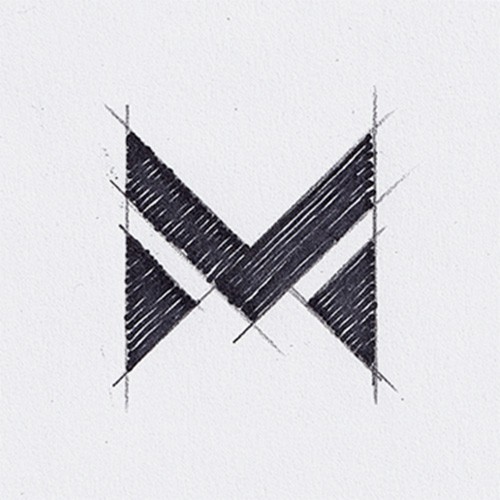
Significance And Structure

This 11" x 14" bold, dynamic, geometric abstract makes a unique statement. Lines and curves, angles and shapes in stark black and white convey the arbitrary, yet methodical . . . random, yet systematic nature of the universe . . . and our lives.

  • 1,637
  • 1
  • 0
OKAT OKAT Plus Member
Enlarge
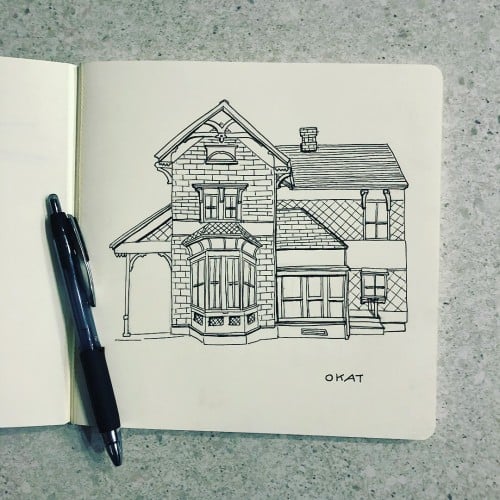
Meditation
1/3

Drawing homes is my new form of meditation. I get lost in building the structure slowly, line after line. I could do this forever...

  • 1,290
  • 37
  • 1
Kathrin Rödl Kathrin Rödl
Enlarge
Untitled

Abstract Exploration, Structure

  • 779
  • 0
  • 0
Jeff Syrop Jeff Syrop Plus Member
Enlarge
Macrocosm
1/2

Macrocosm: the whole of a complex structure, especially the world or the universe. Acrylic on wood panel.

  • 366
  • 3
  • 0
Derek Lowes Derek Lowes
Enlarge
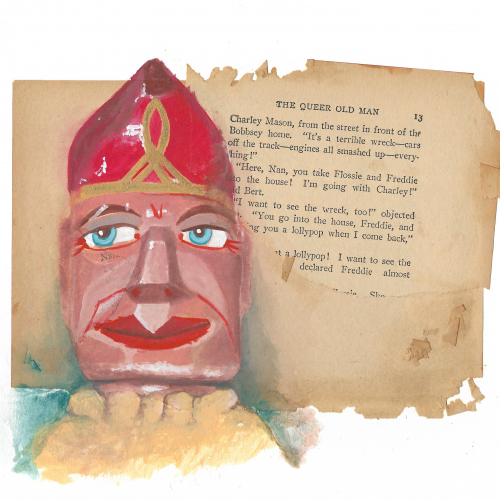
The Queer Old Man

The Queer Old Man is a solid wood puppet head created more than 50 years ago if not more. The eyes of the character are a radiant blue and the carved structure of the face is expressive and bold.

  • 333
  • 5
  • 0
Neil Tackaberry Neil Tackaberry
Enlarge
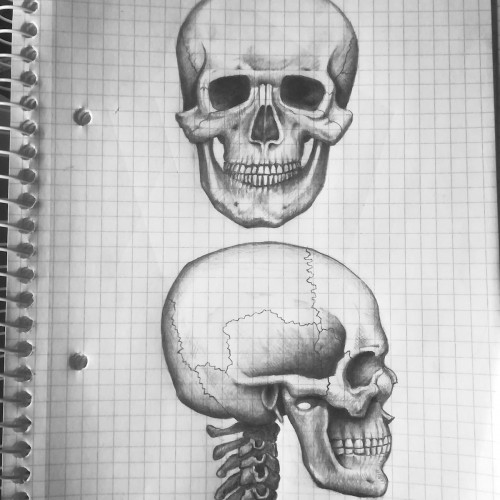
Skull Study

Anatomy practice - skull study. Graphite pencil on notebook paper, (size A5).

  • 330
  • 12
  • 2
Joselo Rocha Joselo Rocha
Enlarge
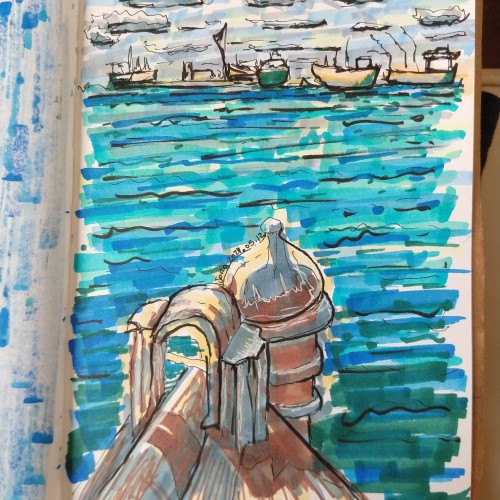
Serene Waterscape in San Juan de Ulua, Veracruz

A serene coastal scene with a building structure in the foreground on a colorful blue water body, likely a canal or lagoon. In the background, there are boats floating on the water under a cloudy sky.

  • 270
  • 5
  • 0
Mariana H Mariana H
Enlarge
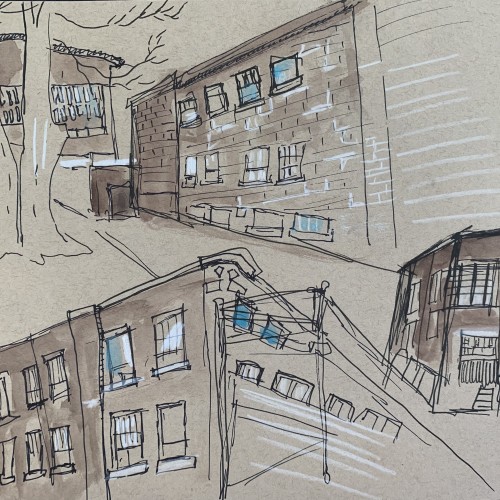
Toronto Heritage Building ‘The Foundry’

Toronto the city is fighting to save Heritage buildings from demolition, they are already on a heritage site called The Distillery District. The current premier of Ontario is corrupt and get financial backing from developer friends, to sell off important pieces of Ontario land., without any public consultation. The situation is currently being fought for by the community through estate lawyers.

  • 247
  • 1
  • 0
Background Processing Background Processing
Enlarge
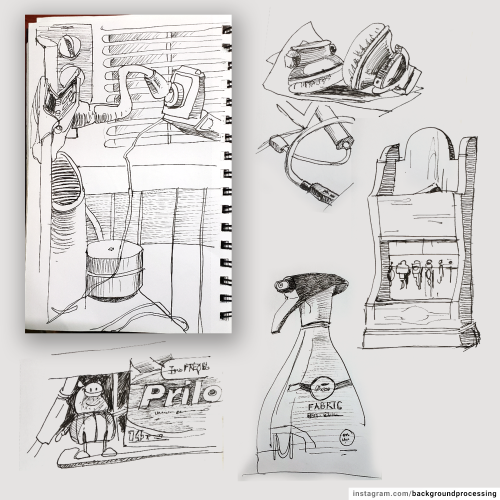
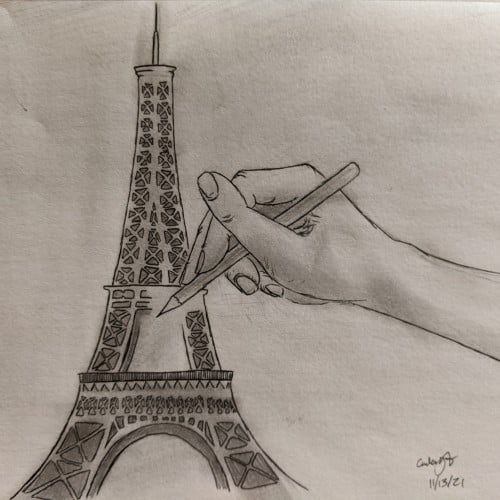
From sketchbook... stuff from life... trying to draw without pencil first for structure

Sketchbook nonsense

  • 232
  • 5
  • 0
NAJ NAJ
Enlarge
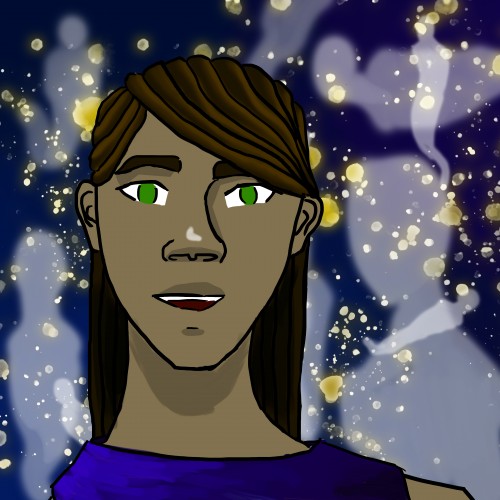
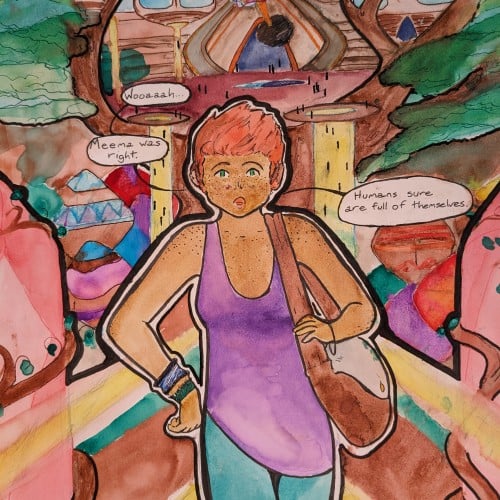
Willow Taylor (OC)

Willow's an oc of mine... she's very quirky. She's better suited to hanging out with the dead than the living. Also, super open to tips on this one because, as a beginner, I'm not amazing at diverse people. Like, black people have different facial structures and hair. Asian people have different facial structures and hair. So if I got something wrong, I'm open to redrawing that part. Just lmk.

  • 206
  • 3
  • 6
Dean C. Graf Dean C. Graf Plus Member
Enlarge
Passing Marks

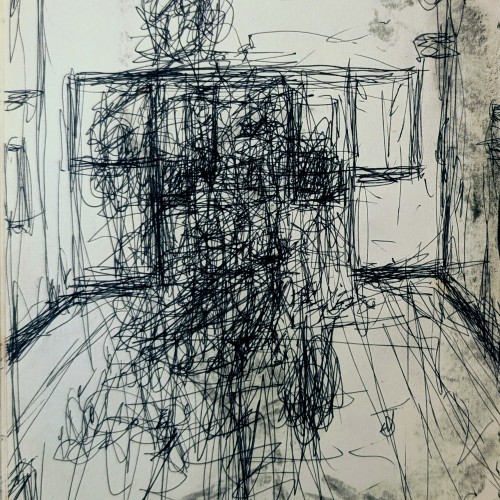
I am an art teacher with a master’s degree—trained by brilliant professors who believed that art could do more than decorate walls. I offer safe spaces for teenagers to grow—nourishing soil where their imaginations can take root. And yet… I am assigned to hallway duty. This is compulsory education, after all. So I sit—posted like a sentinel—watching young lives stream past. “Get to class,” I say with a smile and a nudge. The system wants attendance; I’m hungry for presence. Armed not with a whistle or clipboard, but with a pen— my scribble’s soft insurgency. The hallway stretches out like a geometric hymn. Columns and corners chant structure. Teenagers swirl past—half-formed galaxies of limbs and laughter— their orbits chaotic, their gravity pulling time forward. I begin to draw. Not their tardiness, but their motion. A shoulder. A blur of sneakers. A tilted head chasing freedom. Feet flickering like seconds. Each mark a pulse. Each smudge a breath. My paper becomes a seismograph of seeing— trembling gently through the mundane. This isn’t about making art for a frame or a feed. It’s about refusing to leak away in the fluorescent hum of obligation. It’s a quiet mutiny against the clock. I do this on long car rides, too (passenger side, mind you). Letting the lines grow wild, jagged, and unapologetic. Not for polish— but for presence. This is how I remember I’m still alive. Still growing. Still watching. Still choosing to see. Because sometimes mental health looks like a piece of scrap paper, a moving pen, and the simple, sacred act of marking time with wonder.

  • 155
  • 6
  • 3
Stephen Stephen
Enlarge
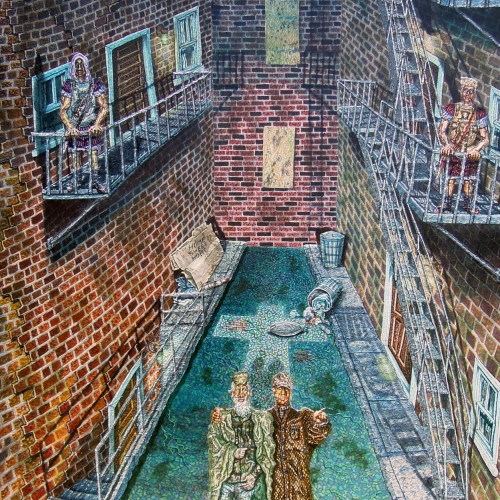
The Three Witnesses

TheStephen Vattimo 7 mins The Three Witnesses Acrylic on Canvas Size :48"x68" Year finished: 2004-14 This painting illustrates three witnesses who are taking part in the salvation of a homeless person. the figure in the background is angled, this imposed by them being Positioned on second-floor balconies, symbolizing they are not humans, they are a higher class of beings. To the left side of the painting a demon and to the right side an angel of God . the kingdoms they serve are identified by the breastplate emblems of their armor. The demon has a dragon head overlaid on a pentagram. The angle of God has a lions head overlaid on a cross. The demon face is partly hidden by a hood which represents deception, where in contrast the angle of God is wearing nothing on his head that hiders the view of his face., representing honest. Angel is always involved in the affairs of the human race. The demon is warring against man to turn their heart against God, and lead them to destruction. God's angel is always warring lead mankind to salvation through Jesus the Christ, and lead him away from the path of destruction that comes from sinful living. The ally way is representing three kingdoms, to the left, the kingdom o Hell. The center road, the kingdom of mankind. To the right side, the kingdom of Heaven. The path of these kingdoms is represented by the direction of stairs. To go the way of Hell is to take the stairs down to the sub-level door. To the go, the way of heaven is to take the fire escape upward. The lighting and the condition of the structures of the walls also identify the nature of the kingdoms they represent. The kingdom of Hell is represented by the dark and crumbling wall. Man's kingdom is represented by a boarded up windowed wall that is a dead end. Symbolizing that mankind only has two roads to chose from, there is no such thing as a third reality. The left side of the paint is a cardboard box and a newspaper floor which serve as a makeshift shelter for the homeless man. The turned over bottle reveals which devise he had that lead him to a life of living in the street. The tipped over trash can which spills its trash onto the light source that is lighting the alleyway, which is in the shape of a cross, represents mankind's sin which Jesus The Christ paid in full the debt which God demand for the payment for sin which is death. So that The guiltless took the place of the guilty, that by faith in this truth all will escape Hell and enter the Kingdom of God as children and heirs of The Highest God. The Homeless man, who is dirty,ill-clothed, cold, tired, hungry, hopeless, symbolizes the condition of Mankind outside a flourishing relationship with God. The Christian witness is better dressed implying he is walking with God, and his life is blessed through God provision. The witness is showing compassion and the love of Christ to this homeless man by wrapping his arm around the shoulder of the dirty smelly homeless man. He points the homeless man in the direction of the path that leads to salvation through faith in the work of Jesus The Christ which is His work on the Cross, receive Jesus as his Lord and Savior. That through a relationship with the Christ, He can receive the guidance, the strength, the willpower to leave his old life of being a drunkard and living in the street. Because in Christ old thing pass away, and all thing are made new. The light that falls on the Christian witness and the homeless man and opens up in the shape of the cross in the alleyway, comes from a heavenly source outside the picture. Written by Stephen J.Vatttimo June 16, 2014

  • 125
  • 4
  • 0
Dean C. Graf Dean C. Graf Plus Member
Enlarge
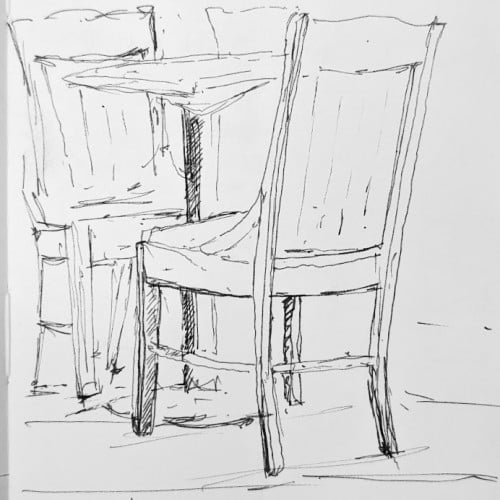
Five Chairs, Holding Space
1/3

Chairs are more than wood or iron. They are metaphors, quiet keepers of what it means to be present. They wait, as Wendell Berry might say, for us to “make a place to sit down. Sit down. Be quiet.” I draw them because they embody the humblest love—affection, as Berry calls it, that “gives itself no airs.” In their stillness, chairs hold the weight of relationships, the churn of thought, the grace of silence. They are where we meet, where we linger, where we become. These three drawings are offerings—sketches of chairs that invite connection, reflection, and the slow work of being. Each is a small sacred place, as Berry reminds us, not desecrated by haste or distraction, but alive with possibility. Drawing 1: The Coffee Shop Chairs Two wooden chairs face each other across a small round table in a coffee shop, their grain worn smooth by years of elbows and whispered truths. The table is a circle, a shape that knows no hierarchy, only intimacy. These chairs are for relationships that dare to deepen—for friends who risk vulnerability, for lovers who speak in glances, for strangers who become less strange. They ask for eye contact, for mugs of coffee grown cold in the heat of conversation. Here, sentences begin, “I’ve always wanted to tell you…” or “What if we…” These chairs shun the clamor of screens, as Berry urges, and invite the “three-dimensioned life” of shared breath. They are the seats of courage, where presence weaves the delicate threads of togetherness. Drawing 2: The Sandwich Café Chairs In a sandwich café, two wooden chairs sit across a small square table, its edges sharp, its surface scarred by crumbs and time. These chairs are angled close, as if conspiring. They are for relationships of a different timbre—perhaps the quick catch-up of old friends, the tentative lunch of colleagues, or the parent and child navigating new distances. The square table speaks of structure, of boundaries, yet the chairs lean in, softening the angles. They wait for laughter that spills over plates, for silences that carry weight, for the small confessions that bind us. These are chairs for the work of relating, for the patience that “joins time to eternity,” as Berry writes. They ask us to stay, to listen, to let the ordinary become profound. Drawing 3: The Patio Chair A lone cast-iron chair rests on a patio, its arms open to the wild nearness of nature—grass creeping close, vines curling at its feet, the air heavy with dusk. This chair is not for dialogue but for solitude, for the slow processing of thought. It is the seat of the poet, the dreamer, the one who sits with what was said—or left unsaid. Here, ideas settle like sediment in a quiet stream; here, the heart sifts through joy or grief. As Berry advises, this chair accepts “what comes from silence,” offering a place to make sense of the world’s noise. Its iron roots it to the earth, unyielding yet tender, a throne for contemplation where one might “make a poem that does not disturb the silence from which it came.” This is the chair for becoming, for growing older, for meeting oneself. These three chairs—one for intimacy, one for the labor of connection, one for solitude—are a trinity of relation. They are not grand, but they are true. They hold space for the conversations that shape us, the silences that heal us, the thoughts that root us. They are, in Berry’s words, sacred places, made holy by the simple act of sitting down. My drawings are but traces of these places—postcards from moments where we might remember how to be with one another, or how to be alone. So, pull up a chair. Or three. Sit down. Be quiet. The world is waiting to soften.

  • 106
  • 2
  • 0
Caden Hoyt Caden Hoyt
Enlarge
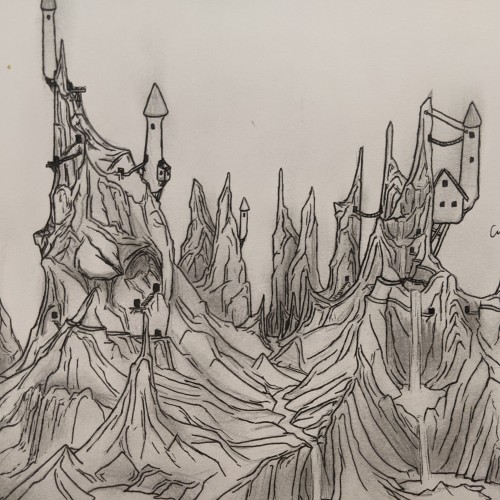
Mountain village

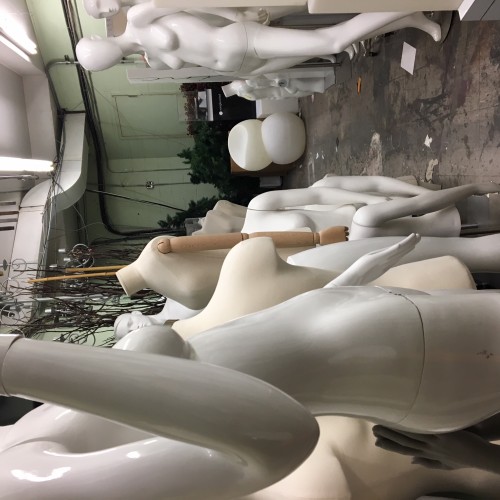
Just a little bit of rock formations and structures

  • 73
  • 5
  • 0
Caden Hoyt Caden Hoyt
Enlarge
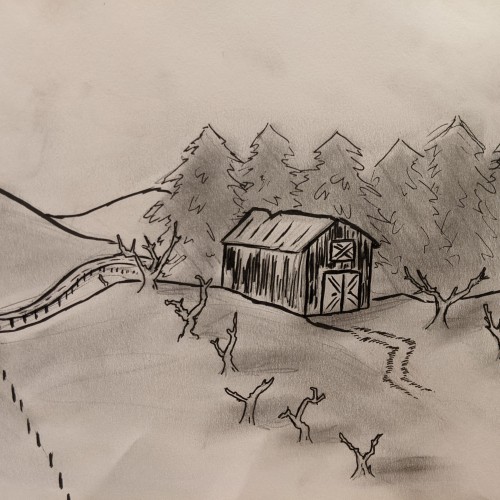
Old barn

Both buildings and trees are things I'd like to be better at... I'm going to have to branch out from leafless trees and decrepit structures eventually but for now the trees stay leafless

  • 63
  • 6
  • 0
Art Craft Land Art Craft Land
Enlarge
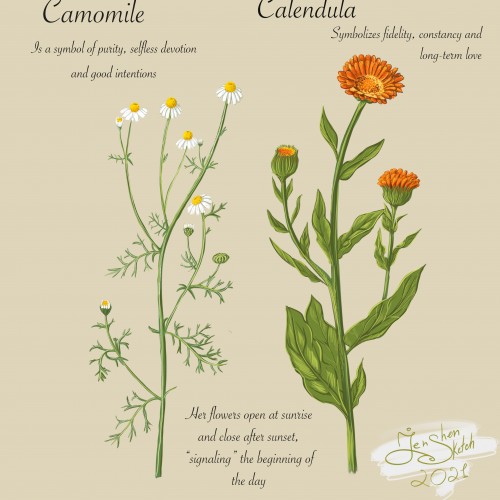
The structure of Calendula

My name is Jenny Lebedev. I am a multidisciplinary artist and illustrator, Making painting on canvas and digital platform, video, photography, drawing. Graduate of the Department of Multidisciplinary Art at Shenkar. I recently finished illustrating the second children's book. I also accept commission projects and work with the client in close communication. I make digital art work for postcards, prints, incl. producing prints. In the field of art I deal with conceptual art on the topics of "nothingness" and the existing emptiness, awareness of the air.

  • 53
  • 5
  • 2
Riley Kane Riley Kane
Enlarge
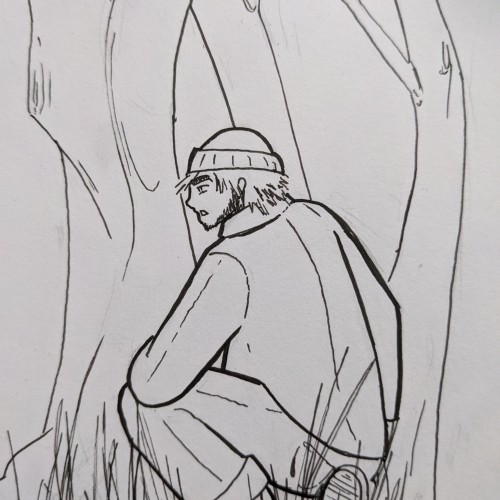
Crouch

As awesome as summer and winter are, I love the transitional seasons the best, especially fall. It's the best time to do sports, orienteering, bird watching, hikes. The crisp air feels so good, and I love the rustle of the dead leaves and grasses on a windy day. While sometimes I get sad to see the branches bare, I also love looking at and analyzing their structure. I find it fascinating that a tree can go from this mighty, fluttering thing to a spindly, knobby structure and remain fundamentally unchanged. It's a bit of a miracle

  • 49
  • 5
  • 0
Art Craft Land Art Craft Land
Enlarge
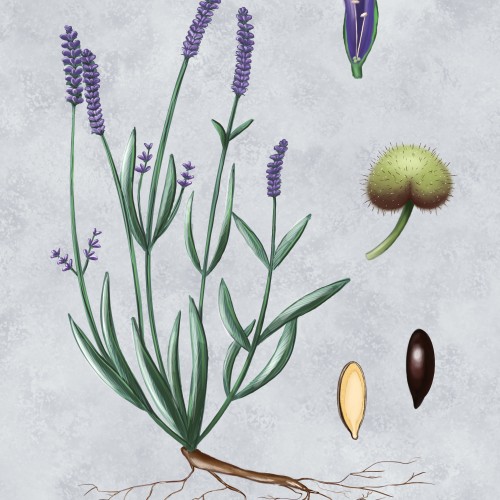
The structure of Lavender

My name is Jenny Lebedev. I am a multidisciplinary artist and illustrator, Making painting on canvas and digital platform, video, photography, drawing. Graduate of the Department of Multidisciplinary Art at Shenkar. I recently finished illustrating the second children's book. I also accept commission projects and work with the client in close communication. I make digital art work for postcards, prints, incl. producing prints. In the field of art I deal with conceptual art on the topics of "nothingness" and the existing emptiness, awareness of the air.

  • 44
  • 3
  • 0
Katerina Husar Lazarova Katerina Husar Lazarova
Enlarge
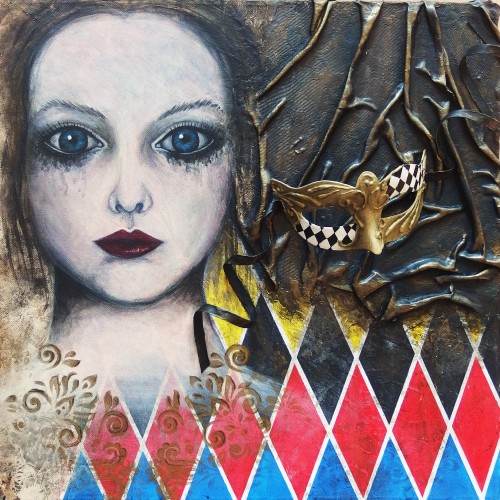
Carnival

Acrylic painting on canvas, with plastic structure. Format 50×50 cm.

  • 34
  • 3
  • 0
Vadim Vadim
Enlarge
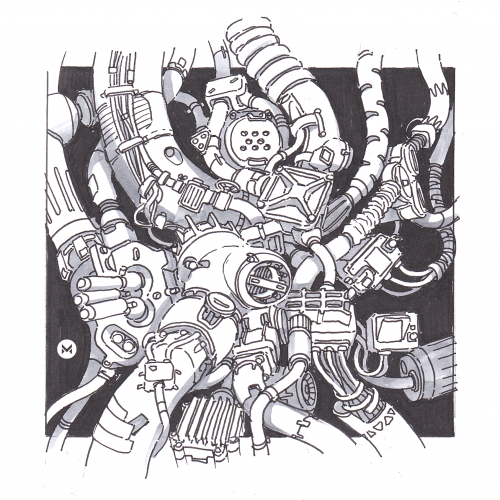
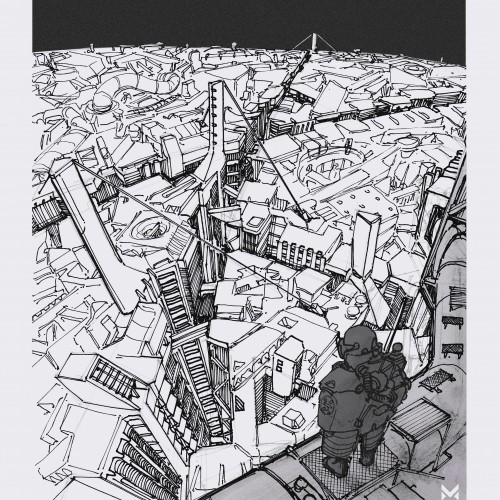
Cablepunk

I love to come up with these mindless but interesting hard surface shapes and technical stuff. It has a meditative effect on me like drawing mandalas ^^ Inspiration comes from Tsutomu Nihei again.

  • 31
  • 6
  • 0
Mary Heath B. Mary Heath B.
Enlarge
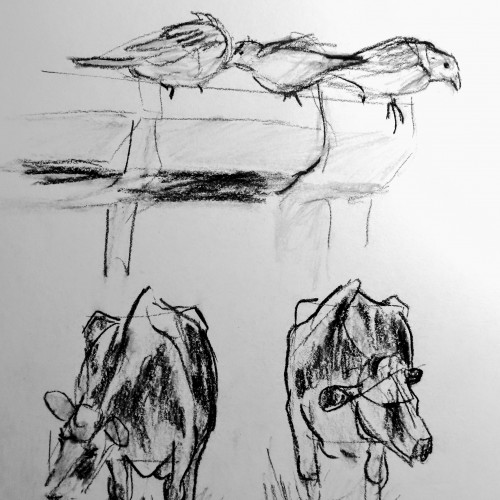
Cows and birds quick sketches

Quick sketch practice. Always trying to capture the structure but keep expression.

  • 31
  • 2
  • 0
Jones Brown Jones Brown
Enlarge
Hire A Cryptocurrency Fraud Recovery Hacker Service Online: VISIT CERTIFIED RECOVERY SERVICES

It started with optimism. A serendipitous encounter with an old college friend in Miami’s bustling airport led to a conversation about financial growth. He spoke glowingly of Dollar fx net, a platform he insisted had doubled his investments. Trusting his enthusiasm, I deposited 10,000 USD a substantial chunk of my job savings only to face a shocking roadblock weeks later. The platform demanded an additional 5,000 “verification fee” to unlock withdrawals. My stomach dropped; this wasn’t a hiccup it was a trap. Stress pushed me into research mode. Scouring cybersecurity forums, I uncovered countless stories mirroring mine: unregulated platforms exploiting trust, draining accounts under false pretenses. Then, a lifeline a Reddit thread praising CERTIFIED RECOVERY SERVICES for their no-nonsense approach to fund retrieval. Skeptical but out of options, I submitted a case file through their portal, hoping for a miracle. The response from CERTIFIED RECOVERY SERVICES was swift and reassuring. They outlined a comprehensive strategy: trace the digital trail of my 10,000 USD, they apply pressure on the platform through legal backchannels. Their transparency struck me while they couldn’t guarantee success, their expertise was evident. Over the next week, CERTIFIED RECOVERY SERVICES became my digital sherpa, guiding me through the murky waters of online fraud recovery. Their team meticulously decoded Dollar fx net’s obfuscated transaction logs, revealing that my funds had been funneled into offshore wallets, far from any regulatory oversight. Armed with this information, their legal team issued takedown notices to payment processors linked to the platform, effectively putting them on notice. The pressure worked: on day 10, I received a cryptic email from Dollar fx net claiming my account was “under review. "By week two, the impossible happened my original 10,000 USD reappeared in my bank account, sans the fabricated fees. CERTIFIED RECOVERY SERVICES later explained how their threat of exposing the platform’s infrastructure to regulators had forced their hand. Their relentless pursuit of justice to recover my funds and also highlighted the importance of holding fraudulent platforms accountable. This ordeal taught me two harsh truths: not all opportunities are as they seem, and due diligence is non-negotiable. Yet it also revealed heroes like CERTIFIED RECOVERY SERVICES ethical hackers who use their skills to fight back against fraud. I now understand that vigilance and the right support can turn the tide against deceit. In a world where fraudsters thrive on silence, speaking out and seeking help can be the most powerful tools in reclaiming what is rightfully yours. Here's Their Info Below: WhatsApp: (+1(740)258‑1417 ) Telegram: https: //t.me/certifiedrecoveryservices mail: (certifiedrecoveryservices @zohomail .com, certified @financier .com) Website info;( https: //certifiedrecoveryservices .com)

  • 27
  • 2
  • 2
Jennifer Jennifer
Enlarge
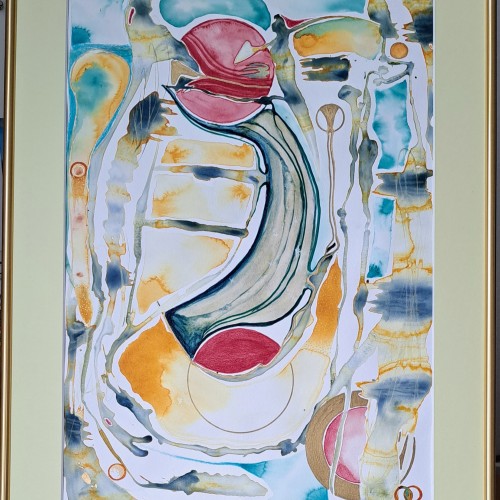
Connections

The flow of wet on wet watercolor with a little structure.

  • 25
  • 3
  • 0
Luca Mussino Luca Mussino
Enlarge
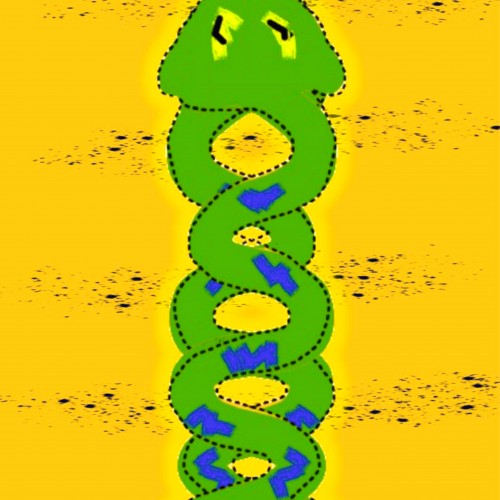
Serpentine Helix: The Dance of Life

"This digital artwork represents two snakes coiled in a helix, symbolizing the indissoluble union between physical and mystical life. The intertwined shapes evoke the structure of DNA, reflecting the fusion of science and spirituality and inviting reflection on how these dimensions are woven into the fabric of life."

  • 23
  • 0
  • 0
Ty patmore Ty patmore
Enlarge
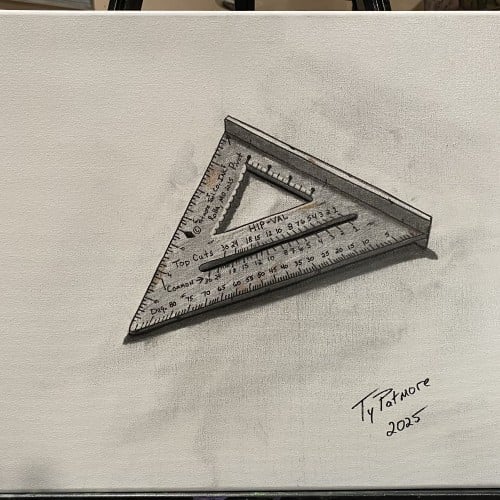
Speed square

This piece continues my ongoing tool series, focusing on objects shaped by use, precision, and repetition. The speed square—an essential instrument of measurement and accuracy—is rendered with attention to wear, markings, and subtle imperfections left by time and handling. Isolated against a minimal background, the tool becomes both subject and symbol: a quiet reflection on structure, angles, and the human need to measure and make sense of the physical world. Like the others in this series, it honors everyday labor and the overlooked beauty found in functional objects.

  • 14
  • 6
  • 1
Jeli Jeli
Enlarge
My first upload :)

The paper had a bad structure but it's ok :)

  • 14
  • 3
  • 0
Ty patmore Ty patmore
Enlarge
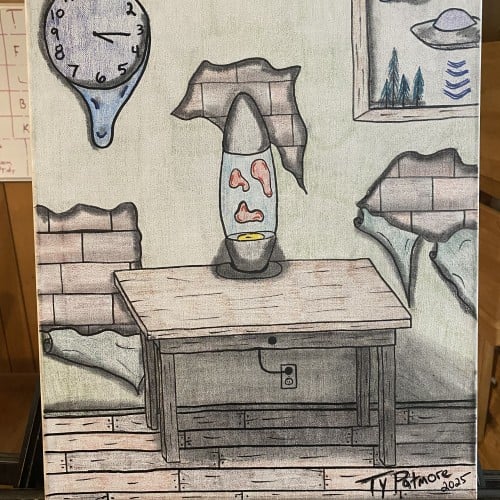
I love lamp, lava lamp.

In “I Love Lamp,” Ty Patmore blends nostalgia, humor, and subtle unease into a surreal domestic scene where time, space, and memory feel slightly off-center. A lava lamp—softly glowing with drifting shapes—sits on a worn wooden table, acting as the sole beacon of warmth inside a room that is quietly falling apart. The wallpaper peels back to reveal fractured brick beneath, as if the structure itself is shedding its old skin. A melting wall clock drips down the surface like time losing its grip, while a framed picture of a UFO drifting over pine trees hints that even the outside world may not be quite right. Every object bends reality just enough to make the viewer question whether this room is comforting… or unsettling.

  • 13
  • 2
  • 1
Vadim Vadim
Enlarge
Exploring the Megastructure

Little tribute to the visualy amazing works of Tsutomu Nihei.

  • 13
  • 6
  • 0
LeBoucher LeBoucher
Enlarge
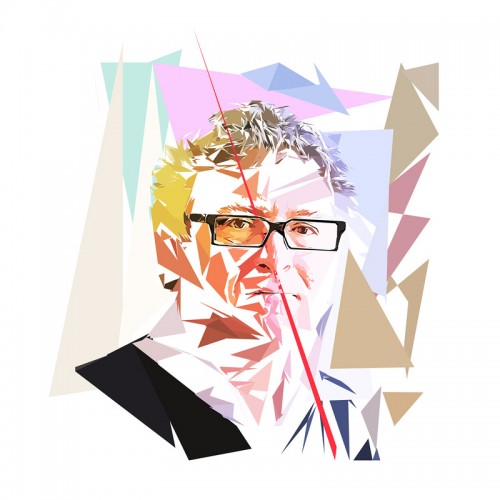
Michel Onfray

Digital painting on canvas of "Michel Onfray" in the manner of the praise of the approximation of the exhibition. This graphic and stylistic style is borrowed from the concept elaborated in the Praise of Approximation ": a painting to be reconstructed using the structure to which the perceptions are subordinated, highlighting the perceptual disturbances of perception. whose memory has been recorded in the brain of each individual. Peinture numérique sur toile de « Michel Onfray » à la manière de l’éloge de l’approximation de l’exposition. Ce style graphique et stylistique sont emprunt au concept élaboré dans l’Éloge de l’approximation » : une peinture à reconstruire à l’aide de la structure à laquelle sont subordonnées les perceptions qui met en évidence les troubles de la perception liés à la manière dont le souvenir a été enregistré dans le cerveau de chaque individu.

  • 13
  • 4
  • 0
crais robert crais robert
Enlarge
The House of Ryman: A Family of Artists

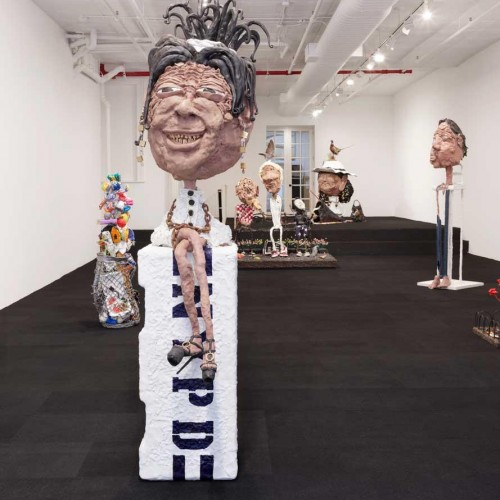
Take the Rymans, for instance. There is Robert Ryman (1930 – 2019), the patriarch whose paintings are indisputable icons of the modernist canon. Then there are his wives and children. Ethan Ryman (b. 1964) is the oldest of Robert’s three artist children. Though his mother was not an artist, Lucy Lippard (b. 1937) was still a scrappy and eloquent art critic, a feminist, a social activist, and an environmentalist. Ethan’s meticulously considered and crafted artworks might be characterized as somewhere between photography and sculpture, the abstract and the (f)actual. Though Lippard and Ryman divorced just six years after their 1961 marriage, their son is arguably the closest to his father’s methodologies if not his medium, and was certainly the last to become a visual artist. Robert Ryman went on to marry fellow artist Merrill Wagner (b. 1935) in 1969 and they had two sons. Though Wagner is more quietly acknowledged than Ryman, her boundless practice includes sculpture, painting, drawing, installation, and more. With an emphasis on materiality, her sites are indoors and out, her styles alternating. Will Ryman (b. 1969) is the elder son of Robert and Merrill. He started out as an actor and playwright though he too eventually assumed a visual art practice to become a sculptor. He is best known for his large-scale public artworks and theatrical installations that focus on the figurative and psychological, at times absurdist, narratives. Cordy Ryman (b. 1971) is the youngest, and the only one of the three who knew that he was going to be a visual artist early on. His work is abstract, the sophistication understated, and his output is prolific. With his mother’s DIY flair, his homely materials seem sourced from the overflow of construction projects, lumberyards, and Home Depot. Ethan Ryman said that, when he was young, he didn’t want to be a visual artist. Instead, he pursued music and acting, producing records for Wu-Tang Clan, among others, getting “my ears blown out.” But he was always surrounded by artists—Sol LeWitt, Carl Andre, Jan Dibbetts, William Anastasi, and countless others at his mother’s place on Prince Street in SoHo and at the Rymans’s 1847 Greek Revival brownstone on 16th Street in Manhattan, where everyone was often seated around the family dinner table. He would spend part of most weekends in the highly stimulating chaos that reigned there—birds, dogs, plants, toys, art, people, everywhere. “While nowhere near as overwhelming, I was also constantly exposed to artists, writers and other creative folks at my Mom’s place.” “While nowhere near as overwhelming, I was also constantly exposed to artists, writers and other creative folks at my Mom’s place.” Ethan Ryman Lippard was “a powerhouse.” She took Ethan on her lecture tours, readings, conferences, galleries, studios, wherever she had to go. And while that almost always breeds rebellion, at some point, he began noticing all the art around them—both what it looked like and how it was made. He began to take photographs of buildings and realized that “abstract color fields were all around us.” He also began to notice his father and Wagner’s work more carefully—how sensitively it was executed and how reactive it was to its surroundings. “Once you’re interested, you notice. When I asked my dad questions, I would most likely get a one-word response. I had to go to his lectures for answers where he broke down modern art for me. After listening to him, it seemed to me we should all be painting, otherwise what were we doing with our lives?” Will Ryman, on the other hand, said that all his work has a narrative component. His background is in theatre and his interests have always been film and plays, his narratives about New York City and American culture and history. “It’s a city I love,” he said. “I try to observe culture in a bare-bones way and I’ve always been interested in telling stories—we’re the only species that tells stories to each other. It comes from an intuitive, cathartic place in me. I want to stay away from preconceived notions, although that’s not completely possible. I have no plan except to do something honest, with a little bit of a political bent and humor but I’m not an activist. I’m interested in exploring a culture and its flaws as an interaction between human beings.” His interests and his work are very different from his last name. There is no connection to minimalism. He didn’t go to art school, drawn instead to theatre workshops and theatre troupes. “I didn’t become involved with the visual arts until my mid-thirties. It’s easy to say what I make is a reaction, but I dismiss that. And I also wouldn’t say it’s rebellious after twenty years.” Of his family, he said, “we’re a normal family, a close family, with all the dynamics and complications that go along with that. And while everyone who came to 16th Street were artists, they were also just family friends. I have no other measure for how a family interacts. It was just the way it was.” Cordy Ryman was the only one of the three who went to art school, earning a BFA from the School of Visual Arts, but it was reportedly awkward for him, since all his teachers knew his parents. “When I started making abstract paintings, it was kind of push and pull but it became more interesting to me than my earlier figurative or narrative work. That’s when I started to know where I came from. I realized that I had a visual memory, and the language was there, a language I didn’t know I knew. We all had different ways of working; our processes are very different and it’s hard to compare us. Ethan and I use a similar inherited language but he thinks about what he does more. I work very fast, the ideas come from the process itself. I work in two or three modes simultaneously and bounce around.” At home, they were around Wagner’s work since her studio was there. “Will and I were always in her studio, helping her, going to her installation sites with her, adjusting her boulders or whatever the project was she was working on. That was special and made a deep impression, but I didn’t realize it then.” All five Rymans have in common an acute consciousness of space and of place as an integral component of their work. For the brothers, part of that consciousness might stem from their parents, but also from their attachment to their family home, which was a crucible of sorts for them, where everyone was an artist. To Cordy, the house was a “living, breathing thing, and the art in it felt alive, growing, and occupying any space that was available. It was the structure of our world. When I’m making work, it doesn’t need to be the most beautiful thing ever, but it needs to have its own life, its own space, like the art we grew up with.” And the next generation of Rymans, also all sons—what about them? Will said his son is still too young to know. Cordy thought the same about his two younger children; his oldest is in the art world, but not as an artist—so far. Ethan perhaps summed it up best: my two sons are artists; they just don’t know it yet.

  • 12
  • 1
  • 0
 
Next »

Doodle Addicts

Navigate
  • Discover Art
  • Drawing Challenges
  • Weekly Drawing Prompts
  • Artist Directory
  • Art Marketplace
  • Resources
Other
  • News + Blog
  • About Us
  • Contact Us
Newsletter
© 2026 Doodle Addicts™ — All Rights Reserved Terms & Conditions / Privacy Policy / Community Guidelines
Add Doodle Addicts to your home screen to not miss an update!
Add to Home Screen