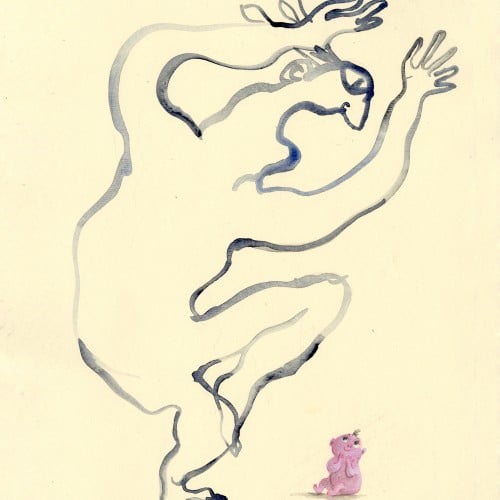
There’s a lot of waiting in life.
Waiting in lobbies.
Waiting on answers.
Waiting for braces to tighten, kids to grow, hearts to heal, or prayers to be answered.
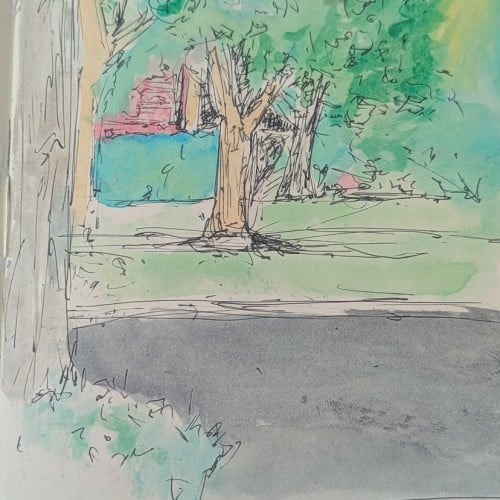
I sat at the orthodontist, watching dollars tighten on tiny wires, and made this sketch. A tree. A house. A street. Color helped the moment breathe.
I remember once hearing a chess master say, “There is no waiting in chess.”
It confused me—wasn’t there always a turn to wait for?
But he explained: “There’s no waiting. Only planning. Plotting. Analyzing. You’re always thinking.”
I once repeated that to a FIDE master. He got mad.
Maybe because waiting and patience aren’t the same thing.
We can be still and deeply active inside.
We can pause without being passive.
And then there’s Lindsey’s voice in the back of my head:
“That sounds like a first-world problem.”
“Speak life.”
“Be thankful. Rejoice always.”
And she’s right.
So here’s to filling waiting time with something creative.
Something kind.
Something that turns a delay into a doorway.
I am an art teacher with a master’s degree—trained by brilliant professors who believed that art could do more than decorate walls. I offer safe spaces for teenagers to grow—nourishing soil where their imaginations can take root.
And yet… I am assigned to hallway duty.
This is compulsory education, after all.
So I sit—posted like a sentinel—watching young lives stream past.
“Get to class,” I say with a smile and a nudge.
The system wants attendance; I’m hungry for presence.
Armed not with a whistle or clipboard, but with a pen—
my scribble’s soft insurgency.
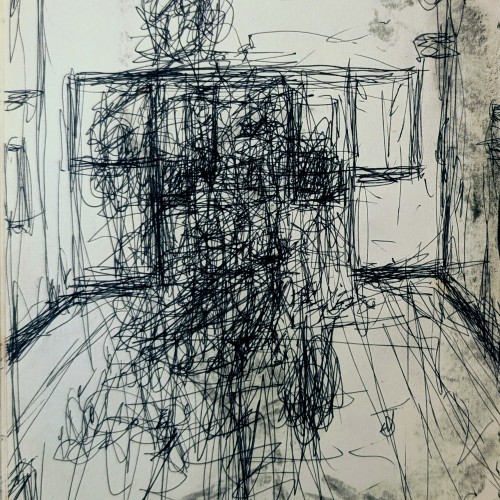
The hallway stretches out like a geometric hymn.
Columns and corners chant structure.
Teenagers swirl past—half-formed galaxies of limbs and laughter—
their orbits chaotic, their gravity pulling time forward.
I begin to draw.
Not their tardiness, but their motion.
A shoulder. A blur of sneakers.
A tilted head chasing freedom.
Feet flickering like seconds.
Each mark a pulse.
Each smudge a breath.
My paper becomes a seismograph of seeing—
trembling gently through the mundane.
This isn’t about making art for a frame or a feed.
It’s about refusing to leak away in the fluorescent hum of obligation.
It’s a quiet mutiny against the clock.
I do this on long car rides, too (passenger side, mind you).
Letting the lines grow wild, jagged, and unapologetic.
Not for polish—
but for presence.
This is how I remember I’m still alive.
Still growing.
Still watching.
Still choosing to see.
Because sometimes mental health looks like
a piece of scrap paper,
a moving pen,
and the simple, sacred act of
marking time with wonder.
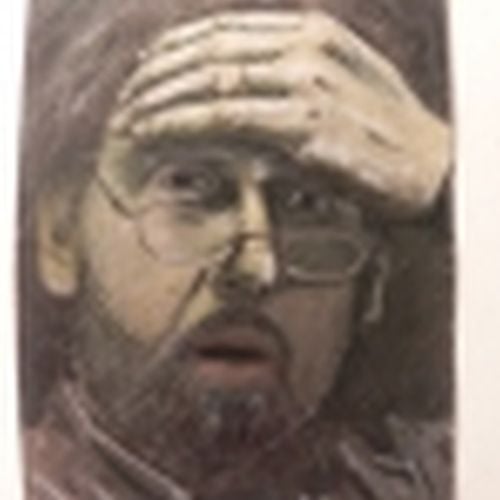
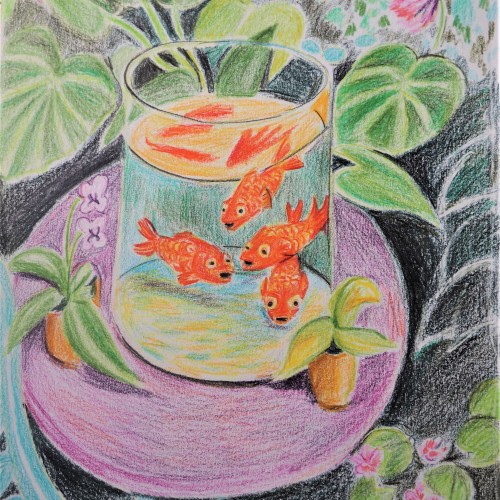
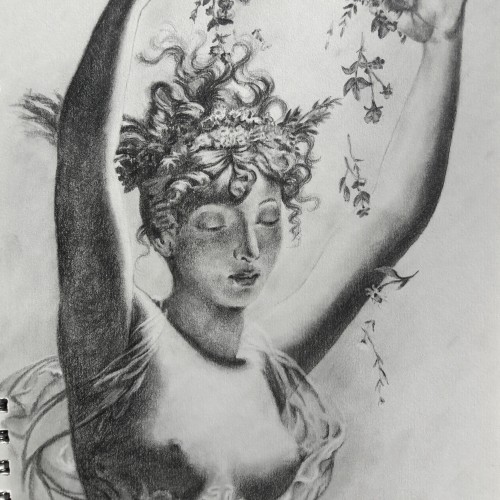
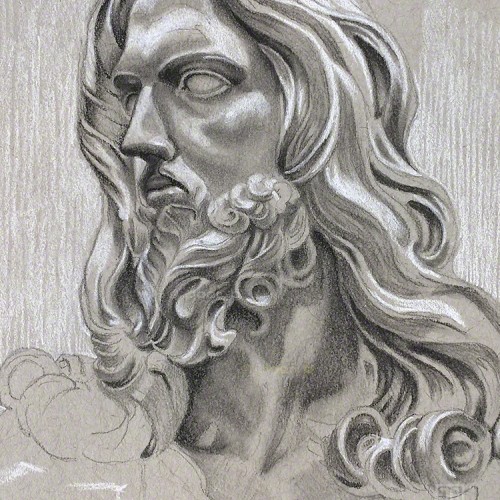
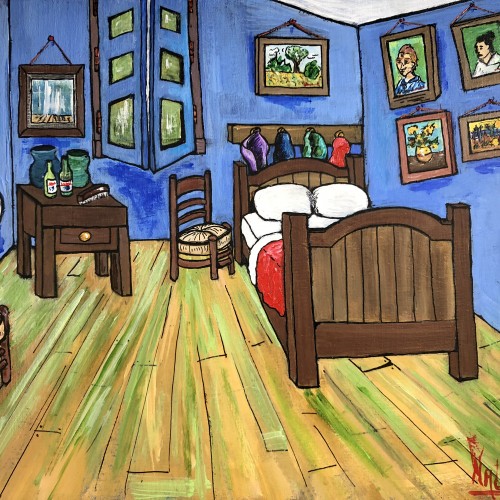
This is a reproduction study only of a very famous Monet piece. I am not selling this. I learned how to do art according to the traditional methods of studying great masterpieces. I did this in soft pastel,but the origional is done in oil I think.
Imperfect Lines, Honest Presence
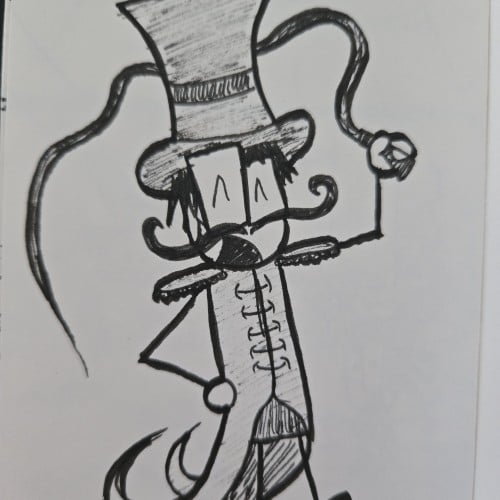
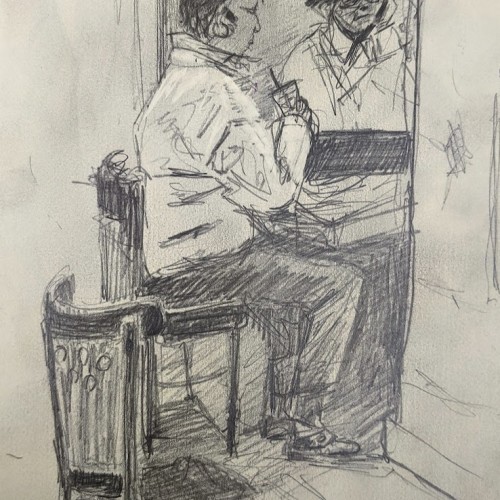
This sketch is not perfect—and that’s exactly why it’s alive. The bold figure, the dissolving hat, the tilted chair: all of it feels unfinished, fleeting, caught in motion. It’s what the Japanese call wabi-sabi—finding beauty in the imperfect, the impermanent, the incomplete.
But there’s something deeper here too. A quick sketch is not just what the eye records. It’s what the soul permits. To draw without fixing, without polishing, is to admit the world will not hold still for us. Life slips past. The lines break off. And yet, somehow, the essence remains.
When you sketch this way, you are not the master of the moment—you are its guest. The pencil does not carve permanence; it pays attention. The act of drawing becomes an act of being present, of honoring what is already vanishing.
So here’s a challenge: grab a pencil and sketch someone near you in sixty seconds. Do not erase. Do not perfect. Let the lines falter. When you finish, ask yourself: What truth did the imperfection reveal?
Perhaps presence itself is the real art.
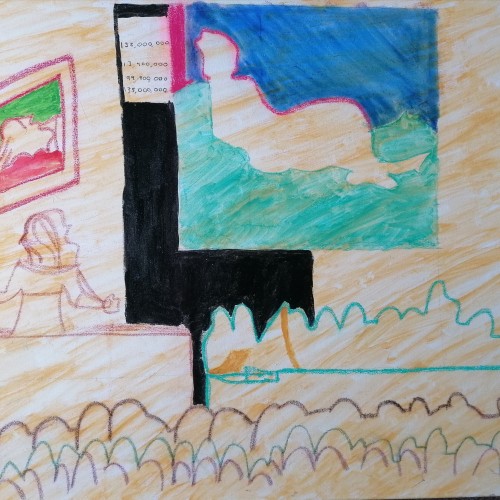
I did this in responce to seeing the selling of a great masterpiece in a tabloib paper in 2018. This is the dipiction of the sale at a famous auction house.
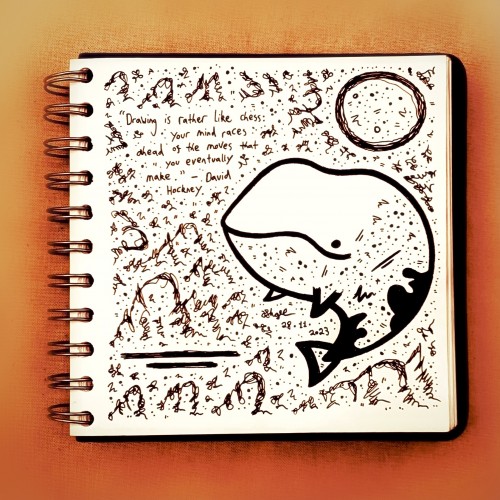
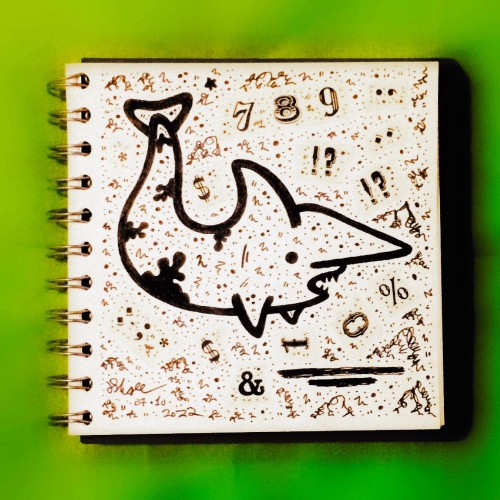
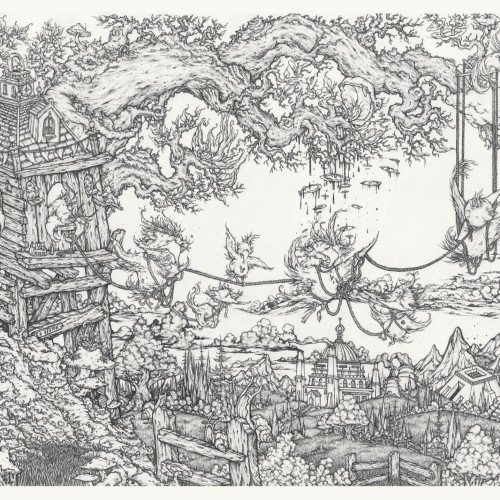
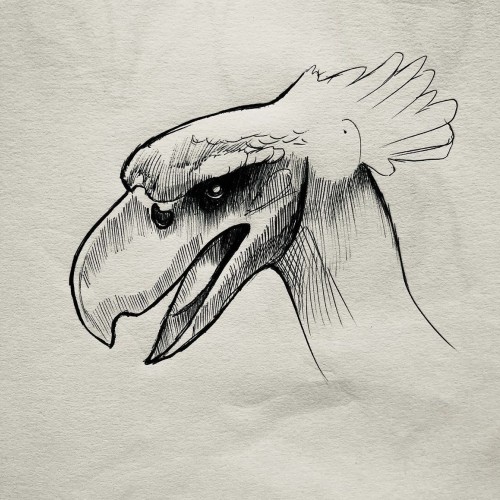
Fineliner scribblings on a back ground of paper... . . . ... . . . . . . ..... . ... . . . . . ...... ... . . A rabble of sozzled birds on a tightrope of joy heading towards the puppet master up above. . . .... . . ... . .... .. .... .. ... . . . . Prints are available (16 out of 20 at the time of going to press) . ..............................
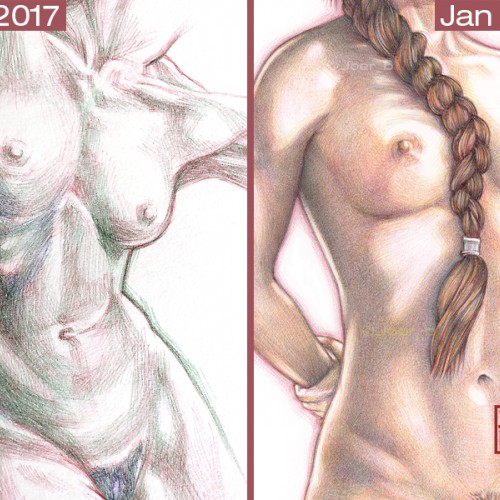
I’m often asked about my Bic pen drawings and how I do them. It starts with a good foundational drawing, the ballpoint pen part is just trying to colour within the lines. I try to do my best to explain the process, but the best way to show my progress is by posting my efforts to master pen drawings over the span of 3 or so years. I have been doodling/drawing with ballpoint pens as far back as I can remember - they were cheap, readily available and always lying around the house. It wasn’t until I was bored during a particularly long team meeting-conference call (around 2016-17) that I started to think about the possibilities of ballpoint pens as serious portrait illustration tools. My first experiments with full colour ink portrait drawings were rather crude, but that’s the point of learning new techniques—as long as the curiosity and the love of drawing is there, you can transfer that skill and passion into any medium. Remember, the most exquisite drawings and paintings you see didn’t materialise fully formed, they started out as failed experiments. Failure after failure after failure. It’s important to remember this when you get discouraged (I've failed spectacularly over the years). The only difference between the accomplished artist and the beginner is hundreds of hours of practice. Talent can only get you so far. It’s the hard work that you do behind the scenes that makes your work look effortless. Keep doodling. Keep learning. Stay curious.
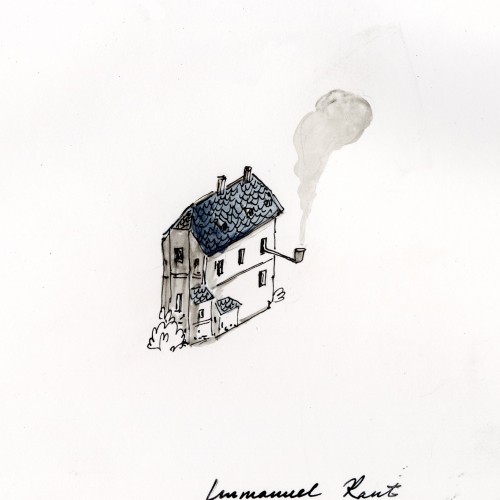
Immanuel Kant (1724–1804)
Kant’s biography is unusually devoid of external events.
As Heinrich Heine wrote: The history of Kant’s life is difficult to describe. For he neither had a life nor a history.
In actual fact, as Manfred Kuehn argues in his 2001 biography, Kant’s life was not quite as abstract and passionless as Heine and others have supposed…. If he failed to live a more adventurous life, it was largely due to his health: the philosopher had a congenital skeletal defect that caused him to develop an abnormally small chest, which compressed his heart and lungs and contributed to a generally delicate constitution. In order to prolong his life with the condition—and in an effort to quell the mental anguish caused by his lifelong hypochondria—Kant adopted what he called “a certain uniformity in the way of living and in the matters about which I employ my mind.”
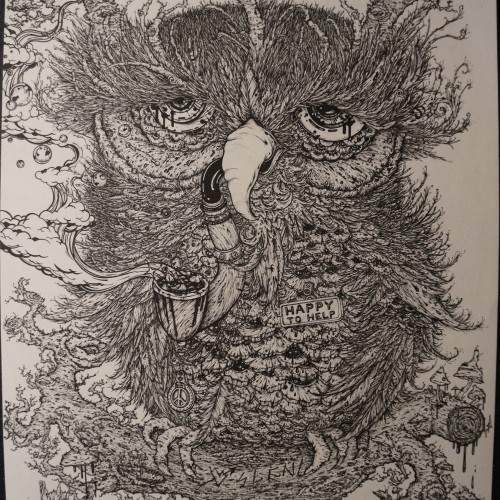
This routine was as follows: Kant rose at 5:00 A.M., after being woken by his longtime servant, a retired soldier under explicit orders not to let the master oversleep. Then he drank one or two cups of weak tea and smoked his pipe. According to Kuehn, “Kant had formulated the maxim for himself that he would smoke only one pipe, but it is reported that the bowls of his pipes increased considerably in size as the years went on.”
- From Daily Rituals: How Artists Work by Mason Currey
#dailyrituals #inktober #ImmanuelKant @masoncurrey
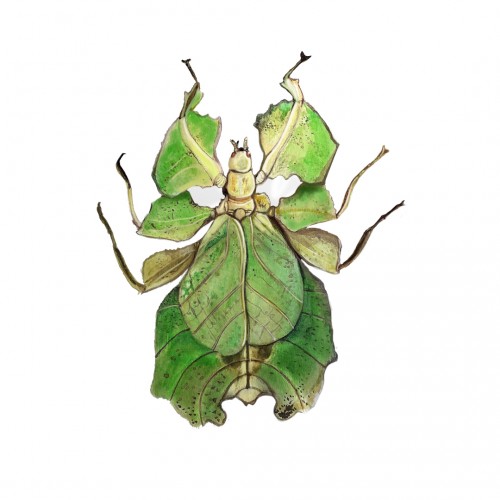
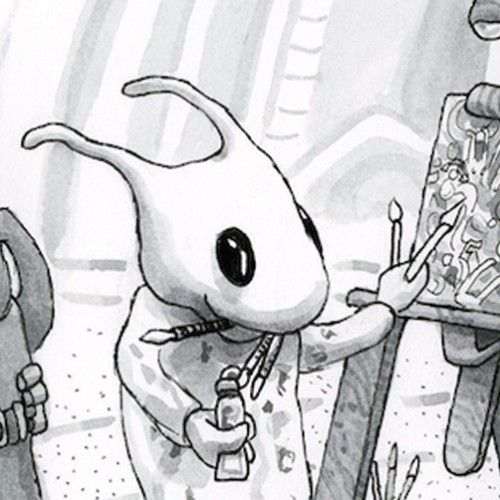
These masters of leaf-like camouflage can be found throughout Southeast Asia, with some of the biodiversity hotspots being Indonesia, Malaysia, and Papua New Guinea . This is Nanophyllium suzukii watercolor painting, I like so much this technique. More like this on: https://www.instagram.com/camilojulianc/
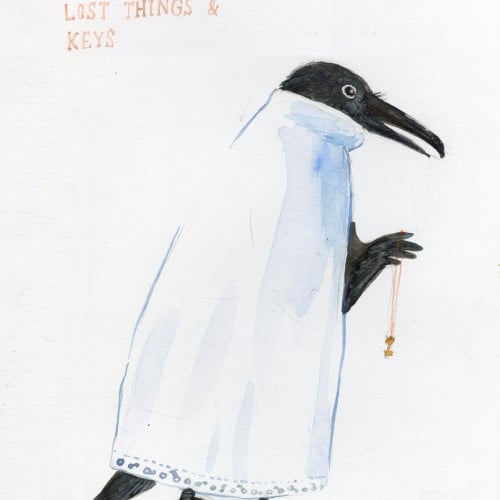
Patron Saint of Lost Keys and Small Things.
Reminded me of this poem by Elizabeth Bishop.
One Art
The art of losing isn’t hard to master;
so many things seem filled with the intent
to be lost that their loss is no disaster.
Lose something every day. Accept the fluster
of lost door keys, the hour badly spent.
The art of losing isn’t hard to master.
Then practice losing farther, losing faster:
places, and names, and where it was you meant
to travel. None of these will bring disaster.
I lost my mother’s watch. And look! my last, or
next-to-last, of three loved houses went.
The art of losing isn’t hard to master.
I lost two cities, lovely ones. And, vaster,
some realms I owned, two rivers, a continent.
I miss them, but it wasn’t a disaster.
—Even losing you (the joking voice, a gesture
I love) I shan’t have lied. It’s evident
the art of losing’s not too hard to master
though it may look like (Write it!) like disaster.
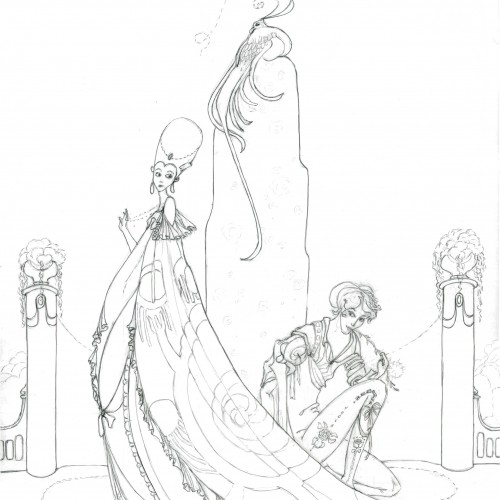
"She stopped to speak to him, altering her mind, and went on her way."
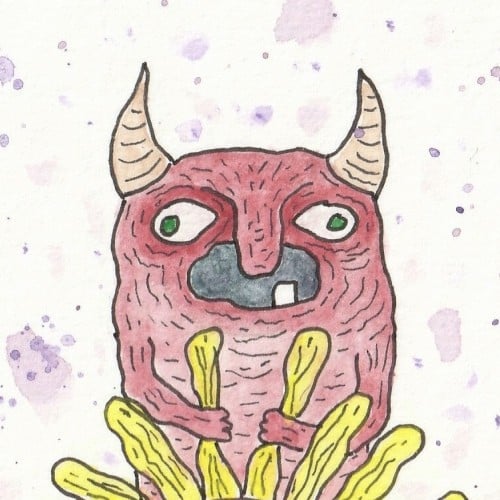
Trying to learn more about Kay Nielsen's style. He illustrated folk and fairy tales in the early 1900s for Grimm and Disney and others. I love his dark/moody style with everything so flowy, elongated, elegant, and tragic. And his amazing compositions.
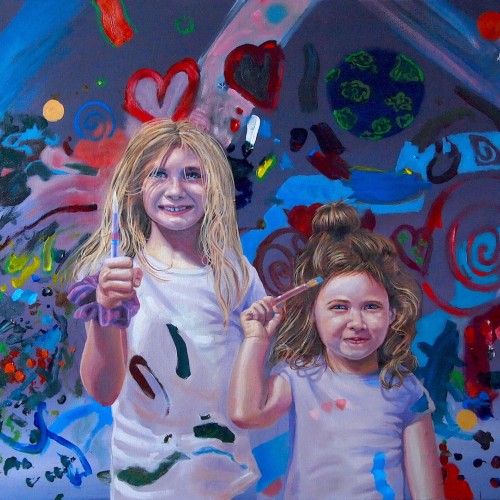
A friend's children painted a canvas I gave them and I painted them into it. The fun messy doodle background is 90% theirs. I added a few streams to pop out some of the shapes they painted. I might do this as a series.
GLOOSCAP AND THE BABY
From Favorite Folktales from Around the World byJane Yolen.
Glooscap, having conquered the Kewawkqu’, a race of giants and magicians, and the Medecolin, who were cunning sorcerers, and Pamola, a wicked spirit of the night, besides hosts of fiends, goblins, cannibals, and witches, felt himself great indeed, and boasted to a woman that there was nothing left for him to subdue.
But the woman laughed and said, “Are you quite sure, master? There is still one who remains unconquered, and nothing can overcome him.” In some surprise Glooscap inquired the name of this mighty one. “He is called Wasis,” replied the woman, “but I strongly advise you to have no dealings with him.” Wasis was only a baby, who sat on the floor sucking a piece of maple sugar and crooning a little song to himself. Now Glooscap had never married and wasignorant of how children are managed, but with perfect confidence he smiled at the baby and asked it to come to him. The baby smiled back but never moved...
#dailydrawing #folktales #kidlitart #babies #algonquian